
Launching an online store is easier than ever. Building an ecommerce website that attracts the right visitors, earns their trust, makes product discovery simple, and turns visits into purchases is much harder.
A successful ecommerce store needs more than attractive product images and a checkout button. It needs a well-planned structure, responsive design, fast performance, secure payments, intuitive navigation, strong product pages, conversion-focused user experience, and a technical foundation that can support SEO and digital marketing.
That is why ecommerce website development should be treated as a business and marketing investment rather than simply a technical project.
Whether you are launching your first online store, moving from an offline business to ecommerce, or rebuilding an existing website, the development decisions you make can affect how easily customers find your products, how confidently they shop, and how effectively your marketing budget is converted into revenue.
In this guide, we will cover what ecommerce website development involves, which features matter most in 2026, how to choose between Shopify, WooCommerce and custom development, common mistakes to avoid, and how to choose the right ecommerce website development company for your business.
Turning ideas into high-converting online stores.
What Is Ecommerce Website Development?
Ecommerce website development is the process of planning, designing, building, testing, and maintaining a website that allows customers to discover products or services and purchase them online.
It includes much more than creating individual web pages.
A properly developed ecommerce website may include:
- Product and category pages
- Shopping cart functionality
- Secure checkout
- Payment gateway integration
- Shipping and delivery options
- Inventory management
- Customer accounts
- Product search and filtering
- Discount and coupon functionality
- Reviews and ratings
- Order management
- Analytics and conversion tracking
- Mobile optimisation
- Technical SEO
- Security and performance optimisation
The exact requirements depend on the business.
A small business selling 30 products does not necessarily need the same technology as an ecommerce company managing thousands of products, multiple warehouses, complex shipping rules, or extensive third-party integrations.
The first step, therefore, should not be choosing a template.
It should be understanding what the business needs the website to accomplish.
Why Ecommerce Website Development Matters in 2026

Seamless shopping experiences, designed to drive sales.
Customers have more choices than ever.
If a visitor lands on an online store and cannot quickly understand what the business sells, find the right product, trust the website, or complete checkout without friction, they can simply leave and purchase somewhere else.
This makes website experience an important part of ecommerce strategy.
A strong ecommerce website should help answer five basic questions quickly:
- What does this business sell?
- Is this product right for me?
- Can I trust this store?
- How much does it cost and how quickly can I receive it?
- How can I complete my purchase?
Good development supports all five.
It also provides the foundation for other marketing channels.
For example, a business might invest in SEO, Google Ads, Meta Ads, influencer marketing, email campaigns, or social media. All of that traffic eventually needs somewhere to go.
If the website experience is poor, increasing traffic alone may not solve the problem.
This is why ecommerce website development should be planned alongside the company’s broader digital marketing strategy.
10 Essential Elements of a High-Converting Ecommerce Website
1. Fast Website Performance
Website speed matters because customers do not want to wait for product pages to load.
Large images, excessive scripts, poorly configured plugins, unnecessary animations, and inefficient code can all contribute to performance problems.
A professional website development service should consider performance during development rather than treating it as a problem to solve after launch.
Important areas include:
- Image optimisation
- Efficient code
- Mobile performance
- Caching
- Proper hosting
- Script management
- Lightweight design elements
The goal is simple: make it easy for customers to access the information they need without unnecessary delays.
2. Mobile-First Experience
An ecommerce website should work properly across smartphones, tablets, laptops, and desktops.
Mobile users should be able to:
- Browse categories
- Search for products
- View product images
- Read descriptions
- Select variants
- Add products to cart
- Complete checkout
without constantly zooming, scrolling horizontally, or dealing with difficult buttons.
A website can look excellent on a desktop monitor and still provide a poor mobile experience.
That is why responsive design should be considered from the beginning of the development process.
3. Simple and Logical Navigation
Customers should not have to work hard to find products.
A well-planned ecommerce structure may include:
Home → Category → Subcategory → Product
For larger stores, search and filtering become particularly important.
Useful filters can include:
- Price
- Size
- Colour
- Brand
- Material
- Availability
- Product type
The exact filters should reflect how customers actually shop for the products.
Good navigation also benefits SEO because a clear website structure makes it easier for users and search engines to understand the relationship between different pages.
4. Product Pages That Help Customers Make Decisions
Product pages are among the most important pages on an ecommerce website.
A product page should provide enough information for a customer to make a confident decision.
Depending on the product, this could include:
- Product name
- High-quality images
- Product description
- Price
- Available variants
- Specifications
- Size information
- Stock availability
- Delivery details
- Return information
- Reviews
- FAQs
- Related products
- Clear call-to-action
A common mistake is treating product pages like digital brochures.
They should instead be designed around the questions customers have before purchasing.
5. A Friction-Free Checkout
A customer can be interested in a product and still abandon the purchase if checkout is unnecessarily complicated.
Common friction points include:
- Too many fields
- Confusing navigation
- Unexpected costs
- Limited payment options
- Difficult mobile checkout
- Forced account creation
- Lack of delivery information
A good ecommerce experience makes the final step as clear as possible.
The objective is not to remove every piece of information from checkout. It is to remove unnecessary friction while still collecting what the business genuinely needs.
6. Secure Payment Integration
Customers need confidence that their transaction and personal information are being handled securely.
An ecommerce store should use appropriate payment solutions and implement security practices suitable for its platform and business model.
Depending on the target market, businesses may offer options such as:
- Cards
- Bank payments
- Digital wallets
- UPI
- Buy-now-pay-later options
- Other region-specific payment methods
Payment requirements should be considered during development, not added as an afterthought.
7. Strong Trust Signals
Customers are naturally more cautious when purchasing from an unfamiliar online store.
A professional ecommerce website should make important information easy to find.
Trust signals can include:
- Customer reviews
- Clear contact information
- Shipping policy
- Return and refund policy
- Privacy policy
- Terms and conditions
- Secure payment information
- Business information
- Frequently asked questions
Trust is especially important for new brands competing with established ecommerce businesses.
8. Search and Product Discovery
If customers cannot find the product they want, they may leave even if the product is available.
Internal website search becomes particularly important as the product catalogue grows.
A useful ecommerce search experience should handle:
- Product names
- Categories
- Relevant variations
- Common search terms
- Misspellings where appropriate
Product discovery should also be supported through:
- Related products
- Recommended products
- Category navigation
- Filters
- Promotional collections
9. Analytics and Conversion Tracking
A website should not operate as a black box.
Businesses should be able to understand what happens after visitors arrive.
Depending on the setup, useful events can include:
- Product views
- Add-to-cart actions
- Checkout starts
- Purchases
- Form submissions
- Coupon usage
- Search activity
This information can help identify where users are dropping out of the buying journey.
It also becomes valuable when running paid advertising.
For example, if a business is investing in Google Ads or Meta Ads, accurate conversion tracking helps determine whether the traffic is actually producing meaningful business results.
10. SEO-Friendly Website Architecture
Ecommerce SEO begins with the website itself.
A technically sound website can make it easier to build organic visibility over time.
Important considerations include:
- Logical URL structure
- Crawlable navigation
- Category organisation
- Internal linking
- Product page optimisation
- Metadata
- Image optimisation
- Mobile responsiveness
- Structured content
- Proper handling of duplicate or similar pages
This is one reason businesses should consider SEO requirements before the website is built rather than trying to add them months after launch.
Shopify, WooCommerce or Custom Development?
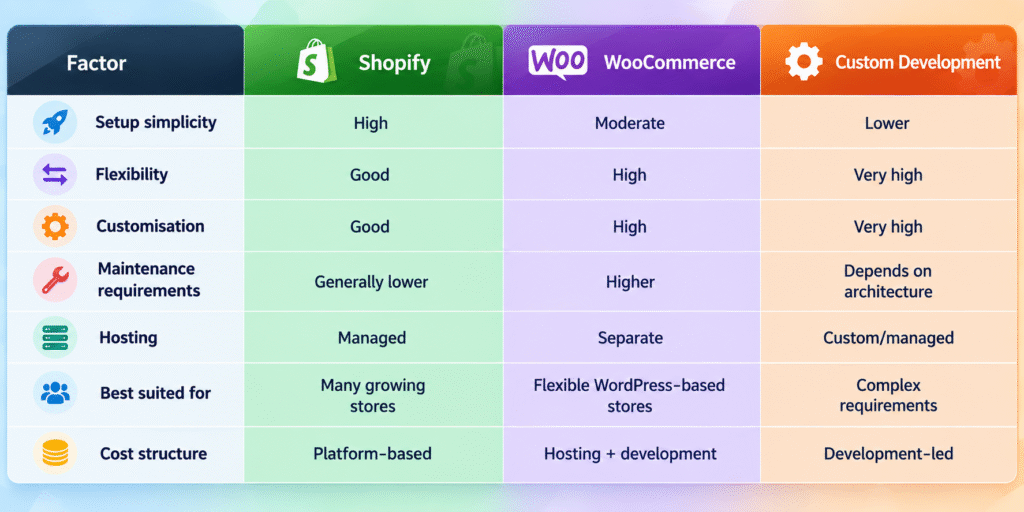
One of the most important decisions in an ecommerce project is choosing the right technology.There is no universally “best” platform.The right choice depends on the business.
Shopify
Shopify can be a practical choice for businesses that want a managed ecommerce platform with a relatively streamlined setup.
It can be suitable for businesses that want to focus heavily on:
- Selling products
- Managing the store
- Marketing
- Customer acquisition
- Order management
Businesses may also work with a Shopify Store Expert when they require customisation, store setup, design improvements, integrations, or ongoing optimisation.
However, Shopify should not automatically be selected simply because it is popular.
The platform should match the actual business requirements.
WordPress and WooCommerce
Businesses that require greater control over their website ecosystem may consider WordPress with WooCommerce.
A WordPress Development Company can help businesses create and customise an ecommerce website around their specific requirements.
WordPress and WooCommerce can provide flexibility for:
- Custom page structures
- Content marketing
- SEO
- Integrations
- Custom functionality
- Design control
However, greater flexibility can also mean more responsibility around updates, security, plugins, hosting and maintenance.
This is where experienced WordPress Development Services become valuable.
Custom Ecommerce Development
Some businesses have requirements that do not fit neatly into a standard ecommerce setup.
Custom development may be considered when a business requires:
- Complex product configurations
- Custom pricing logic
- Advanced integrations
- Unique customer journeys
- ERP integration
- CRM integration
- Custom inventory systems
- Large product catalogues
- Specialised business workflows
Custom development can provide more control, but it can also involve higher development and maintenance costs.
The question should not be:
“Can we build it custom?”
It should be:
“Does the business actually need custom development?”
Common Ecommerce Website Development Mistakes
Even businesses that invest in professional development can make strategic mistakes if the project is approached incorrectly.
Mistake 1: Designing Before Understanding the Customer
The website should be designed around how customers shop, not simply around what the business owner likes visually.
Mistake 2: Focusing Only on Homepage Design
The homepage is important, but ecommerce sales often depend heavily on category and product pages.
A beautiful homepage cannot compensate for weak product pages.
Mistake 3: Ignoring Mobile Users
If mobile users struggle to browse or purchase, the website is creating unnecessary friction.
Mistake 4: Adding Too Many Features
More functionality does not automatically mean a better website.
Every feature should have a clear purpose.
Mistake 5: Installing Too Many Plugins
This can create maintenance, compatibility and performance problems, particularly on WordPress-based stores.
Mistake 6: Forgetting SEO During Development
Fixing technical architecture after hundreds or thousands of pages have already been created can be significantly more difficult than planning it correctly from the start.
Mistake 7: Building the Website Without Marketing in Mind
This is one of the biggest mistakes.
Your website should be capable of supporting:
- SEO
- Google Ads
- Meta Ads
- Social media campaigns
- Email marketing
- Retargeting
- Content marketing
The website is not separate from marketing.
It is one of the most important parts of it.
How Ecommerce Website Development Supports Digital Marketing
Imagine a business spends ₹1 lakh on advertising and generates thousands of visitors.
Those visitors reach an ecommerce website.
If the website has:
- Slow pages
- Poor product descriptions
- Weak trust signals
- Confusing navigation
- Difficult checkout
then increasing the advertising budget may simply increase the amount of traffic that leaves without purchasing.
This is why website development and marketing should work together.
For example, a Digital Marketing Company in Mohali managing paid campaigns should be able to understand where users are being sent and what happens after the click.
Similarly, an ecommerce development team should understand that the website may receive traffic from multiple acquisition channels.
The website therefore needs to be designed for the entire customer journey.
Ecommerce Website Development and SEO
SEO should not be treated as simply adding keywords to product pages.An ecommerce SEO foundation includes technical and structural decisions.
For example:
Category Structure
Categories should reflect how customers search for and browse products.
Internal Linking
Relevant products, categories and supporting content should be connected logically.
Product Content
Descriptions should be useful, original and written for customers rather than created solely for search engines.
Technical Performance
The website should provide a good experience across devices.
Indexation
Search engines need to be able to discover and understand the pages that matter.
This is where collaboration between a Website Development Company and an SEO team can be particularly valuable.
How to Choose an Ecommerce Website Development Company
Choosing the right development partner is one of the most important decisions in the project. Do not select a company based only on how attractive its portfolio looks.
Ask these questions first.
1. Do They Have Ecommerce Experience?
Building a normal business website and building an ecommerce platform are different projects. Ask about relevant ecommerce work and the type of functionality they have implemented.
2. Do They Understand Conversion?
The development company should understand that the objective is not simply to launch a website. The website should support business outcomes.
That means considering:
- Customer journey
- Product discovery
- Calls to action
- Checkout
- Trust
- Analytics
- Marketing integration
3. Can They Work With Your Preferred Platform?
If your business requires Shopify, WooCommerce or custom development, make sure the team has genuine experience with that technology.
4. Do They Understand SEO?
A development team does not necessarily need to be your complete SEO agency. But they should understand how development decisions can affect SEO.
5. Can They Integrate Marketing and Analytics?
Your ecommerce store should be able to work with the tools your business needs.
Depending on your setup, that may include:
- Analytics
- Advertising platforms
- CRM systems
- Email marketing
- Inventory software
- Payment gateways
- Shipping tools
6. What Happens After Launch?
A website is not necessarily finished the day it goes live.
Businesses may need:
- Security updates
- Plugin updates
- Performance improvements
- New features
- Product management
- Technical support
- Conversion optimisation
Ask about ongoing support before signing a development agreement.
What Should a Professional Ecommerce Website Development Process Look Like?
A structured process reduces unnecessary problems.
Step 1: Business and Requirement Discovery
The development team should understand:
- Products
- Customers
- Business model
- Locations
- Competitors
- Sales process
- Marketing channels
- Technical requirements
Step 2: Website Architecture
The team determines:
- Main categories
- Subcategories
- Navigation
- Product structure
- User journeys
- Required functionality
Step 3: UX and UI Design
The design should balance:
- Branding
- Usability
- Product discovery
- Mobile experience
- Conversion
The goal isn’t to make every section visually complicated.
A clean interface can often make shopping easier.
Step 4: Development
The website is then built according to the approved structure and technology.
This can include:
- Front-end development
- Backend functionality
- Product setup
- Payment integration
- Shipping integration
- Third-party integrations
Step 5: Testing
Before launch, test:
- Forms
- Checkout
- Payments
- Product variants
- Mobile responsiveness
- Navigation
- Search
- Links
- Tracking
- Performance
Step 6: Launch
The website is deployed after the core functionality has been checked.
A launch checklist should also cover redirects, analytics, SEO configuration and other technical requirements.
Step 7: Optimisation
Once real users begin interacting with the website, businesses can identify opportunities to improve:
- Product pages
- Navigation
- Checkout
- Content
- Performance
- Conversion rates
The launch should be viewed as the beginning of optimisation, not the end.
How Much Does Ecommerce Website Development Cost?
There is no single price for an ecommerce website. The cost can vary significantly depending on the project.
Factors include:
- Number of products
- Platform
- Custom design
- Custom functionality
- Payment gateways
- Shipping integrations
- Third-party integrations
- Product migration
- SEO requirements
- Content requirements
- Automation
- Maintenance
- Ongoing support
A basic store and a complex ecommerce platform are completely different projects.That is why businesses should be cautious of comparing agencies purely on the lowest quoted price. The more useful question is:
What exactly am I getting for the investment, and will the website support my business requirements?
A cheaper website can become expensive later if it requires major redevelopment, performance fixes, security work or structural changes.
When Should You Redesign Your Ecommerce Website?
Not every ecommerce website needs a complete redesign.
However, certain signs suggest that an upgrade may be worthwhile.
For example:
- The website is difficult to use on mobile.
- Product pages are outdated.
- Checkout is complicated.
- The website loads slowly.
- Customers cannot easily find products.
- The platform limits necessary functionality.
- Marketing campaigns send traffic to weak landing pages.
- Analytics are incomplete.
- The brand has changed significantly.
- The website is difficult to maintain.
- The current architecture does not support future plans.
Sometimes the answer is a complete rebuild. Sometimes targeted improvements are enough. A good development partner should be able to tell you the difference.
Why Local Businesses in Mohali Need a Strong Ecommerce Website
For businesses searching for a Website Development Company in Mohali, local availability can be useful—but location should not be the only deciding factor.
The development partner should also understand:
- Ecommerce
- User experience
- SEO
- Performance
- Digital advertising
- Branding
- Conversion optimisation
A business in Mohali may sell primarily within Punjab, across India, or internationally.
Therefore, the website should be designed around the actual market rather than assuming that a local business only needs local customers.
A strong Website Development Company in Mohali should be able to understand both the local business environment and the broader digital market.
Why Choose Brandagic for Ecommerce Website Development?
At Brandagic, the objective should not be simply to put a business online.
The objective is to build a website that supports the business’s broader growth strategy.
Our approach can bring together:
- Website development
- Web design
- Branding
- SEO
- Paid advertising
- Conversion-focused user experience
- Digital marketing
This integrated approach matters because your ecommerce website does not operate independently. Your website may receive visitors from Google search, Google Ads, Meta Ads, social media, email, referrals and other channels. Every one of those visitors needs a clear path toward the next action.
Whether you’re launching a new store or rebuilding an existing one, Brandagic can help plan a solution based on your products, audience, platform requirements and growth objectives. For businesses looking for an Ecommerce Website Development Company, the focus should always be on building the right solution—not simply building more features.
Final Thoughts: Build an Ecommerce Website That Is Designed to Grow
A successful online store is not created by choosing a template and uploading products. It is built around the customer. Customers need to be able to find products quickly, understand what they are buying, trust the business, complete checkout easily and receive a consistent experience across devices. That is why ecommerce website development should bring together technology, design, user experience, SEO, analytics and marketing from the beginning.Whether you need a Shopify store, WooCommerce website, or a more customised ecommerce solution, the right approach starts with your business requirements—not with a predefined template.
If you’re looking for an Ecommerce Website Development Company or a Website Development Company in Mohali, choose a partner that understands not only how to build a website, but also why the website needs to exist and what it needs to achieve. Ready to build or improve your ecommerce website? Talk to Brandagic about your ecommerce website requirements and create a website designed around your customers, products and growth goals.
Each stage reinforces the others.
Frequently Asked Questions
What is ecommerce website development?
Ecommerce website development is the process of planning, designing, building and maintaining an online store where customers can browse products or services and complete purchases.
How long does ecommerce website development take?
The timeline depends on the number of products, platform, design requirements, integrations, custom functionality and content requirements. A simple store can take considerably less time than a complex ecommerce platform.
Which platform is best for ecommerce website development?
There is no single platform that works best for every business. Shopify, WooCommerce and custom ecommerce development can all be appropriate depending on the company’s requirements.
How much does an ecommerce website cost?
The cost depends on the platform, design, functionality, number of products, integrations, content, SEO requirements and ongoing support.
Is Shopify good for ecommerce?
Shopify can be a strong option for many ecommerce businesses, particularly those looking for a managed ecommerce platform. However, the right platform depends on the company’s specific requirements.
Is WordPress good for ecommerce?
WordPress combined with WooCommerce can provide significant flexibility and customisation. It can be a good choice for businesses that require control over their website and content ecosystem.
Does ecommerce website development affect SEO?
Yes. Website architecture, navigation, performance, mobile usability, internal linking and technical implementation can all influence the website’s SEO foundation.
Should I hire an ecommerce website development company?
If your business requires custom functionality, professional UX, integrations, SEO-friendly architecture or ongoing technical support, working with an experienced ecommerce development company can be valuable.
How do I choose the best website development company in Mohali?
Look for relevant ecommerce experience, platform expertise, a clear development process, understanding of SEO and conversion, transparent communication, and post-launch support.