
The way people discover, compare, and purchase products has changed significantly. Customers increasingly expect businesses to provide convenient online shopping experiences where they can explore products, understand pricing, make secure payments, and place orders without unnecessary complications.
For businesses planning to enter the online market or expand beyond physical stores, having a well-developed ecommerce website can create new opportunities to reach customers and build a stronger digital presence.
However, launching an online store involves more than selecting a website template and uploading products. Businesses need to consider website design, product organisation, navigation, payment methods, mobile responsiveness, search engine optimisation, and the overall shopping experience.
This is why ecommerce website development in Mohali is becoming an important consideration for local retailers, manufacturers, startups, and growing businesses looking to establish or expand their online presence.
In this guide, we will explain how ecommerce website development works, what features an online store needs, how to choose the right platform, and what businesses should consider before investing in an ecommerce website.
“Attract customers with value, retain them with trust.”
What Is Ecommerce Website Development?
Ecommerce website development is the process of planning, designing, building, and launching a website that allows businesses to sell products or services online.
An ecommerce website provides customers with a digital shopping experience where they can browse product categories, explore product details, add items to their cart, complete payments, and receive order information.
Unlike a basic business website, an online store needs additional functionality to manage products, inventory, transactions, customer information, and order processing.
A professionally planned ecommerce website generally includes:
- Homepage: Introduces the business, its products, and important shopping categories.
- Product pages: Display product images, descriptions, prices, available options, and other relevant information.
- Category pages: Organise products into meaningful collections.
- Shopping cart: Allows customers to review selected products before purchasing.
- Checkout: Collects necessary customer and delivery details and supports payment completion.
- Payment integration: Enables customers to pay through supported payment methods.
- Order management: Helps businesses manage incoming orders and their status.
- Customer support: Provides information about delivery, returns, contact details, and other customer requirements.
Each element contributes to the overall shopping experience. Therefore, the objective should be to build a store that supports both customer needs and business operations.
“Don't just attract attention, build relationships.”
Why Do Businesses Need an Ecommerce Website?
An ecommerce website gives businesses an additional channel to present and sell their products. It can also help create a more organised shopping experience and support long-term business development.
1. Reach Customers Beyond Your Local Market
A physical store generally serves customers who can visit its location. An ecommerce website allows businesses to present their products to a wider online audience.
For example, a clothing business in Mohali can use an online store to showcase its collections to customers in Chandigarh, Panchkula, Delhi, and other locations, depending on its delivery capabilities.
2. Provide a Convenient Shopping Experience
Customers want to find product information without unnecessary effort.
A well-organised online store allows shoppers to browse categories, compare products, understand prices, and complete purchases through a convenient digital experience.
3. Build a Recognisable Brand
An ecommerce website is also an important part of brand identity.
Your website design, product photography, messaging, colours, typography, packaging, and customer communication all influence how people perceive your business.
Consistent branding can make your store more recognisable and help communicate what makes your business different.
4. Present Your Products in One Place
An online store gives businesses a central platform to organise their products, collections, descriptions, pricing, and availability.
This makes it easier for customers to explore the catalogue and understand what the business offers.
5. Support Marketing and Business Growth
An ecommerce website can become the foundation for several marketing activities, including SEO, Google Ads, Meta Ads, social media marketing, email campaigns, and content marketing.
Instead of depending entirely on social media platforms or third-party marketplaces, businesses can develop their own online shopping destination and build direct relationships with customers.
Essential Features of a Successful Ecommerce Website
A successful online store should combine visual presentation, functionality, and usability. Before starting ecommerce website development in Mohali, businesses should identify the features that their customers and operations actually require.
1. Professional and Responsive Website Design
Your website should reflect your brand identity while making it easy for customers to explore products.
A responsive design adapts to different screen sizes, including desktops, tablets, and smartphones.
Since customers may discover and purchase products using mobile devices, the mobile shopping experience should receive particular attention.
2. Clear Product Pages
Product pages help customers understand what they are considering purchasing.
A useful product page should include:
- Clear product names and descriptions.
- High-quality product images.
- Accurate prices and product variants.
- Relevant product specifications.
- Availability information.
- Shipping and return details where applicable.
- Clear add-to-cart functionality.
Product information should answer common customer questions rather than simply describe the product in promotional language.
3. Easy Website Navigation
Customers should be able to find products without searching through confusing menus.
Organise products into relevant categories and subcategories. Add useful filters and search functionality where appropriate.
For example, an apparel store might organise its catalogue into men’s clothing, women’s clothing, footwear, accessories, and seasonal collections.
A clear navigation structure also helps search engines discover relationships between important pages.
4. Secure Payment Integration
Customers need a convenient and reliable way to complete purchases.
Depending on the business model and target market, an online store may support payment options such as:
- UPI.
- Debit and credit cards.
- Net banking.
- Digital wallets.
- Cash on delivery, where available.
- Other supported payment methods.
Payment integration should be selected according to customer preferences, platform compatibility, transaction requirements, and business needs.
5. Shopping Cart and Checkout Experience
A complicated checkout process can create unnecessary friction.
Keep the purchasing journey straightforward by requesting only necessary information, clearly displaying order details, and communicating applicable delivery charges and policies.
Customers should understand what they are purchasing and what happens after completing the payment.
6. Inventory and Order Management
Businesses with growing product catalogues need an organised way to manage inventory and incoming orders.
The website should support the operational requirements of the business, including product availability, stock updates, order processing, and fulfilment workflows.
The exact functionality depends on the ecommerce platform and required integrations.
7. Search Engine Optimisation Features
SEO should be considered during website development, not added as an afterthought.
Important considerations include:
- Descriptive page titles and meta descriptions.
- Search-friendly product and category descriptions.
- Clean and consistent URL structures.
- Image optimisation and descriptive alt text.
- Mobile-friendly page layouts.
- Logical internal linking.
- Appropriate product and breadcrumb structured data.
- XML sitemap and indexability considerations.
These elements can help search engines understand the website and its products. However, technical SEO does not guarantee rankings; content quality, competition, relevance, and other factors also influence search visibility.
How to Choose the Right Ecommerce Website Development Platform
Choosing an appropriate platform is an important part of building an online store. The right choice depends on your catalogue, budget, technical requirements, business operations, and future plans.
1. Shopify
Shopify is an ecommerce platform designed to help businesses build and manage online stores.
It can be suitable for businesses that want a dedicated ecommerce environment with product management, store themes, checkout functionality, and an ecosystem of applications and integrations.
Shopify website development in Mohali can be considered by businesses planning to create a new online store, redesign an existing store, or organise their ecommerce operations.
Before selecting Shopify, consider your required features, app costs, payment options, design requirements, and integrations.
2. WooCommerce
WooCommerce is an ecommerce platform built for WordPress websites.
It can be suitable for businesses that want to manage their online store within the WordPress ecosystem and have flexibility over hosting, plugins, themes, and website functionality.
However, businesses should also consider hosting, maintenance, updates, security, plugin compatibility, and technical management.
3. Custom Ecommerce Development
Some businesses require functionality that may not be conveniently supported by standard platform features.
Custom ecommerce development may be considered when a business has specialised workflows, complex integrations, or specific operational requirements.
However, custom development should be selected based on genuine business needs, available resources, maintenance requirements, and long-term costs.
Which platform should you choose?
There is no single platform that is right for every business. Evaluate the features you need today, the complexity of your operations, and how you expect your store to develop over time.

Step-by-Step Ecommerce Website Development Process
A structured development process helps businesses make better decisions before investing in an online store.
Step 1: Understand Your Business Requirements
Start by identifying your business model, products, target customers, and online sales objectives.
Consider:
- What products will you sell?
- Who are your target customers?
- Will you sell locally, nationally, or internationally?
- How many products and categories will your store contain?
- What payment and delivery options will you require?
- Do you need integrations with other business systems?
These answers help establish the scope of the project.
Step 2: Plan Your Website Structure
Create a clear website structure before beginning development.
Identify the important pages, product categories, navigation menus, and customer journeys.
A typical online store may include:
- Home.
- Shop or product categories.
- Individual product pages.
- About Us.
- Contact.
- Shipping and delivery policy.
- Returns and refund policy.
- Privacy policy.
- Terms and conditions.
The final structure should reflect the business model and customer requirements.
Step 3: Develop Your Brand and Design Direction
Your ecommerce website should communicate a consistent brand identity.
Choose appropriate colours, typography, photography, messaging, and design elements that reflect your business positioning.
For example, a premium skincare brand may need a different visual experience from a sportswear retailer or an electronics store.
The design should not only look attractive; it should also make product discovery and purchasing straightforward.
Step 4: Build Product and Category Pages
Organise your products into logical categories and create informative product pages.
Use accurate descriptions, relevant images, clear pricing, and product specifications.
Avoid copying generic descriptions across products. Each product page should provide useful information that helps customers make purchasing decisions.
Step 5: Integrate Payments and Required Tools
Set up the necessary payment methods and operational integrations.
Depending on your requirements, these may include shipping providers, inventory systems, analytics tools, marketing platforms, and customer relationship management systems.
Only install applications and integrations that support actual business needs. Unnecessary tools can increase costs and add complexity.
Step 6: Implement Ecommerce SEO
Build search engine considerations into the website structure.
Create descriptive category and product URLs, optimise page titles, write useful product descriptions, and ensure important products can be reached through internal links.
Businesses should also consider product structured data and Google Merchant Center product feeds where appropriate.
These steps help Google understand product information and can make products eligible for certain search and shopping appearances. They do not guarantee enhanced listings or higher rankings.
Step 7: Test the Website Before Launch
Before making the store available to customers, test the complete shopping journey.
Check:
- Website functionality on mobile and desktop.
- Product images and descriptions.
- Category navigation and search.
- Cart and checkout.
- Payment processing.
- Order confirmation.
- Forms and contact details.
- Shipping and return information.
- Broken links and technical errors.
Testing helps identify issues that could affect the customer experience after launch.
Step 8: Launch and Continue Improving
Launching the website is the beginning of its operational journey, not the end of development.
Monitor website performance, customer behaviour, product performance, and marketing activity.
Use the information to identify areas that need improvement and update the store as the business develops.
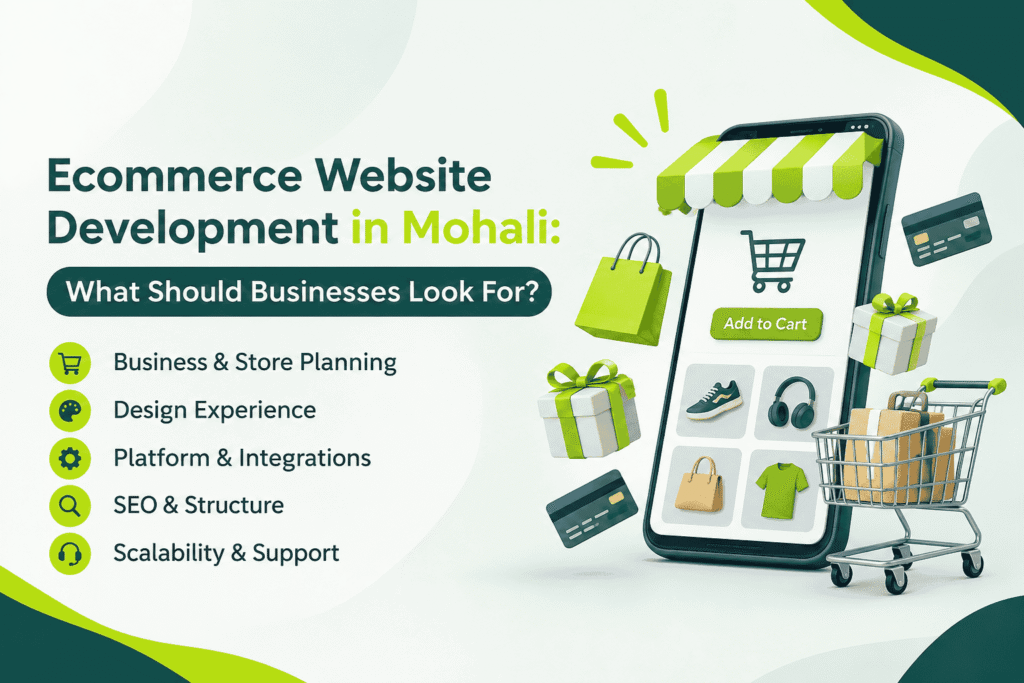
Ecommerce Website Development in Mohali: What Should Businesses Look For?
If you are planning to build an online store, choosing an ecommerce website development company in Mohali requires more than comparing design samples or development prices.
The development partner should understand the relationship between your business objectives, brand identity, website functionality, and customer experience.
Here are some important factors to consider.
1. Business and Store Planning
The development process should begin with an understanding of your business model, customers, products, and operational requirements.
A clear plan helps avoid unnecessary features and supports better decisions throughout the project.
2. Ecommerce Design Experience
Review whether the development partner understands product presentation, navigation, mobile responsiveness, and the overall shopping journey.
The website should be designed around your customers rather than simply following a generic template.
3. Platform and Integration Requirements
Discuss the platform, payment methods, shipping requirements, third-party applications, and other integrations before development begins.
Make sure the proposed solution fits your business requirements.
4. SEO and Website Structure
Ask how product pages, category pages, URLs, internal links, metadata, and technical SEO considerations will be handled.
Search engine visibility should be considered during the planning and development stages.
5. Scalability and Ongoing Support
Your store may expand with new products, categories, markets, and integrations.
Choose a development approach that can accommodate realistic future requirements without creating unnecessary complexity.
Businesses comparing ecommerce website development companies in Mohali or ecommerce website design companies in Chandigarh should evaluate these factors alongside cost, timelines, communication, and project scope.
How Ecommerce Branding and Marketing Support Online Store Growth
Building an ecommerce website creates the foundation for online sales, but customers still need to discover the store and understand why they should consider purchasing from it.
This is where branding and marketing become important.
Branding for Ecommerce
Branding helps create a recognisable identity across your website, product packaging, photography, social media, and customer communication.
A consistent identity can help customers understand what your business represents and how it differs from competitors.
For example, a home decor business may use a consistent visual style, product photography, tone of voice, and packaging approach to communicate its brand personality.
Ecommerce Marketing Strategies
Once the online store is ready, businesses can use different marketing channels to reach relevant audiences.
Some useful approaches include:
- SEO: Helps product and category pages attract relevant organic search traffic.
- Social media marketing: Helps showcase products and communicate with potential customers.
- Google Ads: Helps businesses reach people searching for relevant products.
- Meta Ads: Can help promote products and reach relevant audiences across supported platforms.
- Content marketing: Provides useful information through blogs, buying guides, and product-related content.
- Email marketing: Supports customer communication, promotional updates, and ongoing engagement.
The right combination depends on the product category, audience, budget, and business objectives.
Businesses looking for digital marketing in Mohali should consider how marketing activities connect with their online store, brand positioning, and customer acquisition goals.
For more guidance, explore our ecommerce website optimisation guide.
How Brandagic Helps Businesses Build Their Ecommerce Presence
At Brandagic, we believe that an ecommerce website should be developed around the business it supports.
A successful online store needs more than a visually appealing layout. Its structure, brand identity, product presentation, functionality, and customer experience should work together.
Our Shopify Store Development services focus on strategic store planning, experience-led design, custom development and integrations, optimised product architecture, and launch support.
We also believe that brand strategy plays an important role in how businesses present themselves online. Through our Brand Strategy and Consulting services, businesses can work on brand positioning, identity development, pricing strategy, packaging design, and brand guidelines.
Whether you are planning a new Shopify store or developing a stronger ecommerce presence, the starting point should be a clear understanding of your business objectives and customer requirements.
Explore Brandagic or contact our team to discuss your ecommerce website requirements.
Final Takeaway
Ecommerce website development is an important step for businesses that want to establish an online store, reach new customers, and develop their digital presence.
However, a successful ecommerce website requires more than attractive design. It needs a clear structure, useful product information, responsive layouts, convenient checkout, appropriate integrations, and SEO considerations.
For businesses in Mohali and Chandigarh, choosing the right ecommerce platform and development approach can help create a store that supports both present requirements and future business plans.
Most importantly, your website should reflect your brand, serve your customers, and support your overall business strategy.
A well-planned ecommerce website gives your business a stronger foundation for building and growing its online presence.
Frequently Asked Questions
1. What is ecommerce website development?
Ecommerce website development is the process of planning, designing, building, and launching an online store where customers can browse products, add items to a cart, and complete purchases through supported payment methods.
2. How much does ecommerce website development cost in Mohali?
The cost depends on the selected platform, design requirements, product catalogue, custom functionality, integrations, and overall project scope. Businesses should request a detailed project proposal based on their specific requirements rather than relying on a single standard price.
3. Which platform is best for ecommerce website development?
Shopify, WooCommerce, and custom ecommerce development are possible options. The right choice depends on your business model, technical requirements, budget, product catalogue, and future plans.
4. How long does it take to develop an ecommerce website?
The timeline depends on the complexity of the store, number of products, design requirements, integrations, content readiness, and testing. A basic store and a store requiring extensive custom functionality will have different development timelines.
5. Is Shopify suitable for small businesses?
Shopify can be suitable for small businesses that want a dedicated platform to build and manage an online store. Businesses should evaluate its features, subscription costs, applications, payment options, and integration requirements before choosing it.
6. What features should an ecommerce website have?
Important features include responsive design, product pages, category navigation, shopping cart, checkout, payment integration, order management, customer support information, and appropriate SEO functionality.
7. Does an ecommerce website need SEO?
SEO helps search engines discover and understand your product, category, and other website pages. Businesses should consider technical SEO, product descriptions, page titles, internal linking, mobile usability, and structured data during development.
8. Can I promote my ecommerce website through digital marketing?
Yes. Businesses can use SEO, Google Ads, Meta Ads, social media marketing, content marketing, and email marketing to reach potential customers.The appropriate strategy depends on the target audience, products, budget, and business objectives.
9. Why should I choose a professional ecommerce website development company in Mohali?
A suitable development partner can help plan the website structure, design, platform, integrations, and customer experience around your business requirements. Evaluate its approach, technical capabilities, communication, project scope, and support before making a decision.