
Getting your business in front of the right audience is one of the biggest challenges in a competitive market. While organic marketing helps businesses build long-term visibility, paid advertising can help them reach potential customers who are actively searching for products, services, and solutions.
This is where PPC marketing becomes important.
Pay-per-click advertising allows businesses to promote their products and services across platforms such as Google, Facebook, and Instagram while paying according to the advertising model used by each campaign. Instead of waiting for organic visibility to grow, businesses can use paid campaigns to reach relevant audiences and generate website traffic, enquiries, and sales.
However, successful PPC marketing involves more than setting a budget and launching advertisements. It requires the right keywords, audience research, compelling ad copy, relevant landing pages, conversion tracking, and continuous optimisation.
Whether you operate a local business in Mohali or Chandigarh, manage an ecommerce store, or are planning to expand your brand, understanding PPC can help you make better advertising decisions.
In this guide, we will explore what PPC marketing is, how it works, its different types, benefits, limitations, budgeting considerations, and practical ways to build an effective paid advertising strategy.
“Turn your advertising budget into measurable business results with the power of PPC.”
What Is PPC Marketing?
PPC stands for Pay-Per-Click. It is an online advertising model in which advertisers pay when someone clicks on their advertisement.
Businesses use PPC advertising to promote products, services, websites, and offers across different digital platforms.
For example, when someone searches for a phrase such as “website design company in Mohali” on Google, relevant sponsored advertisements may appear above or alongside organic search results.
If a user clicks one of those advertisements, the advertiser may be charged for that click.
PPC marketing is commonly used through:
- Google Ads
- Microsoft Advertising
- Facebook Ads
- Instagram Ads
- LinkedIn Ads
- Other advertising platforms that support click-based campaigns
The objective is to connect businesses with relevant audiences and encourage valuable actions, such as purchases, enquiries, bookings, or registrations.
“Stop guessing. Start targeting. Let data-driven advertising drive your business forward.”
How Does PPC Marketing Work?
campaigns, choose their targeting options, set budgets and bidding strategies, and compete for available advertising placements.
When a relevant search or advertising opportunity occurs, the platform evaluates eligible advertisements and determines which ones can appear.
For example, Google Ads considers factors such as bids, ad quality, landing-page relevance, search context, and competition when determining ad placement.
Here is how the process works.
1. Choose Your Advertising Platform
Start by identifying where your potential customers are most likely to discover your business.
For example:
- Google Ads can reach people searching for specific products or services.
- Facebook and Instagram Ads can introduce products and services to relevant audiences.
- LinkedIn Ads can help businesses reach professional and industry-specific audiences.
Your platform choice should depend on your target audience and campaign objectives.
2. Select Relevant Keywords or Audiences
For search advertising, identify the keywords your potential customers use when looking for a solution.
For social media advertising, define relevant audiences using the targeting options available on the platform.
A business offering services in Mohali might consider search terms related to its services and location, while an ecommerce brand may focus on product categories and purchase-related searches.
3. Set Your Budget and Bidding Strategy
Decide how much you can invest in advertising and select a bidding strategy that supports your campaign objective.
Depending on the platform and campaign type, you may optimise for clicks, impressions, conversions, or other actions.
4. Create Your Advertisements
Develop advertisements that clearly communicate your product, service, offer, or business advantage.
Your ad should include a relevant headline, useful information, and a clear call to action.
5. Direct Users to a Relevant Destination
When someone clicks your advertisement, they should reach a page that matches the message in the ad.
For example, an advertisement promoting Shopify store development should direct visitors to a relevant Shopify service page rather than an unrelated homepage.
6. Measure and Optimise Performance
Track campaign performance and identify opportunities to improve.
Monitor metrics such as clicks, cost per click, conversions, cost per lead, and return on ad spend.
Use actual campaign data to decide what needs to change.
Types of PPC Advertising
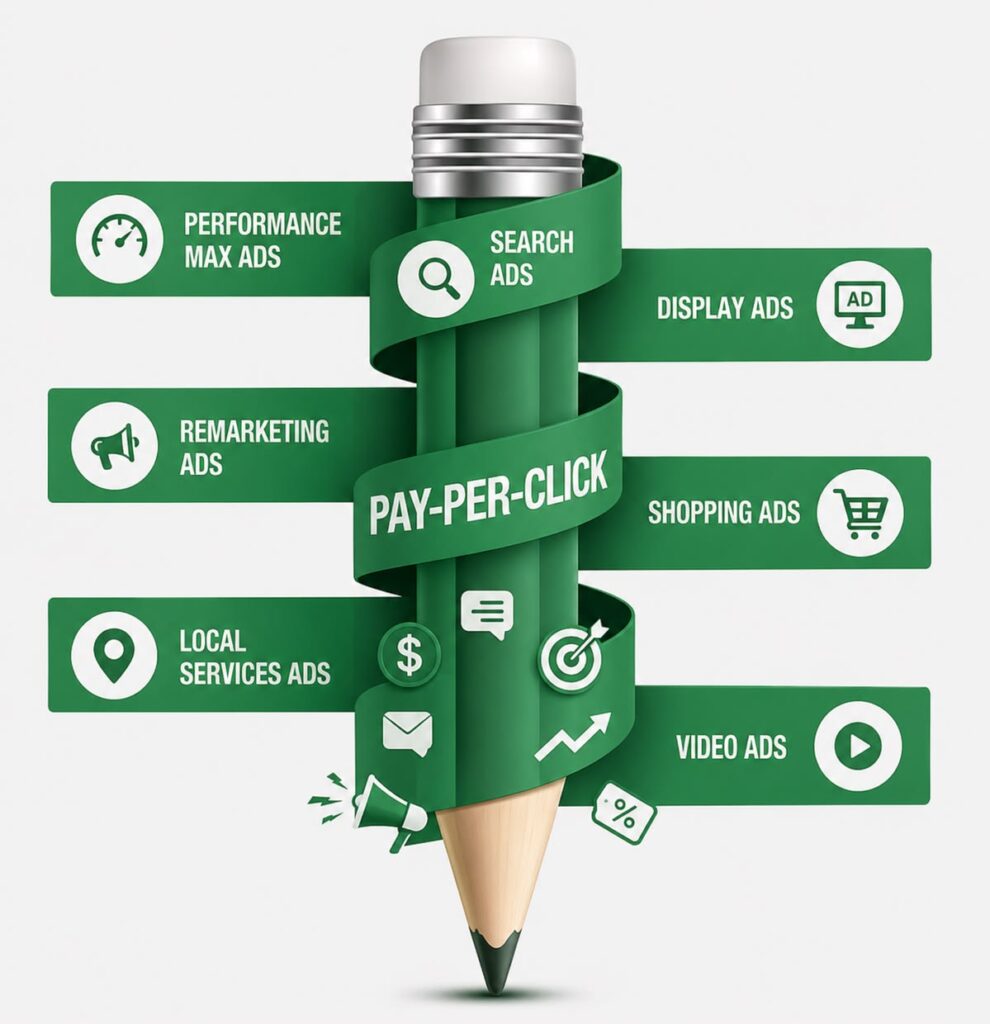
PPC advertising is not limited to search engine advertisements. Businesses can use several formats depending on their products, audience, and marketing objectives.
1. Search Advertising
Search advertisements appear on search engine results pages when users search for relevant keywords.
For example, a person searching for “Google Ads services in Mohali” may see advertisements from businesses offering related services.
Search advertising is useful when you want to reach people who are actively looking for a product or service.
2. Display Advertising
Display advertisements use visual elements such as images, graphics, and text to promote a business across supported websites and placements.
These campaigns can help brands increase awareness and reconnect with relevant audiences.
3. Shopping Advertising
Shopping advertisements showcase product information, such as images, prices, and product titles, across supported Google placements.
They are particularly relevant for ecommerce businesses that want to promote products to people searching for specific items.
4. Social Media Advertising
Social media PPC campaigns allow businesses to promote their products and services on platforms such as Facebook and Instagram.
These advertisements can use images, videos, carousels, and other supported formats.
For example, a clothing brand may use Instagram advertisements to showcase its latest collection, while a local service business may run lead-generation campaigns to receive enquiries.
Businesses looking for Meta Ads services should ensure that their creative strategy, audience selection, and conversion goals work together.
5. Video Advertising
Video advertisements allow businesses to communicate through product demonstrations, brand stories, customer-focused content, and promotional videos.
Platforms such as YouTube offer video advertising opportunities that can support brand awareness, product discovery, and other campaign objectives.
6. Remarketing and Retargeting Advertising
Remarketing helps businesses reconnect with people who have previously interacted with their website, app, or business, where supported by the platform and applicable consent and privacy requirements.
For example, an ecommerce business may show relevant product advertisements to visitors who viewed products but did not complete a purchase.
This approach can help brands maintain visibility among people who have already shown interest.
PPC Marketing vs. SEO: What Is the Difference?
PPC and SEO are two different approaches to increasing website visibility.
PPC uses paid advertisements to reach potential customers, while SEO focuses on improving a website’s visibility in organic search results.
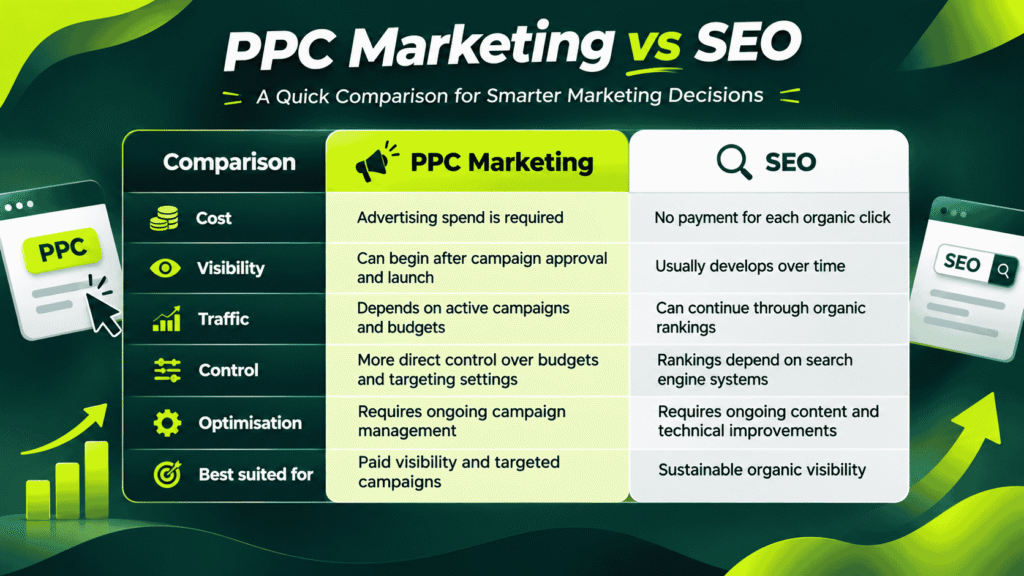
Neither approach needs to replace the other.
Businesses can use PPC to support immediate advertising objectives while building SEO for long-term organic visibility.
A balanced marketing strategy can combine both channels according to business priorities and available resources.
Benefits of PPC Marketing for Businesses
PPC marketing can support different business objectives when campaigns are planned and managed effectively.
1. Reach Potential Customers Faster
Organic visibility can take time to develop. PPC allows businesses to enter paid advertising placements once campaigns are approved and eligible to run.
This can be useful when launching a new product, promoting a service, or testing demand for a particular offer.
2. Target Relevant Audiences
Advertising platforms provide targeting options that help businesses reach audiences based on factors such as location, search intent, interests, and other available signals.
For a business serving Mohali and Chandigarh, location-based targeting can help focus campaigns on relevant markets.
3. Control Advertising Budgets
Businesses can define campaign budgets and adjust spending according to their objectives.
Google Ads does not have one fixed advertising price for every business. Costs depend on factors such as competition, keywords, industry, and campaign settings.
4. Measure Campaign Performance
PPC platforms provide reporting that helps advertisers understand how their campaigns are performing.
You can evaluate clicks, impressions, conversions, costs, and other relevant metrics to make informed decisions.
5. Test Marketing Messages
Businesses can experiment with different headlines, creative formats, offers, and landing pages.
This helps identify which messages are more relevant to the target audience.
6. Support Ecommerce Sales
Ecommerce businesses can use PPC to promote individual products, collections, seasonal offers, and new launches.
When advertising is connected with a well-structured online store, it can support the customer journey from product discovery to purchase.
How to Build an Effective PPC Marketing Strategy
Running advertisements without a clear plan can lead to wasted spending and poor-quality traffic.
A structured strategy helps businesses connect their advertising activity with measurable business objectives.
Step 1: Define Your Business Goals
Before launching a campaign, decide what you want to achieve.
Your objectives may include:
- Generating qualified leads.
- Increasing online sales.
- Promoting a new product.
- Driving relevant website traffic.
- Increasing brand awareness.
- Receiving consultation or booking enquiries.
Your campaign structure should reflect your selected objective.
Step 2: Understand Your Target Audience
Identify who is most likely to purchase your product or enquire about your service.
Consider their location, needs, challenges, search behaviour, and buying preferences.
For example, a local business in Mohali may focus on customers within its service area, while an ecommerce brand may target customers across multiple regions.
Step 3: Conduct Keyword Research
For search campaigns, identify relevant keywords based on search intent.
Consider the difference between broad informational searches and high-intent commercial searches.
For example:
- Informational: What is PPC marketing?
- Commercial: PPC services in Mohali.
- High-intent: Best PPC company in Mohali.
- Service-specific: Google Ads management services in Mohali.
Use keyword research tools to evaluate search demand, competition, and estimated costs. Also create a negative keyword list to reduce irrelevant clicks.
Step 4: Select the Right Campaign Type
Choose a campaign type based on your objective and audience.
For example, search campaigns may suit businesses targeting people actively searching for services, while social media campaigns may help brands introduce products and generate interest.
Do not select a platform simply because it is popular. Choose it because it supports your business goals.
Step 5: Write Relevant Ad Copy
Your advertisements should communicate a clear benefit and encourage the right audience to take action.
Focus on:
- Relevant headlines.
- Clear service or product information.
- Specific customer benefits.
- Trust-building messages.
- Strong calls to action.
Avoid exaggerated claims and generic promises that do not explain what makes your business valuable.
Step 6: Build a Relevant Landing Page
A good advertisement can attract visitors, but the landing page influences what happens next.
Your landing page should:
- Match the advertisement’s message.
- Explain your offer clearly.
- Load properly on mobile devices.
- Provide useful information.
- Include a visible call to action.
- Make it easy to contact or purchase from your business.
A disconnected or confusing landing page can reduce the value of your advertising traffic.
Step 7: Set Up Conversion Tracking
Conversion tracking helps businesses understand which advertising interactions lead to valuable actions.
Depending on your campaign, conversions may include form submissions, phone calls, purchases, bookings, or other meaningful events.
Use appropriate tracking tools and verify that conversions are recorded correctly before making optimisation decisions.
Step 8: Monitor and Optimise Campaigns
Review campaign performance regularly.
Identify irrelevant search terms, weak advertisements, poor-performing landing pages, and opportunities to improve targeting.
Make changes based on actual data rather than assumptions.

How Much Should a Business Spend on PPC Advertising?
There is no single PPC budget that works for every business.
The right advertising budget depends on your industry, competition, target locations, average customer value, conversion rate, and business objectives.
For example, a local service provider may need a different budget from an ecommerce business promoting hundreds of products.
Before deciding how much to spend, consider the following:
Budget factor | What to evaluate |
Business objective | Leads, sales, traffic, or awareness |
Keyword competition | Estimated cost and competition for relevant searches |
Target location | Mohali, Chandigarh, Tricity, or wider markets |
Average customer value | Revenue or value generated from a customer |
Conversion rate | Percentage of visitors completing a desired action |
Profit margin | How much the business can afford to spend to acquire a customer |
Testing period | Budget required to gather meaningful campaign data |
Start with a budget that your business can reasonably support. Review the results and scale only when the campaign economics and business capacity justify it.
Remember that advertising spend and agency management fees may be separate costs. Clarify both before starting a campaign.
Common PPC Marketing Mistakes Businesses Should Avoid
Even well-funded campaigns can underperform when important details are overlooked.
Here are some common mistakes to avoid.
1. Targeting Irrelevant Keywords
Broad or unrelated keywords can attract visitors who are unlikely to become customers.
Focus on search intent and use negative keywords to filter irrelevant searches.
2. Ignoring Landing Page Quality
Sending every advertisement to the homepage may not provide the most relevant experience.
Use landing pages that match the specific product, service, or offer being advertised.
3. Focusing Only on Clicks
A high number of clicks does not automatically mean a campaign is successful.
Measure conversions, qualified enquiries, customer acquisition costs, and revenue where applicable.
4. Not Tracking Conversions
Without accurate conversion tracking, it becomes difficult to understand which campaigns are generating valuable business outcomes.
5. Using the Same Creative Everywhere
Different audiences and platforms may respond to different formats and messages.
Adapt your advertising creatives to the platform, audience, and campaign objective.
6. Setting and Forgetting Campaigns
PPC campaigns need regular attention.
Search trends, competition, customer behaviour, and campaign performance can change. Review and optimise campaigns instead of assuming the initial setup will remain effective.
Finding the Right PPC and Digital Marketing Partner in Mohali and Chandigarh
Choosing an advertising partner is an important business decision. A suitable agency should understand your business objectives rather than simply focus on launching advertisements.
If you are comparing a PPC company in Mohali, looking for Google Ads services in Mohali, or evaluating a PPC expert in Chandigarh, consider these factors.
1. Understand Their Strategy
Ask how the agency researches keywords, defines audiences, structures campaigns, and plans budgets.
A clear strategy should explain why particular advertising channels and campaign types are suitable for your business.
2. Evaluate Their Reporting Process
A reliable advertising partner should explain what is being measured and how performance is evaluated.
Ask whether reports cover relevant metrics such as conversions, cost per lead, cost per acquisition, and return on ad spend where applicable.
3. Check Their Understanding of Your Industry
An agency should understand your products, services, customer expectations, and competitive environment.
This is particularly important for businesses operating in specific markets such as Mohali, Chandigarh, and the wider Tricity region.
4. Look Beyond Advertising Costs
The lowest management fee or cheapest click does not necessarily deliver the best business outcome.
Evaluate the quality of the strategy, campaign management, communication, tracking, and optimisation process.
5. Consider Your Wider Marketing Requirements
Paid advertising works best when it supports a consistent brand and customer experience.
If your business also needs brand positioning, marketing strategy, ecommerce development, or stronger customer communication, consider how these areas fit into your overall growth plan.
Businesses comparing the best PPC company in Mohali, a digital marketing agency in Mohali, or the best digital marketing services in Mohali should evaluate the actual scope of services and how closely it matches their business needs.
How Brand Strategy and Marketing Work Together With PPC
PPC can help businesses reach potential customers, but advertising alone cannot build a strong brand. Customers also evaluate the business behind the advertisement: its identity, messaging, website, products, service quality, and overall experience.
This is why paid advertising should be connected with a broader marketing strategy.
At Brandagic, we believe businesses need more than isolated marketing activities. They need a clear direction that connects brand positioning, communication, customer experience, and business objectives.
Brandagic works across brand strategy, marketing strategy, brand consulting, marketing consulting, and Shopify expertise to help businesses build stronger foundations for sustainable growth.
For businesses exploring digital marketing in Mohali, social media marketing in Mohali, or broader advertising opportunities, a clear strategy can help bring consistency to marketing decisions.
Explore Brandagic’s Brand Strategy and Consulting Services or learn more about Shopify Store Development.
Building Brands For Tomorrow, Together.
Visit Brandagic or contact our team to discuss your business goals.
Final Takeaway
PPC marketing can help businesses reach relevant audiences, promote their products and services, and generate measurable advertising activity.
However, effective paid advertising requires more than a budget. It depends on understanding your audience, selecting relevant keywords, creating useful advertisements, building strong landing pages, tracking conversions, and continuously improving campaign performance.
For businesses in Mohali, Chandigarh, and beyond, the right approach is to connect PPC campaigns with clear business objectives and a consistent brand strategy.
Whether you are planning your first Google Ads campaign or looking to improve an existing advertising strategy, focus on attracting the right customers and measuring outcomes that matter to your business.
Frequently Asked Questions
1. What is PPC marketing?
PPC marketing stands for pay-per-click marketing. It is an online advertising model in which advertisers pay when users click on their advertisements, depending on the campaign’s pricing model.
2. What is the difference between PPC and Google Ads?
PPC is an advertising payment model, while Google Ads is an advertising platform. Google Ads supports different campaign formats and bidding models, including pay-per-click campaigns.
3. Is PPC marketing suitable for small businesses?
Yes. Small businesses can use PPC to promote specific products and services, reach relevant local audiences, and generate enquiries. The budget and campaign structure should match their business objectives and capacity.
4. How much does PPC advertising cost in India?
There is no fixed PPC advertising cost in India. Costs depend on factors such as industry competition, keywords, location, bidding strategy, and campaign type. Businesses should determine their budget based on customer value and expected campaign economics.
5. Which platform is best for PPC advertising?
The right platform depends on your audience and objective. Google Ads can help reach people searching for specific products or services, while Facebook and Instagram Ads can support product discovery, awareness, and lead generation.
6. How long does it take to see PPC results?
Campaigns may start receiving impressions and clicks after approval and launch, but meaningful performance evaluation requires sufficient data. The time needed depends on competition, budget, conversion volume, and campaign setup.
7. What is PPC campaign management?
PPC campaign management involves planning, setting up, monitoring, and optimising paid advertising campaigns. It can include keyword research, audience selection, bid management, ad copy improvements, budget allocation, and performance reporting.
8. What is the difference between PPC and SEO?
PPC uses paid advertising to gain visibility, while SEO improves a website’s organic visibility in search engines. PPC can provide paid traffic while SEO builds long-term organic search presence.
9. How do I choose a PPC company in Mohali?
Compare agencies based on their campaign strategy, keyword research, conversion tracking, reporting, industry understanding, and optimisation process. Choose a partner whose approach aligns with your business goals rather than relying only on pricing or promises.
10. Can PPC marketing help ecommerce businesses?
Yes. Ecommerce businesses can use PPC to promote products, collections, shopping campaigns, and special offers. Performance should be evaluated through relevant metrics such as purchases, customer acquisition cost, and return on ad spend.