
Marketing becomes much easier to manage when you can connect your activities to measurable business outcomes.
For a startup, that might mean generating qualified enquiries. For an ecommerce brand, it could mean increasing purchases. For an established business, the objective may be improving customer acquisition efficiency while building stronger long-term demand.
This is where performance marketing becomes useful.
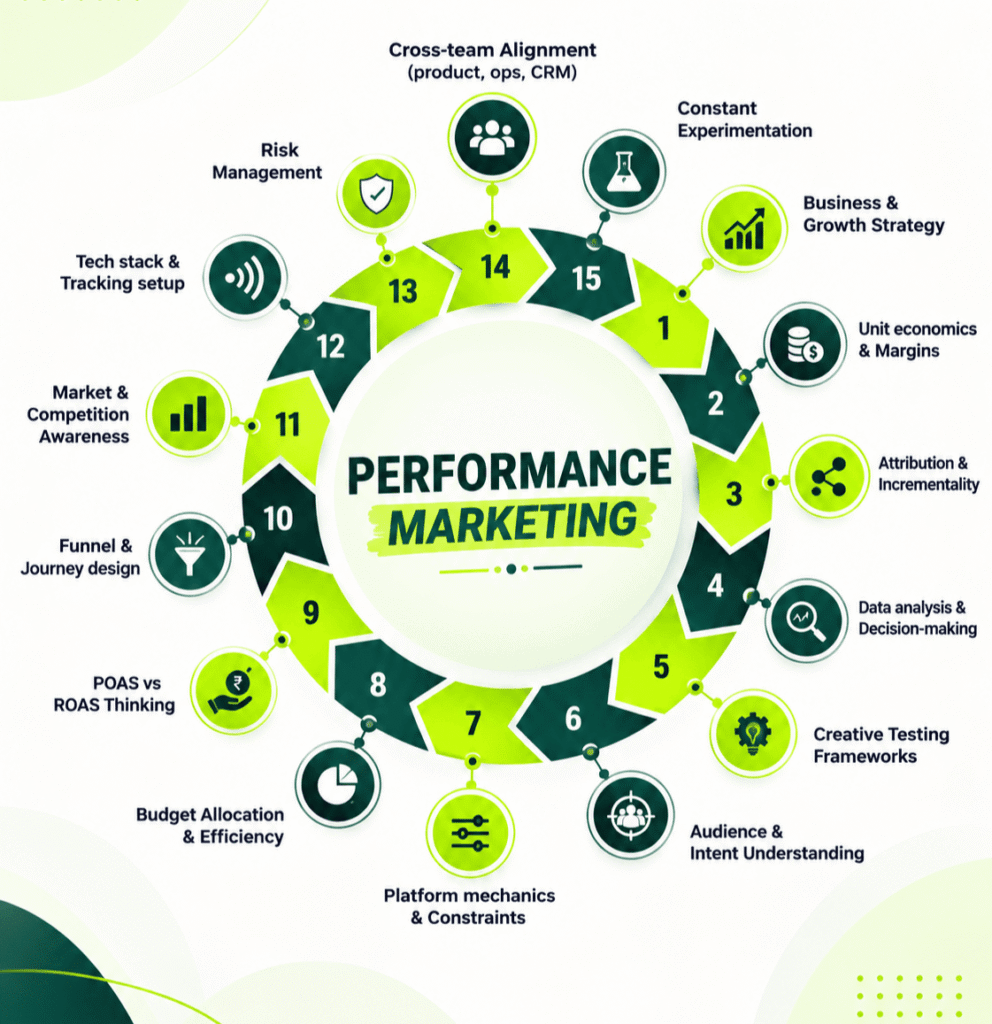
Performance marketing is a results-oriented approach in which campaigns are planned, measured and optimized around actions such as clicks, leads, sales or conversions. Common channels include PPC advertising, social media advertising, search engine marketing and affiliate marketing.
But performance marketing is not simply about running ads.
The real process involves understanding your audience, selecting the right channel, creating the right offer, sending users to an appropriate landing experience, tracking meaningful actions and continuously improving the campaign.
For businesses searching for a digital marketing agency in Mohali, understanding this process can help you evaluate strategies and marketing partners more effectively.
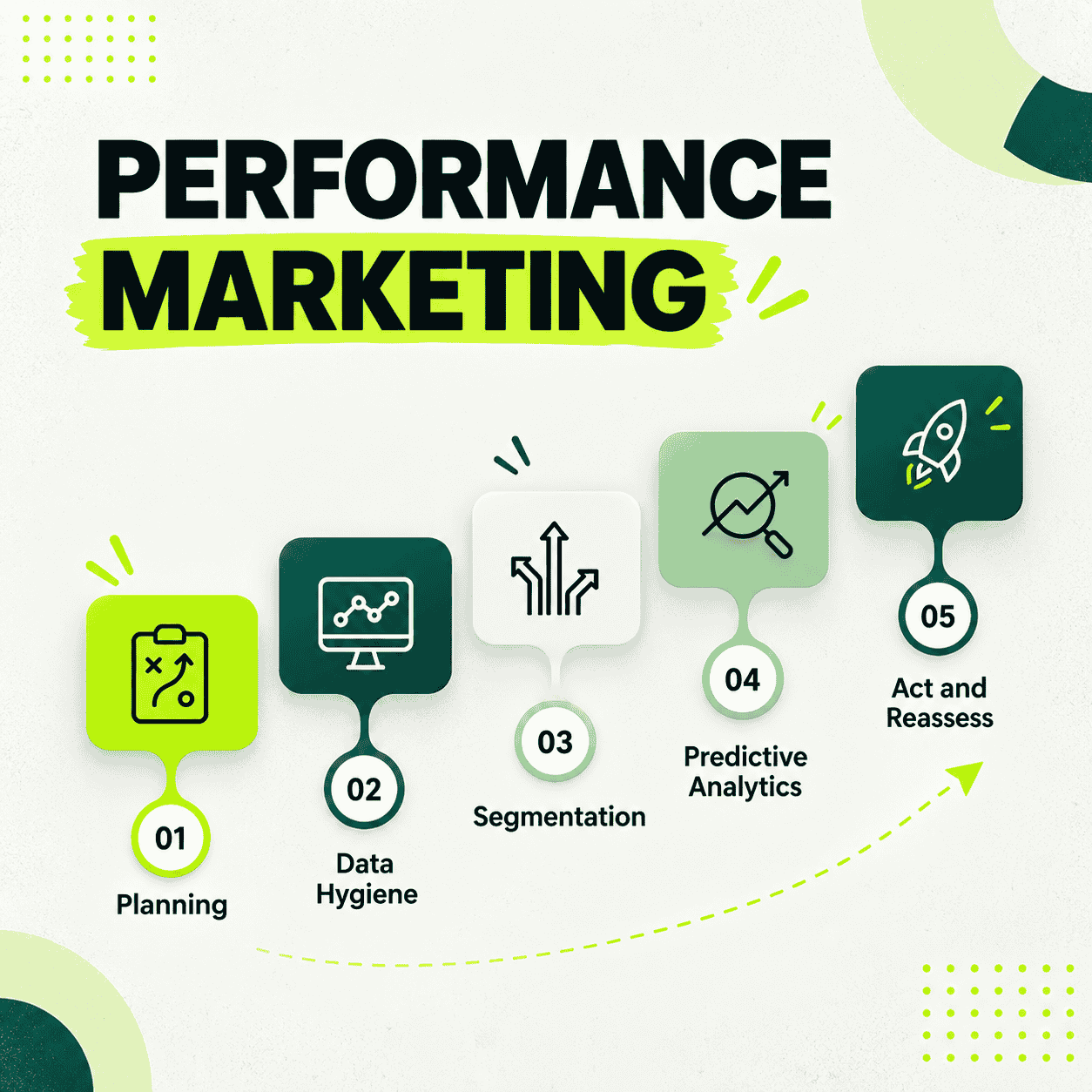
“Don’t just spend on ads — invest in measurable results.”
What Is Performance Marketing?
Performance marketing is a measurable approach to marketing where campaigns are evaluated against specific actions or outcomes.
These outcomes can include:
- Website visits
- Form submissions
- Phone calls
- Product purchases
- App installations
- Qualified leads
- Bookings
- Sign-ups
- Repeat purchases
Unlike a campaign focused only on visibility, performance marketing asks a more practical question:
What business action did the marketing generate?
For example, imagine a Mohali-based furniture business launches an online campaign.
Instead of simply measuring how many people saw the advertisement, the business could track:
Ad impression → Click → Website visit → Product view → Enquiry → Purchase
This creates a clearer relationship between marketing activity and business objectives.
However, not every measurable metric is equally valuable. A campaign can generate thousands of clicks while producing very few relevant enquiries.
That is why quality of conversions matters as much as quantity.
“Test smarter, optimize faster, and scale what works.”
Why Performance Marketing Matters for Businesses
Digital channels can produce large amounts of data. The challenge is knowing which numbers actually matter.
A useful performance strategy connects three areas:
Business objective → Marketing activity → Measurable outcome
For example:
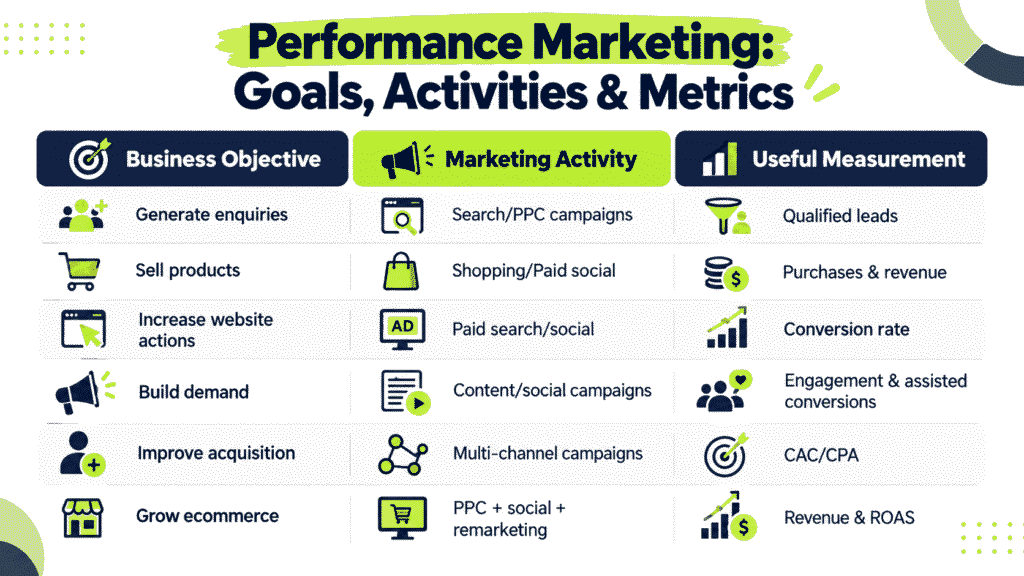
This approach also helps businesses decide where their marketing budget is going.
Shopify’s current marketing reporting documentation includes measurements such as sessions, sales, conversion rate, average order value, customer acquisition cost, CTR, CPA and ROAS for evaluating marketing performance.
Performance Marketing vs. Digital Marketing
The two terms are often used interchangeably, but they are not exactly the same. Digital marketing is a broad category covering marketing activities performed through digital channels.
This can include:
- SEO
- PPC
- Social media
- Content marketing
- Email marketing
- Websites
- Search marketing
- Online advertising
- Ecommerce marketing
Performance marketing, on the other hand, places greater emphasis on measurable actions and outcomes.
Think of it this way:
Digital marketing = the wider ecosystem
Performance marketing = an outcome-focused approach within that ecosystem
This distinction is important when comparing a digital marketing company in Mohali or evaluating whether an agency’s proposed strategy actually connects marketing activity to your business goals.
How Performance Marketing Works
A strong campaign usually follows a logical sequence.
1. Define the Business Objective
Start with the business goal rather than the advertising platform.
Ask:
- Do we need leads?
- Do we need ecommerce sales?
- Do we want more qualified enquiries?
- Are we launching a new product?
- Are we trying to reduce acquisition costs?
- Do we need more traffic to a particular service?
- Are we trying to re-engage previous visitors?
A campaign becomes easier to evaluate once the desired outcome is clearly defined.
2. Understand the Target Audience
Knowing the audience goes beyond age and location.
Consider:
- What problem are they trying to solve?
- What are they searching for?
- What objections could stop them from buying?
- What information do they need before contacting you?
- Are they comparing multiple providers?
- Are they ready to purchase or still researching?
For a local business, location can also influence intent.
Someone searching for:
“digital marketing services in Mohali”
has different intent from someone searching:
“what is digital marketing?”
The first query is closer to commercial investigation. That difference should influence your keywords, ad messaging and landing page.
3. Select the Right Marketing Channel
There is no universal channel that works for every business.
PPC / Search Advertising
PPC can capture people who are actively searching for a product or service.
Examples:
- PPC services in Mohali
- Shopify development company in Mohali
- SEO agency in Chandigarh
- marketing consultant in Chandigarh
Search engine marketing uses paid placements in search results to increase visibility for relevant queries.
Social Media Advertising
Social platforms can be useful for:
- Product discovery
- Lead generation
- Retargeting
- Demand creation
- Content promotion
- Ecommerce campaigns
A social media marketing agency in Mohali may use different campaign structures depending on whether the objective is awareness, engagement, leads or sales.
SEO
SEO focuses on improving organic visibility rather than paying for each click.
It can support longer-term discovery for searches related to:
- Products
- Services
- Problems
- Locations
- Comparisons
- Educational topics
Email Marketing
Email can support:
- Lead nurturing
- Promotions
- Abandoned-cart recovery
- Repeat purchases
- Customer retention
The right combination depends on your customer journey.
Performance Marketing for Startups
Startups often have limited budgets and need to learn quickly. A practical approach is to avoid launching too many channels simultaneously.
Start with:
- One clearly defined audience
- One business objective
- One primary offer
- One or two suitable channels
- One conversion action
- A reliable tracking system
For example, a startup selling a specialized product could initially test paid search and paid social separately.
The goal is not simply to spend money on both platforms.
The goal is to learn:
- Which audience responds?
- Which message gets attention?
- Which offer generates action?
- Which landing page performs better?
- Which channel produces qualified customers?
That learning can then influence the next stage of the marketing strategy.
Performance Marketing for Established Brands
Established brands may already have:
- Website traffic
- Existing customers
- Brand awareness
- Historical campaign data
- Multiple products
- Several customer segments
Their challenge may be optimization rather than simply generating traffic.
Performance marketing can therefore be used alongside broader brand and marketing strategy.
For example:
Brand strategy → Positioning → Marketing strategy → Campaign → Conversion → Measurement → Optimization
This is important because performance campaigns work within the larger customer experience.
If the advertisement promises one thing but the landing page communicates something completely different, improving the ad alone may not solve the problem.
Performance Marketing for Ecommerce Businesses
Ecommerce businesses have an advantage when it comes to measurement because many customer actions can be tracked digitally.
A simplified ecommerce journey might look like:
Ad → Product page → Add to cart → Checkout → Purchase
Useful metrics can include:
- Product views
- Add-to-cart rate
- Checkout rate
- Conversion rate
- Average order value
- Customer acquisition cost
- Revenue
- ROAS
- Repeat purchase rate
Shopify’s marketing reporting tools include metrics such as sales, sessions, orders, conversion rate, AOV, CPA and ROAS, depending on the connected marketing activity and reporting setup.
For a Shopify business, this makes measurement an important part of the overall growth process.
Key Types of Performance Marketing
1. Pay-Per-Click Advertising
PPC advertising allows businesses to appear when users search for relevant terms.
For example:
“best PPC company in Mohali”
or
“Shopify development company in Mohali”
The objective is to match the searcher’s intent with a relevant advertisement and landing page.
2. Paid Social Media
Paid social campaigns can be used for:
- Lead generation
- Ecommerce sales
- Remarketing
- Product launches
- Audience testing
- Content promotion
A strong social campaign usually combines audience understanding, creative testing, compelling messaging and conversion tracking.
3. Search Engine Marketing
Search advertising is particularly useful when people are actively looking for a solution.
For example:
User: “SEO agency in Chandigarh”
Business: Relevant service page
Ad: Clear service proposition
Landing page: Detailed information + proof + CTA
Conversion: Consultation request
The closer these elements are aligned, the more consistent the user journey becomes.
4. Retargeting
Not every visitor converts on their first visit. Retargeting can help businesses reconnect with people who have previously interacted with their website, products or marketing.
For example:
First visit → No conversion → Retargeting → Return visit → Conversion
Retargeting should still be relevant and appropriately controlled rather than repeatedly showing the same message to every visitor.
The Most Important Performance Marketing Metrics
Metrics should be selected according to the business objective.
Click-Through Rate — CTR
CTR measures how frequently people click after seeing an advertisement.
A simple formula is:
CTR = Clicks ÷ Impressions × 100
CTR can help you understand whether an ad is attracting attention, but a high CTR does not automatically mean a campaign is profitable.
Cost Per Click — CPC
CPC tells you how much you are paying for clicks.
It can help compare traffic costs between campaigns, keywords or audiences.
But inexpensive clicks are not necessarily valuable clicks.
Conversion Rate
Conversion rate measures how frequently visitors complete a desired action.
For example:
100 visitors → 5 enquiries
Conversion rate = 5%
The definition of a conversion should be specific to the business.
Cost Per Lead — CPL
For lead-generation campaigns:
CPL = Advertising Spend ÷ Leads
However, businesses should go beyond total leads.
Suppose two campaigns produce:
- Campaign A: 50 leads
- Campaign B: 20 leads
If Campaign B generates substantially more qualified prospects, the raw lead count alone does not tell the full story.
Cost Per Acquisition — CPA
CPA measures the cost associated with acquiring a customer or defined conversion. This is particularly useful when the business can connect advertising spend with actual customer acquisition.
Return on Ad Spend — ROAS
ROAS compares attributed revenue with advertising expenditure.
ROAS = Revenue attributed to ads ÷ Ad spend
It can be useful for ecommerce campaigns, but it should be interpreted alongside margins, refunds, repeat purchases and other business costs.
Leads vs. Qualified Leads: A Critical Difference
One of the most common performance marketing mistakes is optimizing exclusively for lead volume. Imagine a campaign produces 100 enquiries. But only 10 are relevant prospects. Another campaign produces 30 enquiries, of which 15 are relevant. Looking only at lead volume would miss an important part of the picture.
For service businesses, consider tracking:
Lead → Qualified Lead → Sales Conversation → Customer
This allows marketing and sales teams to identify where prospects are dropping out.
It can also help a business refine:
- Audience targeting
- Ad copy
- Offers
- Landing pages
- Lead forms
- Qualification questions
- Follow-up processes
How to Build a Performance Marketing Campaign
A practical framework is:
Step 1: Define the objective
Choose one primary outcome.
Step 2: Identify the audience
Understand their needs, intent and objections.
Step 3: Research search and customer intent
Separate informational, commercial and transactional searches.
Step 4: Select channels
Choose platforms based on where your audience and intent exist.
Step 5: Create the offer
Give users a clear reason to take the next step.
Step 6: Build the landing experience
The landing page should support the promise made in the advertisement.
Step 7: Set up tracking
Track meaningful actions rather than only clicks.
Step 8: Launch controlled tests
Test variables such as:
- Headlines
- Creative
- Audience
- Offer
- Landing page
- Call to action
Step 9: Analyze results
Look beyond surface-level metrics.
Step 10: Optimize
Keep improving based on evidence from the campaign.
Why Landing Pages Matter
You can have a strong advertisement and still have a weak campaign if the landing page does not meet user expectations.
A good landing page should answer:
- What is being offered?
- Who is it for?
- Why should the visitor care?
- What makes the offer relevant?
- What happens next?
- How can the visitor contact the business?
For example, someone searching for best digital marketing services in Mohali should not land on a generic page that provides little information about the relevant service.
The message should remain consistent from:
Search → Advertisement → Landing Page → CTA
Performance Marketing for Mohali & Chandigarh Businesses
Local businesses have an additional advantage: geographic intent. A business serving Mohali may want to structure its content and campaigns around relevant searches such as:
- digital marketing agency in Mohali
- digital marketing company in Mohali
- PPC services in Mohali
- social media marketing in Mohali
- SEO agency in Mohali
- marketing strategy in Mohali
- brand growth Mohali
Similarly, businesses targeting the Chandigarh market may consider searches such as:
- digital marketing agency in Chandigarh
- PPC companies in Chandigarh
- SEO agency in Chandigarh
- marketing strategy in Chandigarh
- brand growth Chandigarh
- brand strategy in Chandigarh
The objective should not be to insert every location keyword onto every page. Instead, create useful content and landing pages that genuinely match the searcher’s intent.
How to Evaluate a Digital Marketing Agency in Mohali
If you’re comparing a digital marketing agency in Mohali, don’t evaluate an agency only by the number of services listed on its website.
Ask practical questions.
1. What is the primary business objective?
A good strategy should begin with the business problem.
2. What exactly will be measured?
Ask which actions count as conversions.
3. How will qualified leads be identified?
Lead volume alone may not represent business value.
4. What happens after the campaign launches?
Look for a clear testing and optimization process.
5. How is reporting handled?
You should know which metrics are being tracked and why.
6. How does the landing page support the campaign?
Advertising and website experience should work together.
7. How does the strategy fit the brand?
Performance campaigns should not operate completely separately from positioning and customer experience.
Common Performance Marketing Mistakes
Focusing Only on Clicks
Clicks indicate interest, but they are not the same as customers.
Targeting Too Broadly
A large audience does not automatically mean a useful audience.
Ignoring Search Intent
Different searches represent different stages of the buying journey.
Sending All Traffic to One Generic Page
Different campaigns may need different landing experiences.
Measuring Only Lead Quantity
A campaign generating low-quality enquiries may create additional work rather than business value.
Changing Campaigns Too Frequently
Constant changes can make it difficult to understand what actually influenced performance.
Ignoring Creative
Audience targeting cannot compensate indefinitely for weak messaging or irrelevant creative.
Forgetting the Brand
Performance campaigns may drive immediate actions, but businesses still need consistent positioning and customer experience.
Shopify also notes limitations of performance marketing, including its potential lack of focus on broader brand-building objectives and the challenges of attribution.
Performance Marketing and Brand Strategy Should Work Together
Performance and brand strategy do not have to compete.
They solve different problems.
Brand strategy answers:
- Who are we?
- What do we stand for?
- Who do we serve?
- Why should customers choose us?
- How should the brand be perceived?
Performance marketing answers:
- Which audience is responding?
- Which channel is producing action?
- Which message converts?
- What does acquisition cost?
- What should be optimized?
A stronger growth system can connect both.
Brand Strategy → Marketing Strategy → Campaign → Conversion → Measurement → Learning
This is particularly useful for startups and growing brands that need both short-term marketing activity and long-term positioning.
Where Brandagic Fits Into the Picture
Brandagic positions its work around building brands through strategy, systems and storytelling, with services including Brand Strategy, Marketing Strategy, Brand Consulting, Marketing Consulting and Shopify Store Development.
For businesses evaluating a digital marketing agency in Mohali, this distinction is important: marketing should be considered within the broader context of the brand, business objectives and customer journey rather than as advertising activity alone.
Brandagic’s Shopify offering covers areas such as store planning, experience-led design, development and integrations, product architecture and launch support. Its brand consulting work focuses on areas including positioning, identity development, pricing strategy, packaging and brand guidelines.
That means a business can think about performance activity alongside the underlying brand and customer experience.
A Practical Performance Marketing Checklist
Before launching your next campaign, check the following:
Strategy
- Business objective is clearly defined
- Target audience is understood
- Customer intent has been considered
- Primary offer is clear
Campaign
- Correct marketing channel selected
- Ad messaging matches user intent
- Creative is relevant
- CTA is specific
- Budget is defined
Landing Page
- Message matches the advertisement
- Page works well on mobile
- Important information is easy to find
- CTA is visible
- Forms are easy to complete
Measurement
- Conversion tracking is configured
- Relevant KPIs are defined
- Lead quality is tracked
- Cost per acquisition is monitored
- Revenue or business outcomes are connected where possible
Optimization
- Campaign performance is reviewed regularly
- Poor-performing elements are identified
- New tests are planned
- Learnings are documented
- Budget decisions are based on evidence
Final Takeaway
Performance marketing is not simply about running paid advertisements. It is a structured approach to connecting audience, messaging, channels, landing experiences and measurable business outcomes. For brands, businesses and startups in Mohali and Chandigarh, the most useful approach is to start with the business objective and work backward. Understand the customer. Choose the appropriate channel. Create a relevant offer.Build a consistent landing experience.
Track meaningful conversions. Then use the data to improve the next decision. If you’re researching a digital marketing agency in Mohali, use the same principle when evaluating potential partners: look beyond the number of services offered and understand how the proposed strategy connects marketing activity with your actual business goals.
Frequently Asked Questions
1. What is performance marketing?
Performance marketing is a measurable marketing approach focused on actions such as clicks, leads, sales or conversions. Common channels include PPC, paid social, search engine marketing and affiliate marketing.
2. Is performance marketing the same as digital marketing?
No. Digital marketing is a broader category covering many online marketing activities. Performance marketing focuses more specifically on measurable actions and outcomes.
3. What is PPC marketing?
PPC, or pay-per-click advertising, is a form of paid advertising where advertisers generally pay when someone clicks an advertisement. It is commonly used in search and other digital advertising environments.
4. How do I choose a digital marketing agency in Mohali?
Start by understanding your business objective, target audience and required outcomes. Then ask potential agencies how they plan to measure conversions, qualify leads, report performance, optimize campaigns and connect marketing activity with business goals.
5. Is performance marketing suitable for startups?
It can be useful for startups that need measurable feedback from their marketing activity. A focused campaign can help test audiences, messaging, offers and channels before expanding the strategy.
6. What metrics should I track in performance marketing?
Depending on the campaign, useful metrics can include CTR, CPC, conversion rate, CPL, CPA, CAC, revenue and ROAS. The appropriate metrics should be connected to the actual business objective. Shopify’s current marketing reporting also includes measures such as sessions, sales, AOV, conversion rate, CPA and ROAS.
7. Can performance marketing help ecommerce businesses?
Yes. Ecommerce businesses can measure multiple stages of the customer journey, including product views, add-to-cart actions, purchases, revenue and acquisition costs. Shopify provides marketing reporting that can connect marketing activities with sales and other ecommerce metrics.
8. Should businesses focus only on performance marketing?
Not necessarily. Performance marketing can help measure immediate actions, while brand and marketing strategy can support positioning, differentiation and longer-term growth. A balanced approach depends on the business, audience and objectives.