
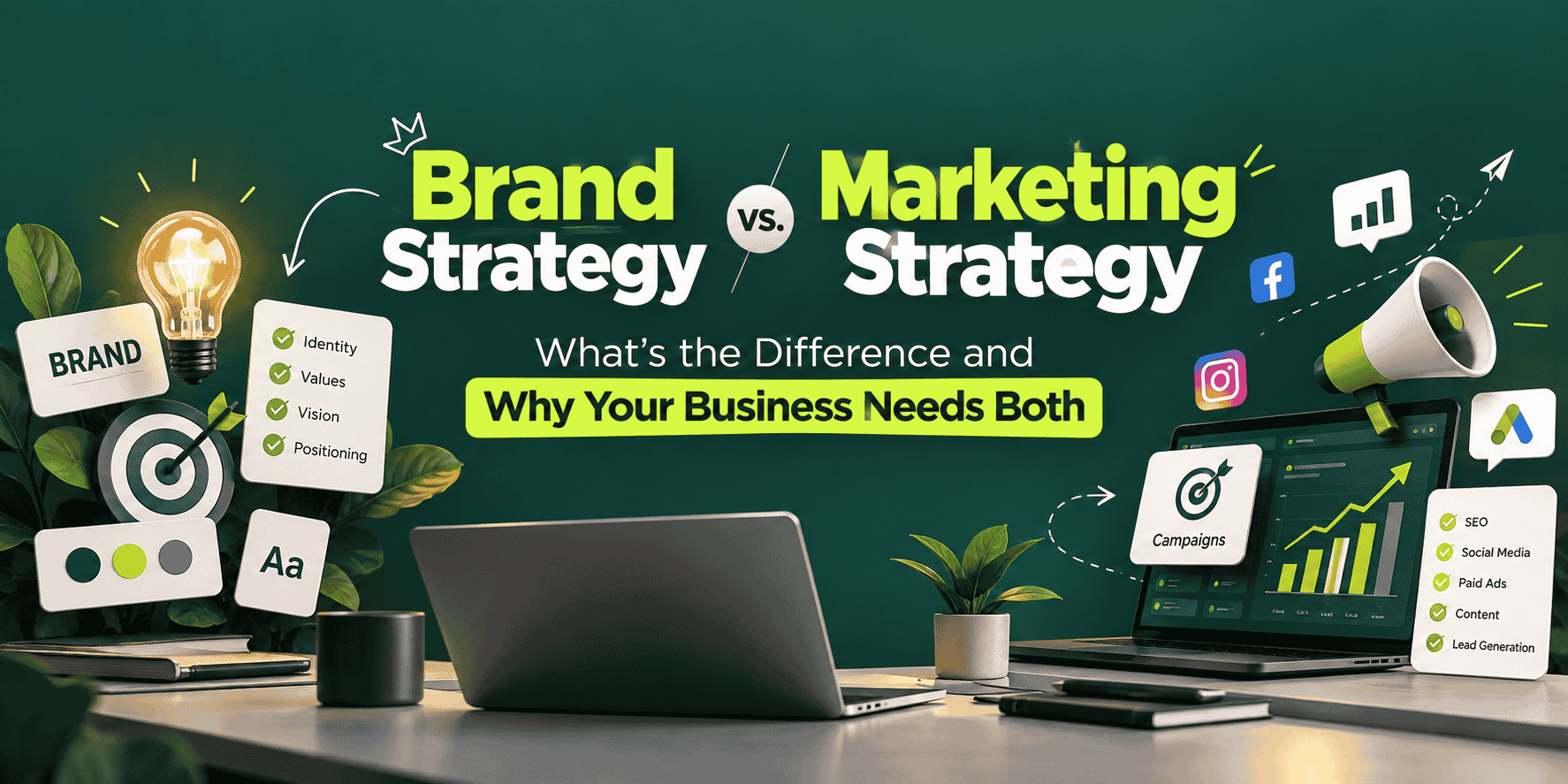
Brand strategy and marketing strategy are often treated as if they mean the same thing.
They don’t. A brand strategy defines how a business should be positioned, perceived and remembered, while a marketing strategy determines how the business communicates with its audience and creates demand through relevant channels.
The two work closely together, but they solve different problems.
A business can have strong advertising and still have unclear positioning. It can also have a well-defined brand but struggle to reach the right customers.
That is why understanding the difference matters before investing in SEO, PPC, social media, websites or other marketing activities.
Here’s how brand strategy and marketing strategy differ, where they overlap, and how businesses can use both to create a more consistent growth approach.
"Our services"
What Is Brand Strategy?
Brand strategy is the strategic foundation behind how a business presents itself and occupies a position in the market.
It answers questions such as:
- Who are we?
- Who are we trying to serve?
- What do we want to be known for?
- How are we different?
- What should customers associate with us?
- How should we communicate?
- What should our brand look and sound like?
- Where do we want the brand to go?
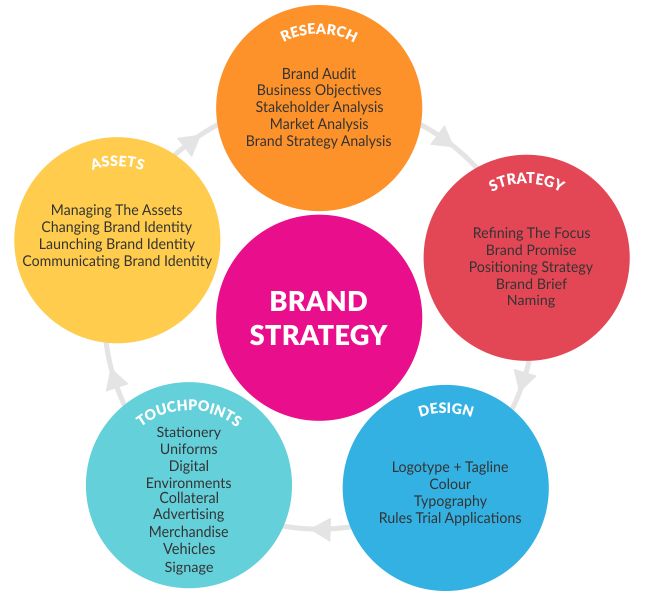
A brand strategy can include areas such as:
- Brand positioning
- Brand identity
- Brand messaging
- Brand voice
- Audience understanding
- Competitive differentiation
- Visual identity
- Brand guidelines
- Long-term brand direction
The goal isn’t simply to create an attractive logo.
The goal is to establish a consistent foundation for how the business is experienced.
Brandagic’s Brand Consulting service, for example, covers brand positioning, brand identity development, pricing strategy, packaging design and brand guidelines. Its process includes discovery, a strategy blueprint, visual identity design, and implementation and support.
What Is Marketing Strategy?
Marketing strategy focuses on how a business reaches its audience and communicates its value through appropriate marketing activities.
It answers questions such as:
- Who should we reach?
- What problem are we solving?
- What should we communicate?
- Which channels should we use?
- What should we prioritize?
- How should customers move from awareness to consideration and action?
- How should marketing performance be evaluated?
Depending on the business, marketing can involve:
- SEO
- Paid search
- PPC
- Social media
- Content
- Websites
- Ecommerce
- Campaigns
- Local search
- Other customer acquisition channels
The important point is that marketing strategy comes before randomly selecting channels. A business shouldn’t run Google Ads simply because its competitor does. It should first understand what it is trying to achieve and which channel is appropriate for that objective.
“Brandagic - A Marketing Agency”
Brand Strategy vs. Marketing Strategy: The Key Difference
The simplest way to understand the difference is:
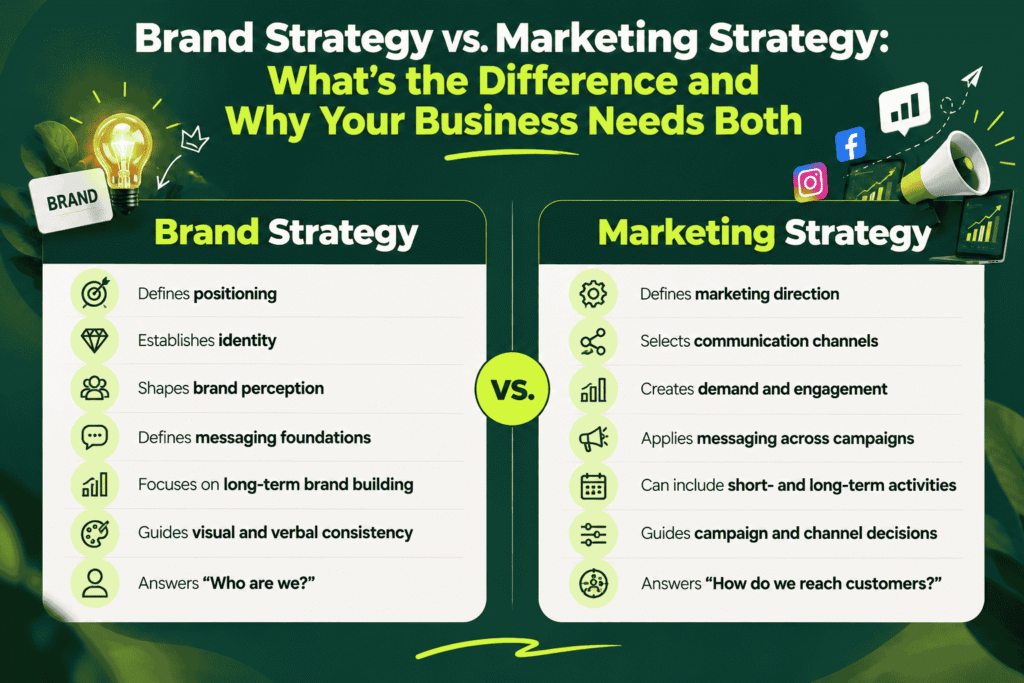
Brand strategy defines who your business is and how you want to be perceived. Marketing strategy determines how you communicate that value and reach the people who matter.
Here’s a practical comparison:
Why Brand Strategy Comes Before Many Marketing Decisions
Imagine a company selling premium products. Its website looks premium. Its packaging looks premium. But its advertising focuses almost entirely on discount offers. Its social media communicates a completely different personality. Its sales team uses another message. The individual activities may not be technically wrong. The problem is inconsistency.
A brand strategy can establish the foundation that marketing activities should follow.
That might include:
Positioning → audience → value proposition → messaging → visual identity → communication principles
Marketing can then translate that foundation into:
SEO → content → PPC → social media → website → campaigns
This doesn’t mean every business must complete a large branding exercise before doing any marketing.
It means important marketing decisions should be connected to a clear understanding of the business and its audience.
What Are the Main Elements of Brand Strategy?
A practical brand strategy can involve several interconnected areas.
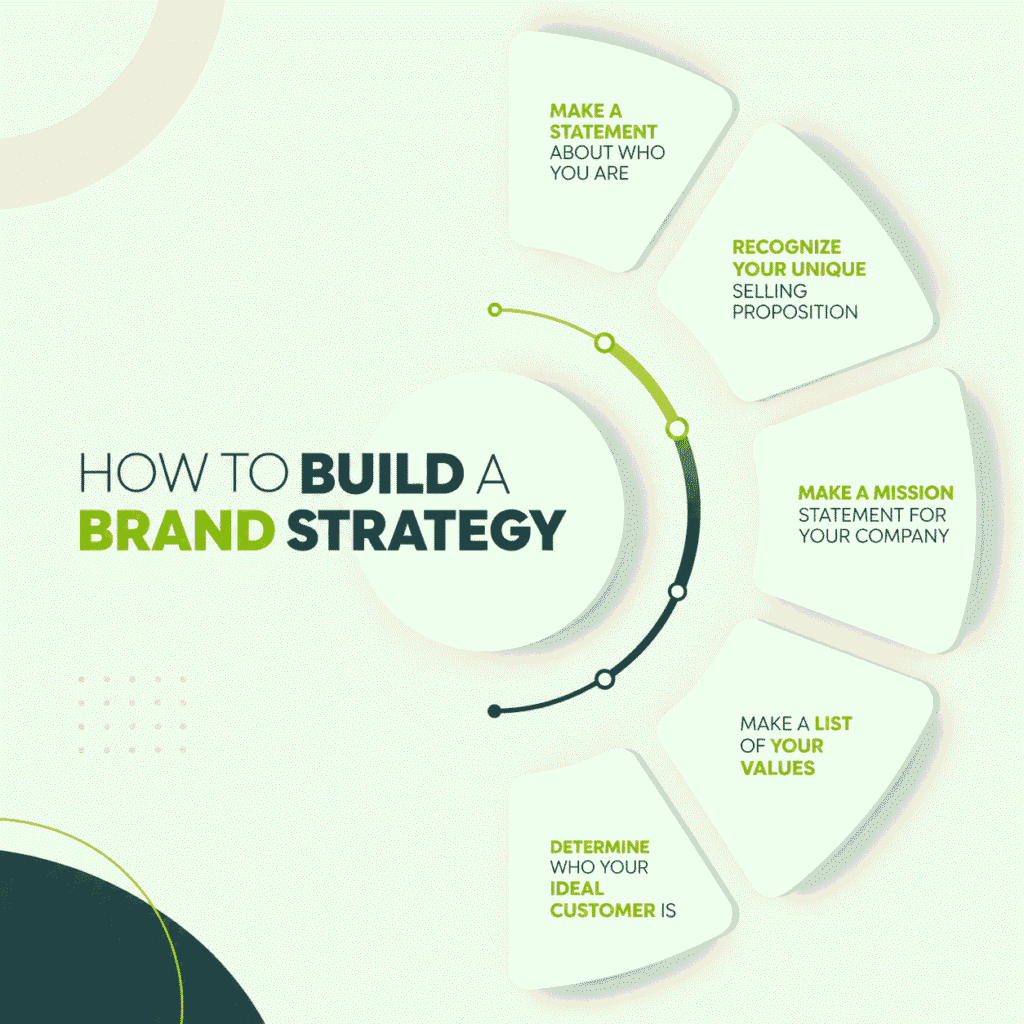
1. Brand Positioning
Positioning defines the space a brand wants to occupy in the customer’s mind and how it differentiates itself from alternatives.
Questions include:
- Who is the ideal customer?
- What does the customer value?
- What alternatives are available?
- What makes this business meaningfully different?
- What should the brand be known for?
Without positioning, marketing messages can become generic.
2. Brand Identity
Brand identity is how the brand expresses itself visually and verbally.
This can include:
- Logo
- Colour system
- Typography
- Imagery
- Visual language
- Brand voice
- Messaging style
But identity should follow strategy.
A visual system should represent the brand rather than simply look attractive.
3. Brand Messaging
Messaging gives the business a consistent way to communicate its value.
It can help determine:
- What the business says
- How it says it
- What benefits it emphasizes
- Which ideas should be repeated
- How different audiences should be addressed
Good messaging can make marketing campaigns easier to develop because the business has already established its core communication principles.
4. Brand Guidelines
Brand guidelines create consistency.
They can document elements such as:
- Logo usage
- Colours
- Typography
- Imagery
- Tone of voice
- Messaging
- Visual applications
Brandagic specifically includes brand guidelines within its Brand Consulting offering.
What Are the Main Elements of Marketing Strategy?
Marketing strategy is broader than simply posting on social media or running advertisements.
1. Audience and Market Research
Before choosing channels, understand:
- Who buys from you?
- What problem are they solving?
- What triggers their search?
- What alternatives do they consider?
- Where do they look for information?
- What prevents them from buying?
These questions help determine where marketing resources should go.
2. Channel Selection
Different channels serve different purposes.
For example:
Channel | Potential role |
SEO | Capture relevant organic searches |
PPC | Reach people through paid search |
Social media | Build visibility and engagement |
Website | Explain, educate and convert |
Content | Answer customer questions and build trust |
Shopify | Support ecommerce selling |
Local SEO | Improve visibility for location-based searches |
The right mix depends on the business.
SEO, PPC and Social Media Are Not the Strategy
This is an important distinction. SEO is a channel. PPC is a channel. Social media is a channel. A strategy explains why, where, when and how those channels should be used.
For example, a business searching for a digital marketing agency in Mohali may immediately think it needs SEO and Google Ads.
But the first question should be:
What business outcome are we trying to create?
If the business has poor positioning, unclear messaging and a weak website, simply increasing traffic may not solve the underlying problem.
This is why strategy should connect the individual activities.
How Brand Strategy and Marketing Strategy Work Together
Consider a hypothetical ecommerce business.
Its brand strategy establishes:
Audience: people looking for thoughtfully designed products. Positioning: a distinctive, quality-focused product experience. Messaging: emphasis on design, quality and product experience. The marketing strategy can then translate those ideas into:
- Search content
- Product pages
- Shopify experience
- Social media content
- Paid campaigns
- Email communication
- Promotional campaigns
The brand provides the direction.
Marketing provides the distribution and customer acquisition framework.
Brand Strategy vs Marketing Strategy: Which One Does Your Business Need?
The answer depends on where your business currently stands.
You may need stronger brand strategy if:
- Customers don’t understand what makes you different.
- Your messaging changes from platform to platform.
- Your visual identity isn’t consistent.
- You’re entering a new market.
- You’re launching a new business.
- Your current positioning no longer reflects the business.
- Your team struggles to communicate the brand consistently.
You may need stronger marketing strategy if:
- You have a clear offer but aren’t reaching enough potential customers.
- Your marketing activities are disconnected.
- You are spending across multiple channels without clear priorities.
- You don’t know which channels deserve more attention.
- Your campaigns don’t have clearly defined objectives.
- You need a more structured customer acquisition approach.
You may need both if:
Your brand is unclear and your marketing activities lack direction.
That is common when businesses grow quickly and marketing develops channel by channel without an overarching plan.
What About SEO, PPC and Social Media Agencies?
This is where choosing a marketing partner becomes important. A business searching for an SEO agency in Mohali may be primarily focused on organic search. Another business may be looking for a PPC company in Mohali because it wants to build a paid acquisition program.
Someone else may search for social media marketing services in Mohali. These are legitimate requirements, but businesses should still consider the broader context.
Ask:
What role should this channel play in our overall marketing strategy?
For example:
SEO
Can help capture people actively searching for relevant information, products or services.
PPC
Can provide paid visibility for selected searches and audiences.
Social media
Can support communication, awareness, engagement and content distribution.
Website
Can provide the destination where people learn more, evaluate the offer and take action. The channels should support the business strategy rather than exist as disconnected activities.
How Local Businesses in Mohali and Chandigarh Should Think About Marketing
Local intent changes how customers search.
Someone looking for an agency may search for:
- digital marketing agency in Mohali
- digital marketing agency in Chandigarh
- SEO agency in Mohali
- SEO agency in Chandigarh
- PPC company in Mohali
- PPC companies in Chandigarh
- web development companies in Mohali
- web designing company Mohali
These searches tell you something important: The customer isn’t only searching for a service. They are often searching for a service provider within a specific market.
For businesses serving Mohali, Chandigarh and the wider Tricity, local positioning can therefore become part of the broader marketing strategy. But local SEO should not be reduced to repeating city names across a website.
Useful local content should provide genuine information relevant to the people and businesses being served. Current search results also show substantial competition among businesses targeting marketing and SEO searches in Mohali, including dedicated agency listings and comparison pages. That makes clear positioning and useful content more important than simply repeating a location keyword.
What Should Come First: Branding or Marketing?
There isn’t one universal sequence for every business. A new company may need to establish its positioning before launching significant campaigns.
An established company with strong brand recognition may already have that foundation and need to focus more heavily on marketing execution.
A useful framework is:
If your brand is unclear:
Start with positioning and brand clarity.
If your brand is clear but visibility is weak:
Develop the marketing strategy.
If both are clear but execution is inconsistent:
Improve implementation and measurement.
If you’re launching an ecommerce business:
Connect brand strategy, Shopify experience and marketing from the beginning.
The important thing is to avoid treating branding and marketing as unrelated departments.
How Brandagic Approaches Brand Building
Brandagic’s current positioning is built around strategy, systems and storytelling, with the stated aim of helping founders build brands and businesses with clarity, creativity and confidence. Its core service structure includes Brand Strategy, Marketing Strategy and Shopify.
Its Brand Consulting process includes:
- Brand Discovery
- Strategy Blueprint
- Visual Identity Design
- Implementation & Support
The process begins by understanding the business, audience, competition and market before developing the strategic direction.
For businesses that need an ecommerce presence, Brandagic’s Shopify offering covers strategic planning, experience-led design, custom development and integrations, product architecture, launch and ongoing support.
When Should You Work With a Brand or Marketing Consultant?
need additional strategic direction.
You might consider consulting support when:
- You’re preparing to launch a brand.
- Your positioning isn’t clear.
- You’re entering a new market.
- Your marketing channels aren’t aligned.
- Your ecommerce experience needs strategic planning.
- You need an outside perspective on your current brand.
- You want a structured roadmap before investing in execution.
Brandagic offers Brand Consulting and Marketing Consulting as part of its current service structure.
Marketing Consulting
Common Mistakes Businesses Make
Mistake 1: Starting With the Channel
“Let’s run Instagram.”
“Let’s start Google Ads.”
“Let’s do SEO.”
These are channel decisions, not necessarily strategic decisions.
Start with the business objective first.
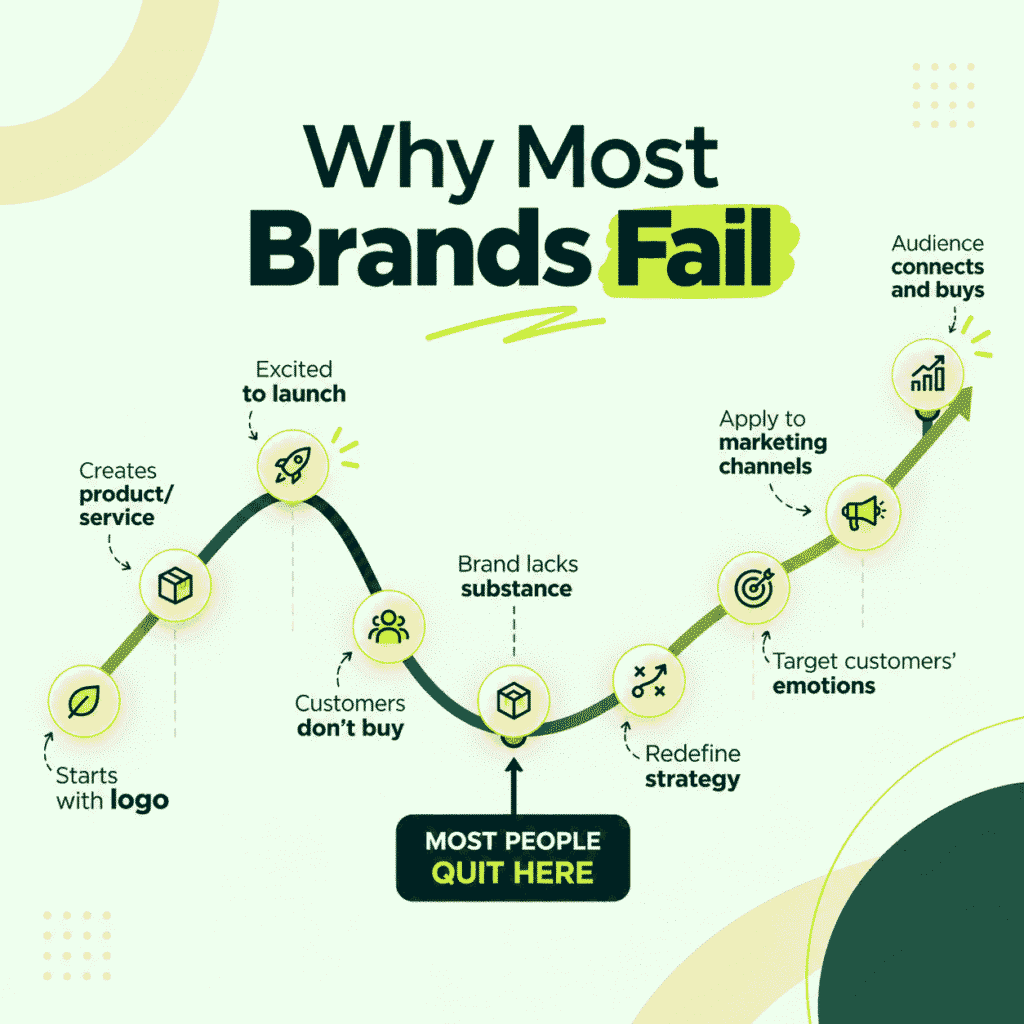
Mistake 2: Treating a Logo as the Brand
A logo is an important brand asset, but it isn’t the complete brand strategy. Positioning, messaging, identity, customer experience and consistency all contribute to how a brand is experienced.
Mistake 3: Running Marketing Without Clear Positioning
If the business cannot clearly explain:
Who we serve + what we offer + why we’re different
then advertising and content can become difficult to make consistent.
Mistake 4: Measuring Everything Through Traffic
Traffic matters, but it isn’t always the final business outcome.
Depending on the business, you may also need to consider:
- Qualified leads
- Sales
- Conversion rate
- Customer acquisition
- Ecommerce transactions
- Search visibility
- Brand-related indicators
The right measurement depends on the objective.
A Simple Framework for Connecting Brand and Marketing
Use this five-step framework:
1. Define the business
What does the company actually want to achieve?
2. Define the audience
Who matters most to the business?
3. Define the position
Why should that audience choose this business?
4. Define the marketing strategy
Which channels can reach and influence that audience?
5. Define measurement
What evidence will show whether the strategy is working? This framework is simple enough for a startup and useful enough for an established business.
Final Thoughts
Brand strategy and marketing strategy are different, but they are much more effective when they work together.
Brand strategy establishes the foundation.
Marketing strategy determines how that foundation reaches the market.
SEO, PPC, social media, websites and Shopify can then become practical tools within that larger framework.
For businesses in Mohali, Chandigarh and the wider Tricity, this distinction is particularly useful when evaluating agencies. Instead of choosing a provider simply because it describes itself as a digital marketing company in Mohali, look at the underlying strategy, services, process and business fit.
Brandagic approaches brand building through strategy, systems and storytelling, with current services including Brand Strategy, Marketing Strategy, Brand Consulting, Marketing Consulting and Shopify.
If your business needs greater clarity around its brand or marketing direction, you can explore Brandagic’s approach or schedule a consultation.
Frequently Asked Questions
Is brand strategy the same as marketing strategy?
No. Brand strategy focuses on the business’s positioning, identity, messaging and long-term brand direction. Marketing strategy focuses on how the business reaches and communicates with its audience through appropriate marketing activities.
Which is more important: branding or marketing?
They serve different purposes. A strong brand provides a foundation for communication, while marketing helps distribute that message and create demand. The appropriate balance depends on the business’s stage, objectives and existing brand position.
Does every business need a brand strategy?
Not every business needs the same level of formal brand strategy work. However, businesses benefit from having clarity around their positioning, audience, messaging and identity, particularly when they are launching, repositioning or growing.
What does a digital marketing agency in Mohali do?
A digital marketing agency may provide services such as SEO, PPC, social media, content, websites and other online marketing activities. The exact service mix varies between agencies, so businesses should evaluate providers based on their actual capabilities and objectives.
Should SEO and PPC be used together?
They can be. SEO focuses on organic search visibility, while PPC provides paid visibility. Whether they should be used together depends on the business’s goals, audience, budget and search opportunity.
How can a business choose between an SEO agency in Mohali and a broader marketing agency?
Start with the problem you need to solve. If organic search is the primary requirement, an SEO-focused partner may be appropriate. If you need broader strategic direction across brand, marketing and multiple channels, a broader marketing or consulting partner may be more suitable.
Is Shopify part of marketing strategy?
Shopify is primarily an ecommerce platform and development environment, but the store experience can be an important part of a broader marketing strategy. Product architecture, user experience, messaging and conversion paths all influence how marketing traffic interacts with the store.