
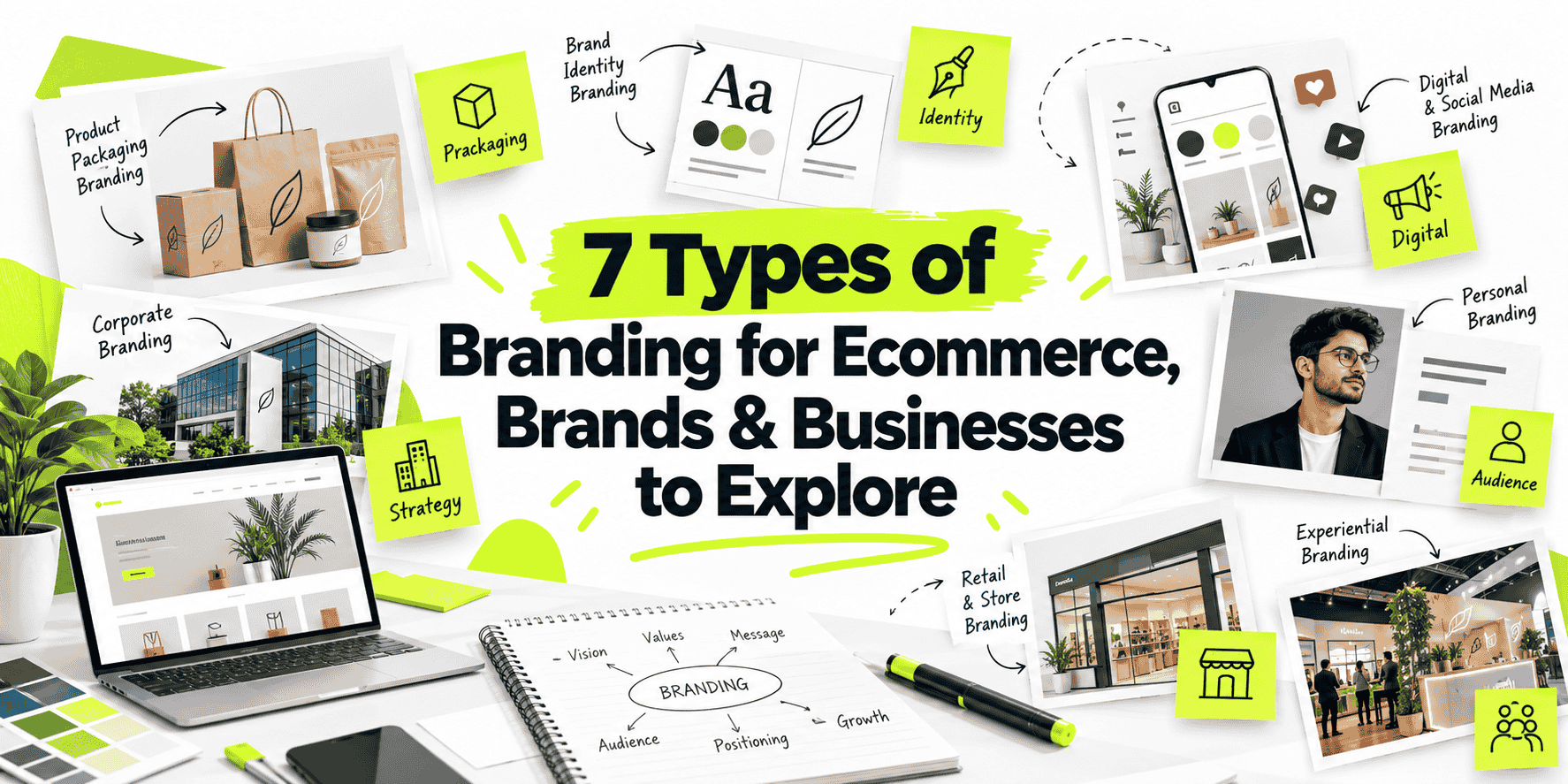
Branding is much more than creating a logo.
For an ecommerce company, branding can influence how customers experience a website, product, packaging, social media profile and every interaction that happens after a purchase.
For a service business, branding may be communicated through its positioning, messaging, visual identity, customer experience and the way its expertise is presented.
And for a founder-led startup, the founder’s own reputation can become an important part of the brand.
That is why there isn’t one single approach to branding.
Different businesses may use different types of branding depending on what they sell, who they serve, how they compete and where they want to grow.
Shopify describes branding as the process of creating a distinct identity for a business and identifies several approaches, including company, product, service, ingredient, personal, collaborative branding and rebranding.
In this guide, we’ll explore seven types of branding, how they work, when businesses should consider them, and how they can contribute to long-term brand growth in Mohali, Chandigarh and beyond.
“When your brand speaks with purpose, your audience listens with interest.”
What Is Branding?
Branding is the process of creating and managing the identity and perception of a business, product or service. It includes much more than visual design.
A brand can be expressed through:
- Brand positioning
- Visual identity
- Logo
- Colors
- Typography
- Messaging
- Tone of voice
- Product design
- Packaging
- Website experience
- Social media
- Customer experience
- Brand story
- Value proposition
Shopify similarly identifies visual identity, messaging, mission, value proposition and brand story as important components of a brand identity.
Think about the difference between these two statements:
“We sell skincare products.”
and
“We create skincare products for people looking for a simpler, more intentional approach to their daily routine.” The product category may be similar. The brand meaning is different. That distinction is what makes branding strategically important.
“A clear message turns attention into trust and trust into loyalty.”
Why Does Branding Matter for Businesses?
A strong brand can help a business communicate what makes it different and create consistency across customer touchpoints.
This matters whether you’re:
- Launching a startup
- Building an ecommerce store
- Growing a local business
- Expanding into new markets
- Launching a new product
- Repositioning an existing company
- Building a founder-led brand
For a growing business in Mohali, for example, branding should not stop at creating a logo.
Your website, social media, advertisements, packaging, sales material and customer experience should communicate a recognizable direction.
This is particularly important when customers encounter your business through multiple channels.
Search → Website → Social Media → Product → Customer Experience
Each interaction contributes to how the brand is perceived.
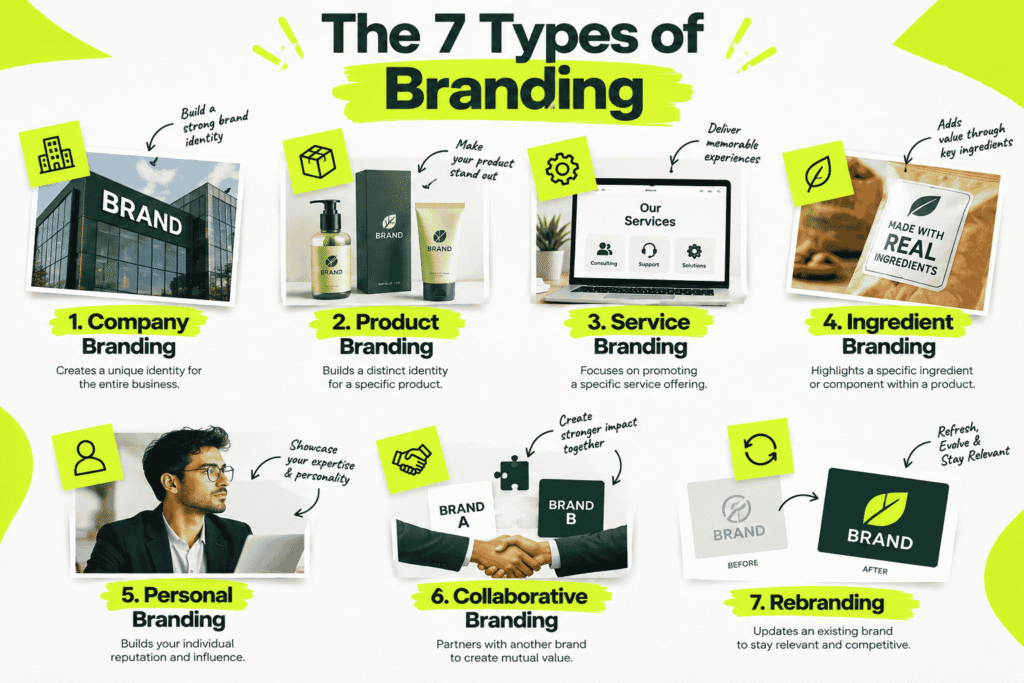
The 7 Types of Branding
The seven approaches covered in this guide are:
- Company Branding
- Product Branding
- Service Branding
- Ingredient Branding
- Personal Branding
- Collaborative Branding
- Rebranding
A business doesn’t necessarily need to choose only one.
Different approaches can work together depending on the business model.
1. Company Branding
Company branding, sometimes called corporate branding, focuses on building a recognizable identity for the business as a whole.
Instead of branding one particular product, the company becomes the central brand.
This can include:
- Company name
- Logo
- Brand colors
- Typography
- Brand voice
- Mission
- Values
- Website
- Social media presence
- Customer communication
- Internal brand culture
The objective is to create consistency across the company’s different touchpoints.
When Is Company Branding Useful?
Company branding can be particularly useful for:
- B2B businesses
- Professional services
- Agencies
- Startups
- Companies with multiple products
- Businesses planning long-term expansion
For example, a growing technology company may offer several products over time.
Instead of building an entirely separate identity for every product, it can establish a strong parent brand that provides credibility and consistency.
For businesses in Mohali
A company targeting customers in Mohali and Chandigarh may encounter prospects through Google Search, social media, referrals and its website.
A consistent company brand helps those different interactions feel connected.
This is one reason brand strategy in Mohali should consider the complete customer journey rather than focusing only on visual design.
2. Product Branding
Product branding gives an individual product or product line its own recognizable identity.
This can involve:
- Product name
- Packaging
- Product colors
- Product photography
- Product messaging
- Product-page experience
- Campaign creative
- Product story
Product branding is particularly relevant for ecommerce.
Imagine an ecommerce business selling several product categories.
The overall company may have one identity, while an individual product line has a distinct personality.
The product can therefore become recognizable while still remaining connected to the parent company.
Shopify describes product branding as giving a specific product or service its own identity through elements such as design, packaging and product-page copy.
3. Service Branding
Not every business sells a physical product.
Service businesses also need a strong brand.
Service branding focuses on how a service is presented and experienced.
This can include:
- Service positioning
- Messaging
- Visual identity
- Website experience
- Communication style
- Sales process
- Customer experience
- Consistency of delivery
For example, two companies may offer similar consulting services.
One might position itself around speed and efficiency.
Another might focus on strategic guidance and long-term partnership.
The actual service category may overlap, but the brand experience can be completely different.
This is especially relevant for:
- Consultants
- Agencies
- Professional firms
- Healthcare businesses
- Education companies
- Technology services
- Creative businesses
For a service business looking for brand consulting in Mohali, the goal should therefore be more than making the company look attractive.
The brand should make its positioning easier to understand.
4. Ingredient Branding
Ingredient branding focuses attention on a specific component, material, technology or ingredient that contributes meaningful value to the final product.
Instead of only saying:
“Our product is better.”
the brand explains:
“This particular component is an important reason why our product is different.”
This approach can work particularly well when the ingredient or component has a meaningful advantage.
Examples could include:
- A distinctive material
- A specific food ingredient
- Proprietary technology
- A specialized manufacturing process
- A sustainability-related component
The important point is that the ingredient must have a genuine role in the product’s value proposition.
Ingredient branding should not become a substitute for the broader brand story.
Shopify notes that ingredient branding can communicate a product’s unique value through a standout component, while also cautioning against relying on the same ingredient message so heavily that the overall brand becomes repetitive.
5. Personal Branding
Personal branding puts an individual at the center of the brand.
It can be particularly powerful for:
- Founders
- Consultants
- Coaches
- Creators
- Influencers
- Entrepreneurs
- Experts
- Public-facing professionals
For some businesses, customers are strongly influenced by the person behind the company.
A founder may become the person who communicates:
- Expertise
- Vision
- Experience
- Opinions
- Industry knowledge
- Brand story
Social media can make this especially relevant.
A founder might use LinkedIn, Instagram or YouTube to share insights, behind-the-scenes content and their perspective on the industry.
Over time, the founder’s reputation can become closely connected with the business.
Personal Brand + Company Brand
These two approaches don’t have to compete.
A founder can build personal authority while the company develops its own independent identity.
This can be particularly useful for startups where the founder is an important part of the initial trust-building process.
6. Collaborative Branding
Collaborative branding happens when two or more brands work together to create a shared campaign, product, experience or initiative.
It can take different forms:
- Co-branded products
- Joint campaigns
- Strategic partnerships
- Brand collaborations
- Limited-edition launches
- Creator partnerships
The value comes from combining complementary audiences, capabilities or brand associations.
However, a collaboration should make strategic sense.
Before partnering, ask:
- Do the audiences overlap?
- Are the brands compatible?
- Is there a clear reason for customers to care?
- Does the collaboration strengthen both brands?
- Is the messaging clear?
A collaboration that feels random can create confusion.
A collaboration with a clear strategic connection can create a stronger story.
7. Rebranding
Rebranding involves changing or evolving aspects of an existing brand.
This can range from a visual refresh to a much deeper strategic repositioning.
A rebrand may involve:
- New positioning
- New messaging
- New visual identity
- Updated logo
- New color system
- New typography
- Website redesign
- New packaging
- Updated brand guidelines
- New brand story
But rebranding should not automatically mean changing everything.
Sometimes a business has a strong foundation but needs its positioning or visual system to evolve.
Other times, a business has changed significantly and its existing identity no longer represents what it has become.
When Should a Business Consider Rebranding?
Consider asking:
Has the target audience changed?
Has the business expanded?
Has the product or service changed?
Does the current identity feel outdated?
Is the positioning unclear?
Does the website communicate the current business accurately?
Does the brand look inconsistent across channels?
These questions can help determine whether the business needs a refresh or a more fundamental strategic change.
Branding for Ecommerce: Which Type Should You Use?
Ecommerce brands often combine several types of branding.
For example:
Company Branding
Creates the overall business identity.
↓
Product Branding
Creates identity around specific products.
↓
Website Branding
Expresses the brand through the ecommerce experience.
↓
Social Branding
Keeps communication consistent across social channels.
↓
Personal Branding
Can connect customers with the founder.
↓
Collaborative Branding
Can introduce the brand to new audiences.
This makes branding for ecommerce more comprehensive than designing a logo and choosing colors.
Shopify’s guidance on ecommerce branding similarly emphasizes consistent identity across websites, packaging, social channels and customer-facing communication.
Branding for Ecommerce Websites
Your ecommerce website is one of the most important places where customers experience your brand.
It should communicate:
- Who you are
- What you sell
- Why your products matter
- Who they are for
- What makes them different
- What customers should do next
Important website-branding elements include:
Typography
Your fonts influence how the website feels and how information is consumed.
Color Palette
Colors can create visual consistency across pages, packaging and marketing.
Visual Assets
Photography, illustrations, graphics and product imagery should support the brand.
Layout
Your page structure influences how customers navigate and perceive the business.
Site Structure
Navigation should make it easy to discover products and information.
Written Content
Your product descriptions, headlines, CTAs and brand story should sound like the same brand. Shopify identifies typography, color palette, visual assets, layout, site structure and written content as key website-branding elements for online stores. For businesses building on Shopify, these decisions should also work alongside the store’s product architecture and customer journey.
Branding for Startups
Startups often face a common problem:
They want to look established before they have a fully developed brand system.
The solution isn’t necessarily more design.
It is clarity.
A startup should first understand:
1. Who is the customer?
Be specific.
2. What problem does the business solve?
The brand should make this understandable.
3. What makes the business different?
Identify the meaningful point of difference.
4. What should customers associate with the brand?
Define the intended perception.
5. How should the brand communicate?
Create a consistent voice and messaging direction.
Once these are clear, visual identity becomes much easier to develop.
Branding for Established Businesses
Established businesses have a different challenge.
They may already have:
- Existing customers
- Multiple products
- A recognizable name
- Multiple marketing channels
- Years of brand history
The challenge may therefore be consistency and evolution.
A growing business might ask:
Does our current brand still represent where we are going? This is where brand strategy can help determine whether the company needs:
- A brand refresh
- Repositioning
- New messaging
- Updated visual identity
- Better brand guidelines
- A website redesign
- Stronger customer experience
Branding and Digital Marketing Should Work Together
Branding and marketing are closely connected, but they aren’t the same thing.
Branding answers:
Who are we?
What do we stand for?
How should customers perceive us?
Marketing answers:
How do we reach customers?
Which channels should we use?
What message should we communicate?
How do we generate demand?
A business may use:
- SEO
- PPC
- Social media
- Content
- Influencer marketing
But these activities become more consistent when they are built around a clear brand.
This is why businesses searching for best digital marketing services in Mohali should also consider whether their marketing strategy is aligned with their underlying brand positioning.
Branding + PPC
Paid advertising can bring people to your business.
But the advertisement is only one part of the experience.
Consider this journey:
Google Search
↓
PPC Advertisement
↓
Landing Page
↓
Brand Experience
↓
Enquiry/Purchase
If the advertisement communicates one positioning and the landing page communicates another, the experience can feel disconnected.
For businesses evaluating a best PPC company in Mohali, one useful question is therefore: How will the paid campaign reflect our brand positioning? PPC should not exist separately from the brand.
Branding + Social Media
Social media is often one of the most visible expressions of a brand.
Your:
- Instagram posts
- LinkedIn content
- Reels
- Stories
- Captions
- Visuals
- Comments
- Community interactions
all contribute to the customer experience.
A social media marketing agency in Mohali should therefore understand more than content calendars and posting frequency.
The social strategy should have a clear relationship with:
Brand identity → Brand voice → Content → Audience → Marketing objective
This is especially important for ecommerce brands where social media can be part of the discovery and consideration journey.
Branding + Performance Marketing
Performance campaigns focus on measurable actions.
Brand strategy focuses on differentiation, positioning and perception.
They can work together.
For example:
Brand Strategy
Defines the positioning.
↓
Marketing Strategy
Determines the customer and channel strategy.
↓
Performance Marketing
Delivers targeted campaigns.
↓
Landing Page
Expresses the brand and offer.
↓
Conversion
Generates the desired action.
↓
Data
Provides information for optimization.
This is a more complete approach than treating paid advertising as an isolated activity.
How Branding Supports Brand Growth in Mohali
For businesses competing in a local market, strong branding can help create consistency as the business becomes more visible.
A business in Mohali may appear through:
- Google Search
- Google Business Profile
- Website
- Local referrals
- Paid advertisements
- Packaging
- Offline interactions
If every channel looks and sounds different, customers may struggle to understand the brand.
A consistent brand system can make the business easier to recognize across these touchpoints. This is particularly relevant for businesses targeting Mohali, Chandigarh and the wider Tricity market. Local visibility can generate the first interaction. Brand consistency helps shape what happens after that interaction.
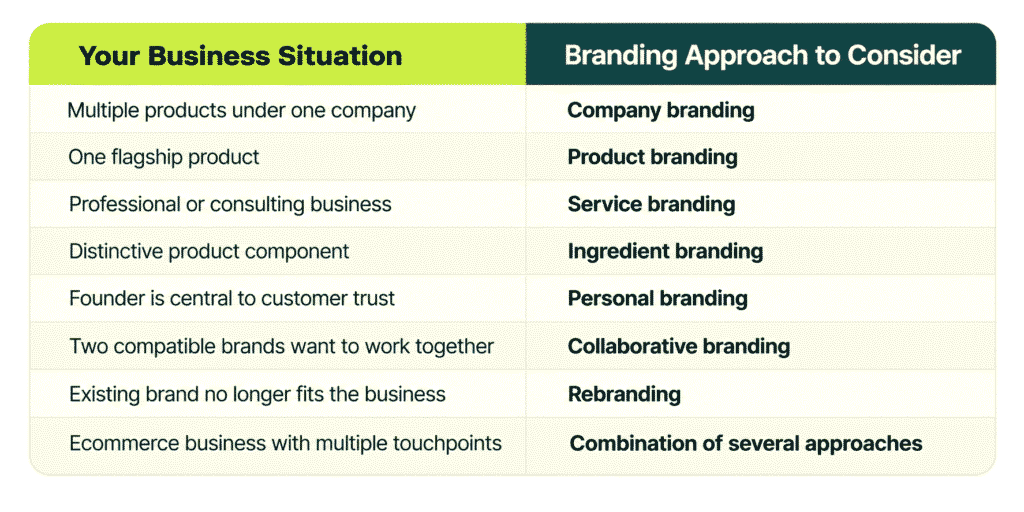
How to Choose the Right Branding Approach
Use this simple framework.
How to Build a Strong Brand Strategy
A practical branding process can start with:
Step 1: Understand the Business
Clarify:
- Business goals
- Products/services
- Market
- Business model
- Growth direction
Step 2: Understand the Audience
Identify:
- Target customers
- Needs
- Problems
- Expectations
- Buying motivations
Step 3: Define Positioning
Determine:
What should customers understand about this brand?
Step 4: Define the Brand Message
Create a consistent:
- Value proposition
- Messaging framework
- Voice
- Tone
Step 5: Build the Visual Identity
Develop:
- Logo
- Colors
- Typography
- Imagery
- Visual system
Step 6: Apply the Brand
Bring the identity into:
- Website
- Packaging
- Social media
- Advertising
- Sales materials
- Customer communication
Step 7: Document the System
Brand guidelines can help maintain consistency as the company grows.
This is closely aligned with Brandagic’s own brand-consulting process, which includes discovery, strategy development, visual identity and implementation/support.
Where Brandagic Fits Into Brand Building
Brandagic approaches brand building through strategy, systems and storytelling, with its website positioning its work around helping founders build brands and businesses grow with clarity, creativity and confidence.
Its Brand Consulting offering covers areas including:
- Brand positioning
- Brand identity development
- Brand pricing strategy
- Brand packaging design
- Brand guidelines
The process includes Brand Discovery, Strategy Blueprint, Visual Identity Design, and Implementation & Support.
For ecommerce businesses, Brandagic also provides Shopify Store Development, including strategic store planning, experience-led design, custom development and integrations, product architecture and launch support.
This creates an opportunity to think about branding and ecommerce experience together rather than treating the brand and store as separate projects.
A Branding Checklist for Businesses & Ecommerce Brands
Before finalizing your branding, ask:
Brand Strategy
- Is the target audience clearly defined?
- Is the business positioning clear?
- Is the value proposition easy to understand?
- Is the brand meaningfully different?
Brand Identity
- Is the logo appropriate?
- Are colors consistent?
- Is typography defined?
- Is imagery consistent?
- Is the brand voice documented?
Ecommerce
- Does the website reflect the brand?
- Are product pages consistent?
- Does packaging support the identity?
- Are product descriptions on-brand?
- Is the checkout experience consistent?
Marketing
- Does social media reflect the brand?
- Do PPC advertisements use consistent messaging?
- Does SEO content sound like the same brand?
- Are campaigns aligned with the positioning?
Growth
- Are brand guidelines documented?
- Is the brand scalable?
- Can new products fit into the system?
- Can the brand evolve without losing recognition?
Common Branding Mistakes to Avoid
Treating Branding as Only a Logo
A logo is an identity element, not the entire brand.
Copying Competitors
Your brand should communicate a meaningful reason to choose you.
Changing Visuals Constantly
Inconsistency can make recognition harder.
Ignoring Messaging
A beautiful visual identity cannot compensate for unclear positioning.
Designing Without Understanding the Customer
Brand decisions should be connected to the people you’re trying to reach.
Separating Branding From the Website
For digital businesses, the website is one of the most important brand touchpoints.
Running Marketing Without Brand Direction
PPC and social media can generate attention, but the messaging still needs to reflect the brand.
Rebranding Without a Strategic Reason
Changing a logo simply because it looks old may not solve the actual business problem.

Should a Business Use More Than One Type of Branding?
Yes. In fact, many successful businesses combine several approaches. For example, an ecommerce company might use:
Company Branding
for the overall business.
Product Branding
for individual product lines.
Personal Branding
for the founder.
Collaborative Branding
for partnerships.
Website Branding
to bring everything together online.
Shopify similarly notes that businesses can combine multiple types of branding depending on their business model and objectives.
The important thing is that the different layers should feel connected rather than competing with one another.
Final Takeaway
Branding is not a single design exercise.
It is a system for making a business recognizable, understandable and distinct. For ecommerce brands, branding can influence everything from the product and packaging to the website and social media experience. For service businesses, it can shape positioning, messaging and customer perception. For startups, it can provide clarity while the business establishes its place in the market. And for established businesses, it can help the brand evolve without losing its identity.
Whether you’re building an ecommerce business, launching a startup, growing a local company in Mohali or expanding into Chandigarh, the right branding approach should begin with the business—not with the logo.
Understand the business → understand the audience → define positioning → build the identity → apply it consistently → measure and evolve.
That’s how branding becomes a foundation for sustainable brand growth in Mohali, Chandigarh and beyond.
Frequently Asked Questions
1. What are the different types of branding?
The major types covered in this guide are company branding, product branding, service branding, ingredient branding, personal branding, collaborative branding and rebranding. The right combination depends on the business model and growth objectives.
2. What type of branding is best for an ecommerce business?
Ecommerce businesses commonly benefit from a combination of company branding, product branding and website branding. Personal or collaborative branding can also be useful depending on the business model and audience.
3. What is branding for ecommerce?
Branding for ecommerce is the process of creating a consistent identity and customer experience across an online store, products, packaging, social media, advertising and other customer touchpoints.
4. Is branding only about logo design?
No. A logo is only one part of a brand identity. Branding can include positioning, messaging, visual identity, value proposition, brand story, website experience, packaging and customer interactions.
5. How can branding help a business in Mohali?
A clear brand can help a business communicate its positioning consistently across its website, social media, advertising, packaging and customer interactions. This can be especially useful when targeting customers across Mohali, Chandigarh and the wider Tricity market.
6. Can branding and digital marketing work together?
Yes. Branding establishes positioning, identity and messaging, while digital marketing uses channels such as search, social media and paid advertising to reach audiences. Keeping both aligned creates a more consistent customer journey.
7. When should a business consider rebranding?
Consider rebranding when the existing identity no longer reflects the business, target audience, positioning, products or future direction. A strategic review should come before deciding whether a complete rebrand or a smaller refresh is necessary.
8. How do I choose a branding agency in Mohali?
Look for an agency that can explain its strategic process, understand your business and audience, define positioning, develop a cohesive identity and explain how the brand will be applied across relevant customer touchpoints. Don’t evaluate an agency only on logo design or visual portfolios.