
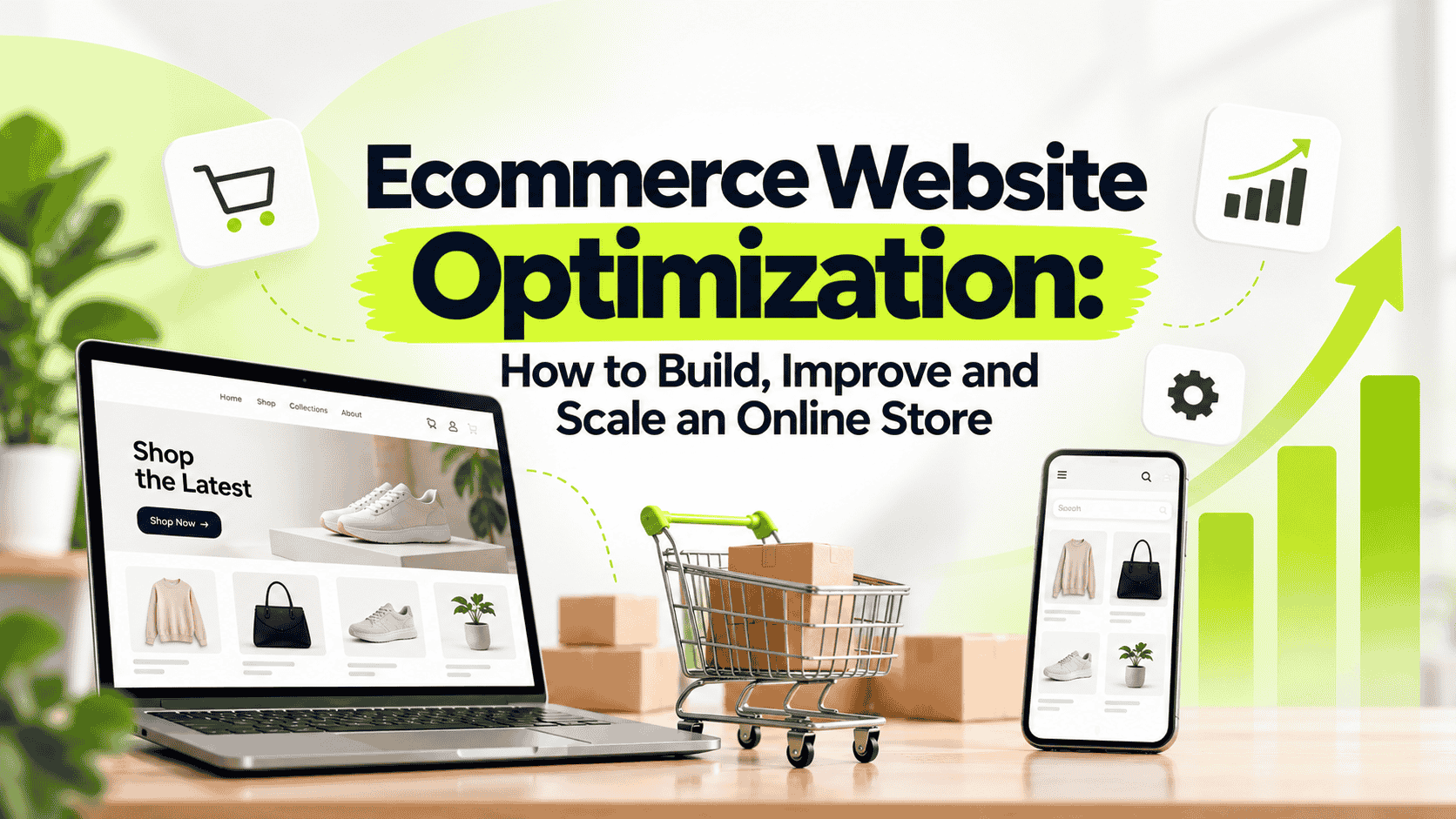
Launching an ecommerce website is only the beginning. Getting products online, choosing a theme, adding payment options, and publishing your store can help you start selling—but a successful ecommerce business requires much more than simply having a website.
Customers expect online stores to be fast, easy to navigate, mobile-friendly, trustworthy, visually clear, and simple to purchase from.
That means an ecommerce website needs to continuously evolve as the business grows.
This is where ecommerce website optimization becomes important.
Ecommerce website optimization is the process of improving different parts of an online store—from website structure and product pages to speed, navigation, checkout, search visibility, and customer experience—with the goal of making the store more useful for visitors and more effective for the business.
For businesses investing in website development in Mohali, ecommerce website design in Mohali, or Shopify development, optimization should not be treated as something that happens only after a website is launched. It should be considered from the beginning.

“A great ecommerce website doesn’t just attract visitors; it turns their experience into lasting customer relationships.”
What Is Ecommerce Website Optimization?
Ecommerce website optimization is the process of improving an online store so customers can discover products, understand their value, navigate the website, and complete purchases with less friction.
Optimization can involve:
- Website structure
- Navigation
- Product pages
- Website speed
- Mobile experience
- Search visibility
- Product images
- Content
- Calls to action
- Shopping cart
- Checkout
- Trust signals
- Analytics
- Conversion experience
The objective isn’t simply to make a website look better. It is to make the entire shopping experience work better.
A useful way to think about it is:
Discover → Explore → Evaluate → Add to Cart → Checkout → Purchase → Return
Every stage creates an opportunity to improve the customer experience.
“Successful ecommerce is not just about selling products; it’s about making every step of the customer journey effortless.”
Why Ecommerce Website Optimization Matters
A beautiful ecommerce website can still struggle if customers cannot quickly find what they need.
Similarly, a website can have strong traffic but poor sales if the product pages, checkout, or user experience create friction.
Optimization helps businesses identify these gaps.
A well-optimized ecommerce store should make it easy to:
- Find products
- Understand products
- Compare options
- Trust the business
- Add items to a cart
- Complete checkout
- Navigate on mobile
- Return for future purchases
This is particularly important as businesses scale. A small ecommerce store may begin with a handful of products. As the catalogue expands, traffic increases, campaigns become more sophisticated, and customer expectations grow, the website needs to keep up.
Build the Right Ecommerce Foundation First
Optimization becomes much easier when the website has a strong foundation. Before thinking about advanced marketing tactics, review the basics.
1. Define the Website’s Purpose
Start by identifying what the website needs to achieve.
For example:
- Sell products directly
- Generate qualified enquiries
- Build a new ecommerce brand
- Enter a new market
- Support an existing physical business
- Create a scalable online store
The objective affects the website’s structure, content, functionality, and marketing strategy.
2. Understand the Customer
Your website should be designed around the customer—not simply around what the business wants to say.
Understand:
- Who is buying?
- What are they looking for?
- What problem are they trying to solve?
- What questions do they have?
- What objections could stop them from purchasing?
- What information do they need before making a decision?
These answers should influence your navigation, product pages, content, offers, and calls to action.
3. Plan the Website Structure
A growing ecommerce website needs a logical structure.
For example:
Homepage → Collection → Product → Cart → Checkout
Depending on the business, you may also need:
Homepage → Category → Subcategory → Product
The structure should help customers reach relevant products without unnecessary clicks. A good ecommerce structure also makes it easier for search engines to understand the relationship between your pages.

10 Ways to Optimize an Ecommerce Website
1. Improve Website Speed
Website speed affects the shopping experience. When pages take too long to load, customers may become frustrated before they even see the product.
Shopify’s recent performance research found a relationship between storefront speed and conversion, reinforcing the importance of monitoring loading and interaction performance. Shopify recommends reviewing real-user performance data, keeping themes updated, auditing apps, and reviewing third-party integrations.
Common areas to review include:
- Large image files
- Unnecessary apps
- Excessive third-party scripts
- Heavy animations
- Unused code
- Outdated themes
- Poorly optimised media
- Complex page sections
Don’t optimize speed simply to achieve a technical score.
Optimize speed because customers expect the store to respond quickly.
2. Optimize the Store for Mobile
A large part of ecommerce browsing happens on mobile devices. Your website should therefore be designed around smaller screens from the beginning.
Check:
- Navigation
- Product images
- Font sizes
- Buttons
- Product descriptions
- Search
- Filters
- Cart
- Checkout
- Pop-ups
A customer should not have to pinch, zoom, or repeatedly scroll just to understand a product.
Mobile optimization checklist
Ask:
Can customers find a product quickly?
Can they read the important information?
Can they add the product to their cart easily?
Can they complete checkout without unnecessary friction?
If the answer is no, the mobile experience needs attention.
3. Improve Ecommerce Navigation
Navigation becomes increasingly important as your product catalogue grows. A customer shouldn’t have to explore multiple unrelated pages to find a product.
Use clear:
- Categories
- Subcategories
- Filters
- Search functionality
- Breadcrumbs where appropriate
- Collection pages
For example, instead of:
Products → All Products → Browse
a fashion ecommerce store might use:
Men → Clothing → Shirts → Casual Shirts
The exact structure depends on the business, but the principle remains the same:
Help customers find what they came for.
4. Build Better Product Pages
Your product page is one of the most important pages on an ecommerce website. It should answer the questions a customer is likely to have before purchasing.
A strong product page can include:
- Product name
- Clear product images
- Product description
- Key benefits
- Specifications
- Size or variant information
- Pricing
- Availability
- Shipping information
- Returns information
- Customer reviews
- FAQs
- Clear call to action
The product page should reduce uncertainty.
Instead of asking:
“What else does the customer need to know?”
Ask:
“What could prevent the customer from feeling confident enough to buy?”
Then improve the page accordingly.
5. Use Better Product Images and Content Ecommerce customers cannot physically touch the product before purchasing.
Your website therefore needs to communicate as much useful information as possible visually and through content.
Use images that show:
- Different angles
- Product details
- Scale
- Product in use
- Important features
- Packaging where relevant
Videos can also be useful when they demonstrate how a product works. But visual quality should not come at the expense of website performance. Large media files should be optimized appropriately.
6. Simplify the Checkout Experience
The checkout is where interest becomes a transaction. Every unnecessary step can introduce friction.
Review your checkout experience for:
- Unnecessary form fields
- Confusing instructions
- Unexpected costs
- Limited payment options
- Difficult navigation
- Poor mobile usability
- Missing trust information
- Error messages
- Slow interactions
Shopify’s guidance on checkout optimization emphasizes reducing friction, simplifying forms, using faster payment options where appropriate, and making important checkout information easy to understand.
The goal is simple:
Make it easy for customers to complete the purchase they have already decided to make.
7. Strengthen Search Visibility
Ecommerce website optimization isn’t only about conversion. Customers need to find your website in the first place. Search-friendly ecommerce websites should pay attention to:
- Page titles
- Meta descriptions
- Product names
- Product descriptions
- Category content
- Internal links
- Image alt text
- URL structure
- Search intent
- Structured data where appropriate
For example, a product page shouldn’t rely only on a product code that customers don’t search for. Use language that accurately describes what the product is and how customers may search for it. SEO should be integrated into the website rather than added as an afterthought.
8. Build a Consistent Brand Experience
An ecommerce store is not simply a catalogue.
It is also a brand experience.
Your:
- Colours
- Typography
- Photography
- Product presentation
- Tone of voice
- Packaging
- Website design
- Social media presence
should work together.
This is particularly important for businesses investing in ecommerce website design in Mohali.
A professionally designed website should not only look attractive.
It should communicate:
Who are we?
What do we offer?
Why should customers trust us?
Why should they choose us instead of another option?
This is where branding and ecommerce website optimization overlap.
9. Use Analytics to Understand Customer Behaviour
You cannot optimize what you don’t understand.
Analytics can help you identify:
- Which pages receive traffic
- Where customers enter the website
- Which products receive attention
- Where visitors leave
- Which channels generate traffic
- Which pages lead to conversions
- Where the customer journey becomes difficult
The objective isn’t to collect data simply because it is available.
Use data to answer specific business questions.
For example:
Question: Why are many visitors reaching a product page but not purchasing?
Potential areas to investigate:
- Pricing
- Product information
- Reviews
- Shipping
- Trust
- Page speed
- Product images
- Offer
- Checkout experience
Data should lead to better decisions.
10. Test, Learn and Improve
Ecommerce optimization is not a one-time project. Customer behaviour changes. Products change. Competitors change. Marketing channels change. Your business grows. That means your website should also evolve.
Test improvements such as:
- Product page layouts
- Headlines
- Calls to action
- Product images
- Offers
- Navigation
- Landing pages
- Content
- Checkout experience
The goal isn’t to change everything at once. Make focused changes and measure the outcome.
Shopify Store Optimization: What Should You Review?
For businesses using Shopify, Shopify Store optimization should cover more than simply changing the theme.
Review the complete store.
Theme
Is the theme appropriate for your brand and product catalogue?
Apps
Are all installed apps still necessary?
Third-party apps can introduce additional scripts and functionality, so Shopify recommends regularly auditing apps and integrations when investigating performance.
Product structure
Can customers easily browse and discover products?
Collections
Are products grouped logically?
Product pages
Do they provide enough information to support a purchase decision?
Speed
Does the store perform well across devices?
Checkout
Is the purchase process straightforward?
Analytics
Can you identify important customer behaviour?
Optimization should consider all of these areas together.
Ecommerce Store Optimization vs Ecommerce Website Optimization
The terms are often used interchangeably, but they can be useful in slightly different ways.
Ecommerce website optimization
Usually refers to improving the overall website experience, including:
- SEO
- Speed
- Navigation
- Content
- Product pages
- Mobile experience
- User experience
Ecommerce store optimization
Can be used more broadly to describe improving the entire online store, including:
- Products
- Collections
- Storefront
- Apps
- Checkout
- Marketing
- Conversion
- Customer experience
In practice, successful ecommerce growth requires both.
How to Improve an Ecommerce Website Before Spending More on Ads
This is an important question for growing brands.
Imagine you are investing heavily in:
- PPC
- Social media advertising
- Influencer campaigns
- Search marketing
- Content
but your website isn’t converting visitors effectively.
Increasing the advertising budget may simply send more people into the same weak customer experience.
Before increasing acquisition spending, review:
Website
Is the website easy to use?
Product pages
Do customers have enough information?
Offer
Is the value proposition clear?
Trust
Does the website provide enough reassurance?
Checkout
Is the purchasing process simple?
Mobile
Does the experience work properly on smartphones?
Tracking
Can you measure the customer journey?
Optimization can therefore improve the foundation on which marketing operates.
Ecommerce Website Optimization and Digital Marketing
An ecommerce website doesn’t work independently from marketing. Marketing brings potential customers to the store. The website helps convert those visitors. This creates a relationship between:
Marketing → Traffic → Website Experience → Conversion
This is why businesses searching for best digital marketing services in Mohali, a digital marketing company in Mohali, or a digital marketing agency Mohali should consider the website as part of the overall marketing system.
For example:
PPC
Paid search can bring high-intent visitors to product or category pages.
Social media marketing
Social platforms can introduce products and generate website traffic.
SEO
Organic search can help customers discover products and categories.
Content marketing
Useful content can help customers understand problems and evaluate solutions.
Retargeting
Businesses can reconnect with visitors who have previously interacted with the website. But each channel ultimately leads somewhere. That destination needs to deliver the experience promised by the marketing.
Ecommerce Website Development in Mohali: What Businesses Should Look For
If you are planning website development in Mohali, choosing the right development partner is important. Don’t evaluate an ecommerce website only by its appearance.
Ask about:
Strategy
Will the website structure be planned around your customers and business objectives?
UX
How will customers move from product discovery to checkout?
Mobile
How will the website behave on mobile devices?
SEO
Will important technical and on-page SEO considerations be built into the website?
Performance
How will speed and third-party scripts be handled?
Scalability
Can the website support a growing product catalogue?
Integrations
Will the store need payment, shipping, analytics, CRM, marketing, or other integrations?
Ongoing optimization
Who will monitor and improve the website after launch?
These questions are more valuable than simply asking:
“How much does an ecommerce website cost?”
Shopify Website Development in Mohali
Shopify can be a practical option for businesses that want to build and manage an ecommerce store without managing the underlying hosting infrastructure themselves.
But the platform alone doesn’t create a successful ecommerce business.
Your Shopify website development in Mohali should consider:
- Store structure
- Brand identity
- Theme selection
- Custom design
- Product architecture
- Navigation
- Apps
- Integrations
- SEO
- Performance
- Checkout
- Analytics
- Growth requirements
The objective should be to build a store that supports the business—not simply to launch another Shopify website.
When Should You Work With a Shopify Development Company?
A growing ecommerce business may benefit from professional support when:
- The existing store needs a redesign.
- The website isn’t converting well.
- The store has become difficult to manage.
- You need custom functionality.
- You need third-party integrations.
- Your product catalogue is expanding.
- Your brand is being repositioned.
- Your existing theme limits the experience.
- Performance needs improvement.
- You are moving from another ecommerce platform.
When evaluating a Shopify development company Mohali, look beyond development alone.
Ask whether the team understands:
Brand + UX + Ecommerce + Marketing + Performance
These areas influence one another.
How to Choose a Website Design Company in Mohali
If you are comparing a website design company in Mohali, evaluate the provider based on the quality of thinking behind the website—not only the visual portfolio.
Ask these questions:
- How will you understand our target customer?
- How will the website structure be planned?
- How will the design support our brand?
- How will the website be optimized for mobile?
- How will ecommerce SEO be considered?
- How will website performance be handled?
- How will conversion tracking be implemented?
- What happens after the website launches?
- Can the website scale as the business grows?
- Can the website connect with our broader marketing strategy?
A strong ecommerce website should be designed for the business you want to build—not only the business you have today.
Social Media, PPC and Ecommerce Optimization
Your ecommerce website is only one part of customer acquisition. Social media can create awareness. PPC can capture intent. SEO can create organic discovery. Content can educate customers. But all of these channels can eventually send customers to your ecommerce store. That makes website optimization particularly important.
For example:
Social Media Post
↓
Product Discovery
↓
Product Page
↓
Add to Cart
↓
Checkout
↓
Purchase
If customers repeatedly leave at the product-page stage, the problem may not be social media. If customers add products to carts but don’t complete purchases, the checkout or offer may need investigation. If traffic is low, the acquisition strategy may require attention. Optimization helps identify where the problem actually exists.
Ecommerce Optimization for Businesses in Mohali and Chandigarh
Businesses in Mohali and Chandigarh operate across many categories, from emerging ecommerce brands and startups to established companies and local retailers.
That means ecommerce optimization should not follow a one-size-fits-all formula.
For a startup
The priority may be building a clear brand, validating the offer, and creating a simple customer journey.
For an established business
The priority may be improving the existing website, increasing conversion efficiency, and connecting marketing channels.
For an ecommerce brand
The focus may be product discovery, product-page experience, checkout, retention, and scalable acquisition.
For a local business moving online
The priority may be creating the right ecommerce foundation while connecting online and offline customer experiences. This is why businesses comparing a top ecommerce company in Mohali should first identify what they actually need.
Do you need:
- Ecommerce strategy?
- Shopify development?
- Website redesign?
- Store optimization?
- SEO?
- PPC?
- Brand strategy?
- Marketing strategy?
The right solution depends on the problem.
A Practical Ecommerce Website Optimization Checklist
Use this checklist to review your online store.
Website Foundation
- Is the website easy to navigate?
- Is the structure logical?
- Is the brand identity consistent?
- Does the website work well on mobile?
Product Pages
- Are product images clear?
- Are descriptions useful?
- Are specifications easy to find?
- Are customer questions answered?
- Are reviews visible where appropriate?
Performance
- Does the website load efficiently?
- Are unnecessary apps removed?
- Are third-party scripts reviewed?
- Are images optimized?
- Is performance monitored regularly?
SEO
- Are titles optimized?
- Are product descriptions useful?
- Are category pages structured properly?
- Are internal links relevant?
- Are images using appropriate alt text?
Conversion
- Are calls to action clear?
- Is pricing easy to understand?
- Are shipping and returns clear?
- Is checkout straightforward?
- Are trust signals visible?
Marketing
- Are PPC campaigns connected to relevant landing pages?
- Does social media lead to relevant products?
- Is SEO generating relevant traffic?
- Is conversion tracking properly configured?

Common Ecommerce Website Optimization Mistakes
Mistake 1: Designing Only for Appearance
A visually attractive website can still be difficult to use.
Design should support the customer journey.
Mistake 2: Adding Too Many Apps
Every additional app should have a clear business purpose.
Review apps regularly, especially when investigating performance.
Mistake 3: Ignoring Mobile Users
A desktop website that looks good isn’t enough.
Test the complete buying journey on mobile.
Mistake 4: Treating Product Pages as Simple Catalogues
Product pages need to answer customer questions and remove uncertainty.
Mistake 5: Making Checkout Complicated
The final stage of the journey should be as clear and friction-free as possible.
Mistake 6: Focusing Only on Traffic
More traffic doesn’t automatically mean more sales.
Look at what happens after visitors arrive.
Mistake 7: Never Testing
Your first website version shouldn’t be considered permanent.
Measure, learn, and improve.
How Brandagic Supports Ecommerce and Growth
Brandagic positions its work around building stronger brands through strategy, systems, storytelling, and business-focused growth. For ecommerce businesses, its Shopify offering includes strategic store planning, experience-led design, custom development and integrations, optimized product architecture, and launch and ongoing support. Its broader Brand Strategy and Marketing Strategy approach can also help businesses think about the relationship between brand positioning, customer experience, and marketing execution.
This is important because ecommerce optimization is rarely just a technical task.
A business may need to improve:
Brand → Website → Marketing → Customer Experience → Growth
For an ecommerce startup, that could mean building a strong foundation. For an established brand, it could mean improving an existing store. For a growing Shopify business, it could mean improving the store structure, customer experience, integrations, and conversion journey. The right approach depends on the business stage and its objectives.
Final Takeaway
An ecommerce website should never be considered “finished” simply because it has launched. Customer expectations change. Products change. Marketing channels change. Your business grows. And your website needs to grow with it.
Ecommerce website optimization is therefore an ongoing process of improving the customer journey—from the first interaction with your brand to product discovery, evaluation, checkout, purchase, and repeat engagement.
For businesses in Mohali and Chandigarh, the strongest ecommerce strategy isn’t simply about finding a website design company in Mohali, a Shopify development company Mohali, or a provider of digital marketing in Mohali.
It is about building a connected system.
Build the right foundation.
Create a better customer experience.
Optimize the store.
Connect marketing with the website.
Measure what matters.
Keep improving.
That is how an ecommerce website can move from simply being an online store to becoming a stronger engine for sustainable business growth.
Frequently Asked Questions
What is ecommerce website optimization?
Ecommerce website optimization is the process of improving an online store’s performance, usability, navigation, product pages, SEO, mobile experience, checkout, and conversion journey to create a better customer experience and support business goals.
How can I optimize my ecommerce website?
Start with the fundamentals: improve navigation, product pages, mobile usability, website speed, checkout, SEO, trust signals, analytics, and conversion paths. Then test improvements and measure their impact.
What is Shopify Store optimization?
Shopify Store optimization involves improving different aspects of a Shopify store, including its theme, navigation, product structure, apps, content, performance, mobile experience, SEO, and conversion journey.
Why is website speed important for ecommerce?
A faster website creates a smoother customer experience and can support better engagement and conversion. Shopify’s recent research found a relationship between storefront performance and conversion, and recommends monitoring real-user performance and reviewing themes, apps, and third-party integrations.
How important is mobile optimization for ecommerce?
Mobile optimization is essential because customers increasingly browse and shop through mobile devices. Ecommerce websites should make navigation, product discovery, product evaluation, cart, and checkout easy on smaller screens.
Is Shopify suitable for an ecommerce business?
Shopify can provide a strong ecommerce foundation for businesses that want hosted infrastructure, ecommerce functionality, customizable storefronts, and tools for selling online. However, the platform itself is only one part of a successful ecommerce strategy.
Should I hire a Shopify development company in Mohali?
If your business needs custom Shopify development, store redesign, integrations, performance improvements, or a more strategic ecommerce experience, working with an experienced Shopify development team can be useful. Evaluate providers based on strategy, UX, development, performance, scalability, and ongoing support.
How does digital marketing help an ecommerce website?
Digital marketing can help generate relevant traffic through channels such as SEO, PPC, social media, content, and retargeting. The website then needs to provide an experience that helps turn that traffic into meaningful actions.
What should I look for in a website design company in Mohali?
Look for a company that understands more than visual design. Evaluate its approach to UX, mobile design, SEO, website performance, conversion, ecommerce functionality, analytics, scalability, and ongoing optimization.
How often should an ecommerce website be optimized?
There is no single schedule that works for every business. Performance, analytics, customer behaviour, product changes, marketing campaigns, and business growth should all influence when and what you optimize. Ecommerce optimization should be treated as an ongoing process rather than a one-time task.