
Getting someone to make their first purchase is an important milestone for any ecommerce business.
But what happens after that purchase?
Does the customer come back?
Do they recommend the brand?
Do they remember the business when they need the product again?
Or do they simply purchase from another company the next time?
This is where loyalty marketing becomes important.
Loyalty marketing focuses on building stronger relationships with existing customers so they have meaningful reasons to continue choosing a brand. It can include loyalty programs, personalized communication, exclusive benefits, referrals, customer experiences, rewards and other retention strategies. For ecommerce brands, loyalty shouldn’t begin with a points system. It should begin with a better customer experience.
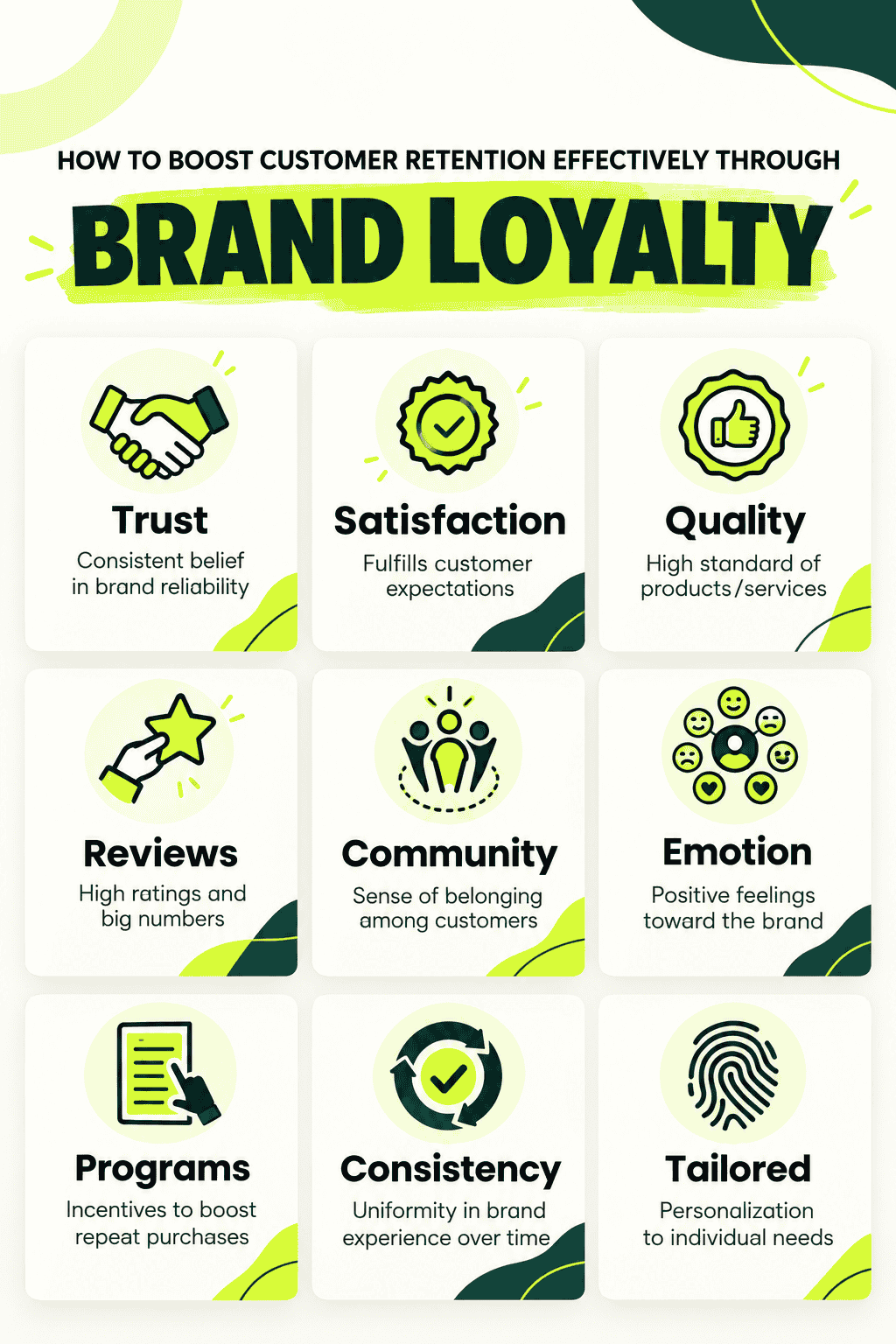
“Loyal customers aren’t just repeat buyers; they’re the foundation of long-term growth.”
What Is Loyalty Marketing?
Loyalty marketing is a strategy designed to encourage customers to continue engaging with and purchasing from a brand by providing ongoing value and building stronger customer relationships.
That value can come in many forms:
- Rewards
- Discounts
- Exclusive access
- Personalized recommendations
- Early product launches
- Referral benefits
- Better customer service
- Helpful content
- Memberships
- Subscriptions
- Recognition
- Community
A loyalty program is therefore only one part of loyalty marketing. A customer may become loyal because of the product, experience, service, brand identity or relationship—not simply because they receive points. Shopify’s current retention guidance makes a similar distinction: customer retention focuses on repeat purchasing, while loyalty involves a deeper relationship that can turn customers into advocates.

“Don’t just sell a product. Build a relationship that gives customers a reason to return.”
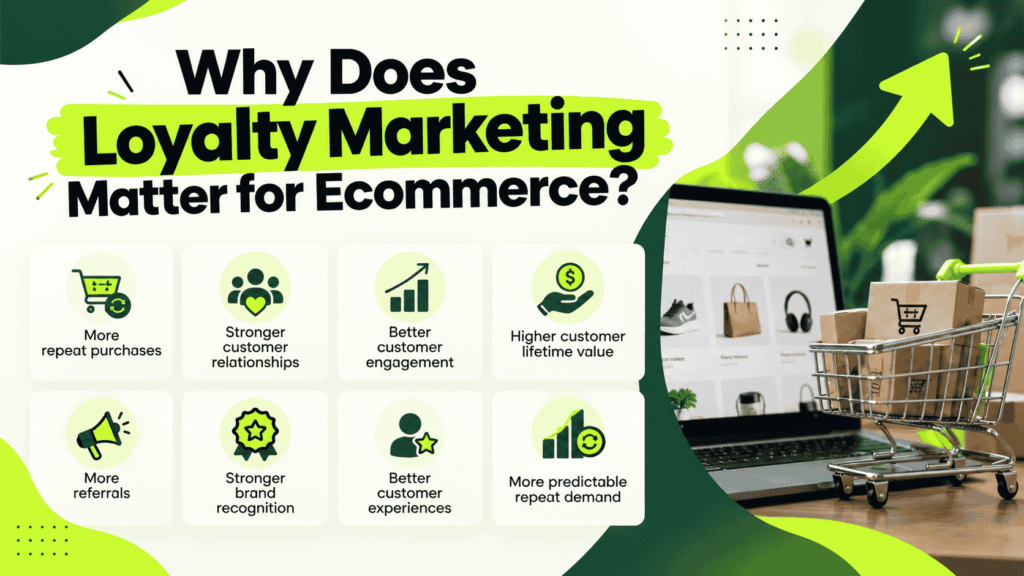
Why Does Loyalty Marketing Matter for Ecommerce?
Ecommerce gives customers almost unlimited choice.
A customer can discover a competing product within seconds, compare prices, read reviews and switch brands without visiting another physical store.
That means businesses need to give customers reasons to return.
A strong loyalty strategy can help businesses work toward:
- More repeat purchases
- Stronger customer relationships
- Better customer engagement
- Higher customer lifetime value
- More referrals
- Stronger brand recognition
- Better customer experiences
- More predictable repeat demand
However, loyalty should not be viewed simply as a way to offer more discounts. The objective is to create more value for the customer and the business at the same time.
Loyalty Marketing vs Customer Retention
There is no universal marketing budget that works for every business. The right amount depends on factors such as:
- Business revenue
- Industry
- Competition
- Target market
- Business stage
These terms are closely connected, but they are not exactly the same.
Customer Retention
Loyalty Marketing
Focuses on keeping customers
Focuses on strengthening the relationship
Encourages repeat purchases
Encourages repeat purchases and advocacy
Can involve service and lifecycle communication
Can involve rewards, community and recognition
Often measured through repeat behaviour
Can also include engagement and referrals
Functional relationship
Functional + emotional relationship
For example, a customer might purchase from your store again because they need the product. That’s retention. They might purchase again because they trust your brand, recommend it to friends and actively engage with it. That’s closer to loyalty.
The two can work together.
- Sales cycle
- Customer acquisition cost
- Average order value
- Marketing objectives
- Existing brand awareness
- Available internal resources
- Marketing channels
A local service business in Mohali may have very different requirements from an ecommerce company selling across India. Similarly, a startup building initial awareness may need a different allocation from an established company trying to increase repeat purchases.
Instead of asking only:
“How much should we spend?”
ask:
“What business outcome are we trying to achieve, and what investment is required to achieve it?”
A practical budgeting process can look like:
Business Goal → Target Customer → Marketing Channel → Required Investment → Expected Outcome → Measurement
This creates a more useful foundation for your marketing budget.
The 7 Most Effective Loyalty Marketing Strategies for Ecommerce
There is no single loyalty strategy that works for every business.
A skincare brand, fashion business, food brand and electronics store may need completely different approaches.
Here are seven practical strategies to consider.
1. Create a Loyalty Program
A loyalty program gives customers a structured reason to continue engaging with your business.
Common models include:
Points-based rewards
Customers earn points for purchases or other valuable actions.
Points can then be exchanged for rewards.
Tiered loyalty
Customers move through levels based on spending, purchases or engagement.
For example:
Member → Silver → Gold → VIP
Higher levels can unlock additional benefits.
Cashback or store credit
Customers receive credit that can be used toward future purchases.
Exclusive membership
Customers pay or qualify for membership and receive special benefits.
Milestone rewards
Customers receive benefits after completing specific actions.
Shopify’s recent loyalty guidance identifies rewards for purchases, referrals, reviews, subscriptions and spending milestones as possible loyalty-program mechanisms.
The important question
Don’t ask:
“How many points should we give?”
Ask:
“What behaviour do we want to encourage, and what value will make that behaviour worthwhile?”
2. Give Customers Reasons to Return
A loyalty strategy shouldn’t depend entirely on discounts.
Think about other reasons a customer might return.
For example:
- New product releases
- Limited collections
- Early access
- Useful educational content
- Personalized recommendations
- Product replenishment
- Exclusive events
- Members-only products
- Useful customer support
A customer may stay with a brand because the brand consistently makes their experience easier.
That can be more sustainable than constantly offering price reductions.
3. Use Personalization Carefully
Customers don’t want irrelevant messages.
They want communication that makes sense based on their relationship with the brand.
An ecommerce business can consider customer signals such as:
- Previous purchases
- Product categories purchased
- Purchase frequency
- Order value
- Browsing behaviour
- Engagement
- Time since last purchase
For example:
A customer purchases a skincare cleanser.
Instead of sending the same promotional message to everyone, the brand could later recommend:
- A compatible moisturizer
- A replenishment reminder
- Educational content
- A related product
Shopify’s current retention guidance recommends segmentation and personalized lifecycle communication as part of ecommerce retention.
4. Build a Strong Post-Purchase Experience
Loyalty doesn’t start with the second purchase.
It starts immediately after the first one.
Consider the complete post-purchase journey:
Order → Confirmation → Shipping → Delivery → Product Experience → Support → Follow-up → Repeat Purchase
Small details can influence how customers perceive the brand.
Your post-purchase experience could include:
- Clear order communication
- Delivery updates
- Product education
- Helpful usage instructions
- Support
- Feedback requests
- Review requests
- Related recommendations
- Replenishment reminders
A customer who feels supported after paying is more likely to develop confidence in the brand.
5. Reward Referrals
Your existing customers can become an acquisition channel.
A referral program can encourage customers to introduce the brand to friends, family or colleagues.
A simple structure might be:
Existing customer refers someone → New customer purchases → Existing customer receives a benefit
Possible rewards include:
- Store credit
- Discounts
- Points
- Exclusive products
- Free shipping
- Membership benefits
The important point is to make the referral experience simple.
If customers have to navigate a complicated process, participation can suffer.
Shopify’s current retention guidance includes referral rewards as one of the ways ecommerce brands can connect retention and acquisition.
6. Use Email and Lifecycle Marketing
Email can become one of the most useful channels for customer retention because it allows brands to communicate after the initial purchase.
Instead of sending every customer the same newsletter, consider lifecycle communication.
Welcome
Introduce the customer to the brand.
Post-purchase
Help the customer get value from the purchase.
Replenishment
Remind customers when they may need the product again.
Cross-sell
Recommend complementary products.
New product
Introduce relevant launches.
Win-back
Reconnect with customers who have stopped purchasing.
Loyalty
Recognize customers who have demonstrated repeat engagement.
Shopify’s current customer-retention guidance recommends lifecycle emails such as post-purchase communication, product recommendations, replenishment reminders and win-back messaging.
7. Build Loyalty Through the Brand Itself
This is where branding for ecommerce becomes particularly important. A loyalty program can provide an incentive. A strong brand can provide a reason to care.
Your brand experience includes:
- Positioning
- Visual identity
- Tone of voice
- Product presentation
- Website experience
- Packaging
- Customer service
- Social media
- Content
- Community
If everything feels disconnected, customers may remember the product but not necessarily the brand.
A consistent experience makes the business easier to recognize.
This is particularly important for ecommerce brands competing in crowded categories.
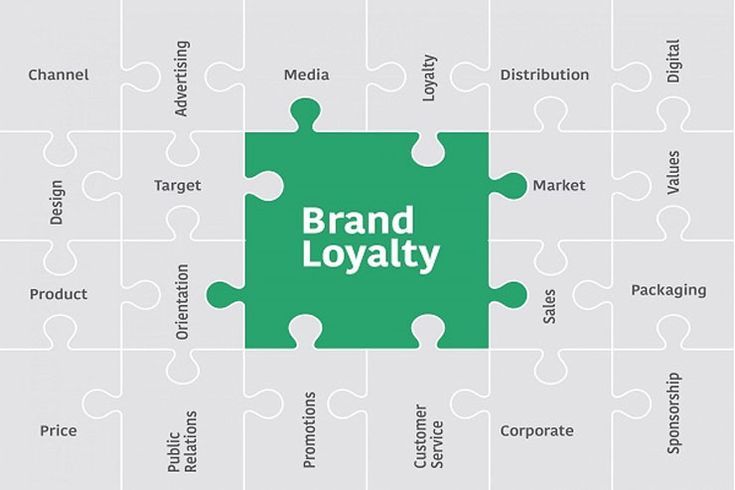
How Branding and Loyalty Work Together
Think of it this way:
Branding creates recognition.
↓
Customer experience creates trust.
↓
Product experience creates satisfaction.
↓
Loyalty strategies create reasons to return.
↓
Retention creates repeat behaviour.
↓
Strong experiences can create advocacy.
Loyalty marketing therefore shouldn’t be treated as a separate campaign that starts after the website and branding are finished.
It should be considered part of the wider customer journey.
Loyalty Marketing Strategies for Ecommerce Businesses
Different ecommerce businesses need different strategies.
For ecommerce brands
Focus on:
- Product experience
- Brand identity
- Personalization
- Repeat purchases
- Loyalty programs
- Community
- Referrals
For startups
Don’t build an overly complicated loyalty system too early.
Start by understanding:
- Why customers buy
- Why they don’t return
- What they value
- What products encourage repeat purchases
- What objections appear after purchase
Then build the loyalty mechanism around those insights.
For established businesses
Look at:
- Customer segments
- Purchase frequency
- Customer lifetime value
- Churn
- Loyalty participation
- Repeat purchase behaviour
Then identify where the biggest retention opportunities exist.
For service-based businesses
Loyalty can involve:
- Memberships
- Priority access
- Referral rewards
- Repeat-service packages
- Personalized communication
- Exclusive benefits
Loyalty isn’t limited to physical products.
Ecommerce Growth and Customer Loyalty
Ecommerce growth is often associated with acquiring more customers. But growth can also come from improving the value generated by existing customers.
Consider two businesses.
Business A
Constantly searches for new customers.
Business B
Acquires new customers while also encouraging existing customers to return. Business B has more opportunities to build value from the customers it has already acquired. That is why strategies for ecommerce should include both acquisition and retention.
A useful growth framework is:
Acquire → Convert → Retain → Grow → Advocate
How to Build an Ecommerce Loyalty Strategy
Instead of immediately installing a loyalty app, follow a structured process.
Step 1: Understand your customers
Look at:
- Who purchases?
- What do they purchase?
- How often do they purchase?
- What is their average order value?
- When do they stop purchasing?
Step 2: Identify the repeat-purchase opportunity
Not every product has the same repurchase cycle.
A consumable product may naturally encourage repeat orders.
A furniture business may have a much longer purchase cycle.
Your strategy should reflect the category.
Step 3: Find the reason customers return
Ask:
What makes our existing customers choose us again?
The answer can help shape your loyalty strategy.
Step 4: Choose the right loyalty mechanism
Consider:
- Points
- Store credit
- Membership
- Tiers
- Referrals
- Exclusive access
- Subscriptions
- Personalized offers
Step 5: Connect loyalty to the customer journey
Don’t isolate the loyalty program.
Connect it with:
- Website
- Social media
- Customer service
- Product experience
- Marketing
Step 6: Measure
Track whether customer behaviour is changing.
What Metrics Should You Track?
A loyalty program can generate plenty of data. Focus on metrics that answer business questions.
Repeat customer rate
What percentage of customers purchase more than once?
Customer retention rate
How effectively is the business keeping customers over time?
Purchase frequency
How often do customers buy?
Average order value
How much does the average customer spend per transaction?
Customer lifetime value
How much value does a customer generate over their relationship with the business?
Loyalty participation
How many customers actively engage with the program?
Redemption rate
Are customers actually using their rewards?
Referral rate
Are existing customers generating new customers?
Churn
How many customers stop purchasing?
The correct benchmark depends heavily on the category and purchase cycle. Shopify’s current guidance specifically cautions against assuming there is one universal “good” retention rate for all ecommerce businesses.
Don't Turn Loyalty Into a Discounting Strategy
One of the biggest mistakes brands make is assuming:
Discount = loyalty
It doesn’t.
If customers only return when a discount appears, you may have created discount dependence rather than genuine loyalty.
Instead, consider non-price benefits:
- Early access
- Exclusive products
- Better service
- Recognition
- Community
- Educational content
- Personalization
- Free shipping
- Experiences
The strongest loyalty strategy gives customers a reason to value the relationship—not just the discount.
Loyalty Marketing and Social Media
Social media can support loyalty beyond simply promoting products.
A social media marketing agency in Mohali working with an ecommerce brand should ideally think about social media as part of the customer relationship.
Content can:
- Educate customers
- Showcase customer stories
- Answer product questions
- Highlight loyal customers
- Build community
- Introduce new products
- Encourage user-generated content
- Support referrals
For example, an ecommerce beauty brand might encourage customers to share how they use a product. The brand can then turn those experiences into useful community content. This can strengthen both engagement and social proof.
Loyalty Marketing and PPC
PPC is usually associated with acquiring customers. But it can also support retention and customer re-engagement when used appropriately. For example, paid campaigns can be used to:
- Re-engage relevant audiences
- Promote new products
- Support launches
- Reach previous visitors
- Introduce complementary products
However, PPC should not be treated as the entire retention strategy.
If you’re evaluating PPC services in Mohali or comparing the best PPC company in Mohali, ask whether the strategy considers what happens after the first purchase.
Acquisition and retention should inform each other.
Where Website Experience Fits Into Loyalty
Customers don’t experience your loyalty strategy in isolation. They experience it through your website. A confusing website can undermine a well-designed loyalty program.
Your ecommerce website should make it easy to:
- Find products
- Understand benefits
- View loyalty status
- Redeem rewards
- Track orders
- Contact support
- Purchase again
This makes website development in Mohali relevant to ecommerce growth beyond simple website creation.
When comparing a website design company in Mohali, consider whether the provider understands:
- Ecommerce UX
- Mobile shopping
- Conversion
- Customer journeys
- Loyalty experiences
- Website performance
- Shopify functionality
Good web design should make the customer’s next step easier.
Loyalty Marketing for Shopify Stores
Shopify can serve as the foundation for an ecommerce loyalty ecosystem.
Depending on your business requirements, a Shopify store can be connected with tools and workflows for:
- Customer accounts
- Email marketing
- Loyalty
- Reviews
- Subscriptions
- Customer support
- Analytics
- Automation
Shopify’s current retention guidance highlights customer profiles, segmentation, lifecycle messaging, loyalty tools and automation as components of an ecommerce retention stack.
For a business looking for ecommerce growth in Mohali, the important question isn’t:
“Which app should we install?”
It is:
“What customer behaviour are we trying to improve?”
Technology should follow strategy.
Choosing an Ecommerce Growth Partner in Mohali
If you’re searching for an ecommerce growth agency in Mohali, don’t evaluate a partner only on the number of services they list.
Look for an understanding of:
- Brand strategy
- Ecommerce customer journeys
- Website experience
- Marketing strategy
- Customer retention
- Paid acquisition
- Social media
- Shopify
- Measurement
Similarly, if you’re comparing an ecommerce PPC agency in Mohali, ask how it understands your complete customer journey rather than only the advertising account. And if you’re researching a top ecommerce company in Mohali, evaluate whether its capabilities actually match your business stage and growth requirements.
The right partner should help you identify priorities—not simply add more activities.
Ecommerce Marketing Strategy in Mohali
For businesses building an ecommerce marketing strategy in Mohali, a useful approach is to connect local strategic knowledge with a broader digital market.
Your business may start by serving customers in:
- Mohali
- Chandigarh
- Panchkula
- Zirakpur
- Kharar
But ecommerce can allow the brand to expand beyond the Tricity. That means your marketing strategy should be built with scalability in mind.
A practical framework is:
Local foundation → Regional reach → National opportunity
Your brand, website and customer experience should be capable of growing with that journey.
How Brandagic Approaches the Bigger Picture
Brandagic’s positioning focuses on combining strategy, systems and storytelling to help businesses build stronger brands and grow with clarity.
Its core services include Brand Strategy, Marketing Strategy and Shopify, making those areas particularly relevant when an ecommerce business needs to connect brand, store experience and growth planning.
For an ecommerce business, the relationship can look like:
Brand Strategy
→ Define positioning and differentiation.
Marketing Strategy
→ Decide how customers should be reached and engaged.
Shopify
→ Build the ecommerce experience.
Growth
→ Learn from customer behaviour and continuously improve.
The objective isn’t to create a loyalty program simply because every ecommerce brand seems to have one.
It’s to determine what will give your customers a genuine reason to come back.
Ecommerce Loyalty Checklist
Before launching a loyalty strategy, ask:
- Do we know why customers buy from us?
- Do we know why customers don’t return?
- Do we understand our repeat-purchase cycle?
- Is our brand experience consistent?
- Is our website easy to use?
- Is our post-purchase experience strong?
- Do customers receive useful communication?
- Is personalization relevant?
- Do we have a clear loyalty objective?
- Are rewards financially sustainable?
- Are we rewarding valuable behaviours?
- Can customers easily understand the program?
- Can customers easily redeem rewards?
- Are we tracking repeat purchases?
- Are we measuring customer lifetime value?
- Are referrals part of the strategy?
- Does loyalty connect with social media?
- Does loyalty connect with ecommerce marketing?
- Are we building relationships rather than only offering discounts?
Common Loyalty Marketing Mistakes
1. Launching a loyalty program without a strategy
Points alone don’t create loyalty.
2. Giving discounts to everyone
This can reduce margins without necessarily creating stronger relationships.
3. Making rewards complicated
Customers should understand how they earn and redeem benefits.
4. Ignoring existing customers
Acquiring new customers while neglecting existing ones creates an incomplete growth strategy.
5. Sending irrelevant messages
Personalization should be useful—not excessive.
6. Forgetting the post-purchase experience
The relationship doesn’t end at checkout.
7. Measuring only program registrations
A large membership number doesn’t necessarily mean an engaged customer base.
8. Ignoring brand experience
Customers can become loyal to the experience, not just the reward.
Final Takeaway
Loyalty marketing is not simply about giving customers points, coupons or discounts.
It is about creating reasons for customers to continue choosing your brand.
For ecommerce brands, businesses and startups, that can come from a combination of:
Strong branding + great customer experience + useful communication + relevant rewards + retention strategy + consistent value.
For an ecommerce business in Mohali or Chandigarh, loyalty can become an important part of a broader ecommerce growth strategy.
The goal isn’t simply to get a second purchase.
It is to build a customer relationship that can continue to create value for both the customer and the business.
That is what turns customer retention into genuine brand loyalty.
Frequently Asked Questions
1. What is loyalty marketing?
Loyalty marketing is a strategy focused on strengthening relationships with existing customers and encouraging repeat purchases, engagement, referrals and long-term connection with a brand.
2. What is the difference between loyalty marketing and customer retention?
Customer retention focuses primarily on keeping customers purchasing over time. Loyalty marketing goes further by building engagement, preference, recognition and advocacy around the brand. The two strategies often overlap.
3. Are loyalty programs important for ecommerce businesses?
They can be useful, but they aren’t appropriate in exactly the same form for every business. The right program should reflect customer behaviour, purchase frequency, margins and the value customers receive from the relationship.
4. How can ecommerce businesses increase customer loyalty?
Businesses can combine strong products, customer service, consistent branding, post-purchase experiences, personalized communication, rewards, referrals, memberships and other retention strategies.
5. Is loyalty marketing useful for startups?
Yes, but startups should generally understand customer behaviour before building complicated loyalty systems. Early-stage businesses can start by learning why customers purchase, what makes them return and what value they expect.
6. How does branding affect customer loyalty?
Consistent branding can make a business more recognizable and help create trust and emotional connection. However, branding alone doesn’t guarantee loyalty; product quality and customer experience also matter.
7. Can PPC help with customer retention?
PPC can support re-engagement and product promotion, but it should be one component of a broader retention strategy rather than the entire loyalty system.
8. How can a Shopify store build customer loyalty?
A Shopify store can combine customer accounts, lifecycle communication, loyalty tools, segmentation, subscriptions, reviews, personalized experiences and post-purchase workflows depending on its business requirements. Shopify’s current retention resources specifically highlight these types of tools and strategies.