
Running a retail business today means competing for attention both online and offline. A customer may discover a product on Instagram, search for the store on Google, check reviews and opening hours, visit the website, compare alternatives, and finally walk into the store—or complete the purchase online.
This means retail marketing is no longer limited to advertisements, banners, flyers, or promotions inside a shop. Retail digital marketing connects online discovery with customer action.
Shopify describes digital marketing for retail stores as the use of online channels such as social media, search and email to support sales across ecommerce and physical stores. It also highlights the connection between online discovery and physical store visits through information such as local inventory and store details.
For retailers in Mohali, Chandigarh and the wider Tricity, this creates an opportunity to combine local visibility, social media, paid advertising, ecommerce and customer engagement into one connected retail marketing strategy.
In this guide, we explore 15 practical strategies retail businesses can use to attract customers, improve visibility and create stronger connections between their online and offline presence.
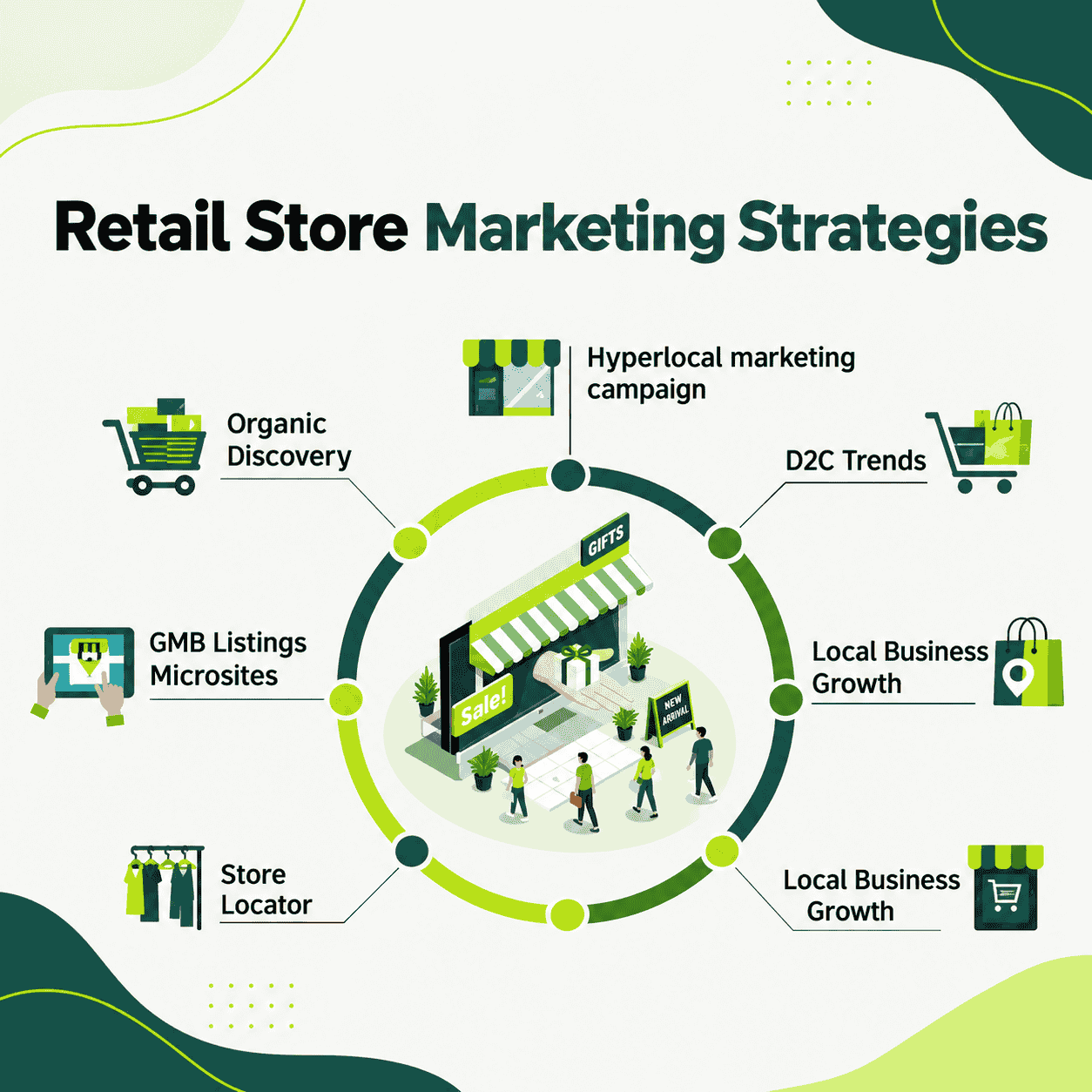
“Don’t Just Sell Products—Create Shopping Experiences People Remember.”
What Is Digital Marketing for Retail Stores?
Digital marketing for retail stores means using digital channels to attract, engage and convert customers for a retail business.
These channels can include:
- Search engines
- Google Business Profile
- Google Ads
- Google Shopping
- Social media
- Email marketing
- Websites
- Ecommerce stores
- Online content
- Video
- Messaging platforms
- Customer databases
For a physical retailer, the goal is not necessarily to move every customer online. A customer might discover your store online and then visit physically. For an ecommerce retailer, the journey might go from an advertisement to a product page and then to checkout.
The important part is creating a connected customer journey.
“Blend Digital Innovation with Local Connection to Turn Shoppers into Superfans.”
Why Retail Businesses Need a Digital Marketing Strategy
Retail customers increasingly research before purchasing.
They may want to know:
- Is the product available?
- Where is the store?
- What does it cost?
- What do other customers think?
- What does the product look like?
- Are there offers available?
- Can I order online?
- What are the store timings?
- Is there a nearby location?
A strong digital presence helps answer these questions before the customer contacts or visits the business.
Digital marketing can help retailers:
Increase discovery:
Help potential customers find your products or store.
Generate demand:
Use content, advertising and offers to create interest.
Drive store visits:
Make it easier for nearby customers to discover your physical location.
Support ecommerce sales:
Connect advertising and social content with product pages and checkout.
Build relationships:
Stay connected with existing customers through email, social media and other channels.
Measure performance:
Track traffic, leads, purchases, advertising performance and other meaningful actions.
Shopify also recommends starting with the channels that fit the retailer, setting clear goals and measuring results rather than attempting every tactic simultaneously.
15 Retail Digital Marketing Strategies to Try
1. Use Short-Form and Live Video
Video can give customers a more immediate view of your products, store and people.
Retailers can create:
- Product demonstrations
- New-arrival videos
- Product comparisons
- Behind-the-scenes videos
- Store tours
- Styling ideas
- Tutorials
- Customer FAQs
- Live product showcases
For a local retail business in Mohali, for example, a short video can introduce a new collection and tell customers where they can find it. Live video can also be used for Q&A sessions, product highlights and behind-the-scenes experiences. Shopify includes live video as one of its recommended retail marketing strategies.
Tip: Don’t make every video a sales pitch. Educational and useful content can give customers another reason to follow your brand.
2. Build a Social Media Strategy for Retail
Social media is particularly useful for showing products in context.
Instead of simply posting:
“New product available.”
Show:
- How it looks
- How it works
- How to use it
- Different ways to style it
- Customer reactions
- New arrivals
- Frequently asked questions
- Behind-the-scenes moments
A strong social media marketing for retail stores strategy should have a purpose for each type of content.
For example:
Content Type | Purpose |
Product video | Product discovery |
Educational | Build interest |
Content | Social proof |
Behind the | Humanize brand |
Offer | Encourage action |
FAQ | Remove objections |
New arrival | Generate demand |
Retail businesses evaluating a social media marketing agency in Mohali should therefore look beyond the number of posts being published.
The more important question is:
How does the content support the customer journey?
3. Use Google Ads for Retail Stores
Google Ads can help retailers reach people actively searching for products, categories, stores or solutions.
Depending on the business, campaigns may include:
- Search campaigns
- Shopping campaigns
- Performance Max
- Brand campaigns
- Local-intent campaigns
- Remarketing
For example, a customer searching for a specific product in Chandigarh may already have stronger purchase intent than someone casually encountering a social post.
This is why Google Ads for retail stores should be structured around search intent, product relevance and conversion goals.
If you are evaluating Google Ads services in Mohali, make sure the strategy includes:
- Keyword research
- Search-intent analysis
- Negative keywords
- Conversion tracking
- Ad testing
- Landing-page relevance
- Search-term analysis
- Budget optimization
The objective shouldn’t simply be generating clicks.
It should be generating valuable customer actions.
4. Optimize Your Google Business Profile
For physical retail stores, Google Business Profile can be an important part of local discovery.
Your profile should accurately communicate:
- Business name
- Address
- Opening hours
- Phone number
- Website
- Photos
- Products/services where applicable
- Updates
- Customer reviews
Customers may discover your business through Google and then use the profile to decide whether to visit.
Shopify specifically identifies local-intent actions such as directions and store contact information as useful signals when evaluating retail marketing performance.
For a retail business in Mohali, local visibility can therefore be just as important as broader digital reach.
5. Create Local Retail Content
Generic content can reach a broad audience.
Local content can make your business more relevant to nearby customers.
For retail marketing in Mohali, consider content around:
- New store arrivals
- Local events
- Seasonal shopping
- Nearby delivery
- Store experiences
- Local customer questions
- Product availability
- Festive campaigns
- Area-specific offers
A retailer serving Mohali and Chandigarh could also create separate content themes for different local audiences instead of treating the entire market as one group.
This can make your messaging more relevant without unnecessarily restricting your reach.
6. Build an Ecommerce Presence
A physical store and an ecommerce store don’t have to compete with each other.
They can support one another.
A website can allow customers to:
- Browse products
- Research before visiting
- Check product information
- Contact the business
- Discover offers
- Purchase online
For retailers expanding online, ecommerce marketing services in Mohali can help connect the ecommerce store with advertising, social media, search and customer retention.
Your ecommerce website should also have:
- Clear navigation
- Strong product pages
- High-quality images
- Useful descriptions
- Mobile-friendly design
- Clear calls to action
- Simple checkout
- Trust information
7. Use Google Shopping and Product-Based Advertising
For product-focused retailers, visual product advertising can help customers understand the offer before they click.
Product advertising can communicate information such as:
- Product image
- Product name
- Price
- Retailer
- Availability where supported
This makes product feeds and product information important parts of ecommerce marketing.
Retail businesses should ensure that product information is accurate and consistent before increasing advertising spend.
A Google Ads agency in Mohali working with a product-based retailer should therefore consider not just ad campaigns but also the quality of the underlying product catalogue and landing experience.
8. Send Promotional and Retention Emails
Not every customer needs to be acquired again from scratch.
Existing customers can become an important part of your retail marketing strategy.
Email campaigns can include:
- New product announcements
- Seasonal collections
- Promotional offers
- Restock notifications
- Educational content
- Customer recommendations
- Loyalty communication
- Event invitations
Segmenting customers can make these messages more relevant.
For example:
New customer: Welcome and product education.
Existing customer: Relevant new products.
Repeat customer: Loyalty-focused communication.
Local customer: Store events or location-specific information.
Shopify recommends segmentation and personalization for retail email campaigns, including campaigns for new subscribers, repeat customers and local shoppers.
9. Create Behind-the-Scenes Content
Retail customers don’t only want to see products.
They can also become interested in the people and processes behind the business.
Show:
- New stock arriving
- Team preparation
- Store setup
- Product selection
- Packaging
- Seasonal displays
- Event preparation
- Day-to-day operations
This can make a local retail brand feel more human.
For a business competing in a crowded category, showing the people behind the business can also contribute to brand differentiation.
10. Build a Branded Social Media Community
Your social media shouldn’t only be a product catalogue.
It can become a community around your brand.
You could encourage customers to:
- Share purchases
- Tag your store
- Use a branded hashtag
- Post reviews
- Share styling ideas
- Participate in challenges
- Submit questions
- Share experiences
User-generated content can then become part of your wider content strategy.
Shopify recommends branded hashtags and customer-generated content as ways for retailers to build communities around their brands.
11. Use Stories and Temporary Content
Stories are useful for quick, frequent communication.
Retailers can use them for:
- Daily arrivals
- Limited-stock products
- Polls
- Questions
- Product tutorials
- Customer FAQs
- Store updates
- Events
- Behind-the-scenes content
For example:
Story 1: New arrivals
Story 2: Product close-up
Story 3: Customer question
Story 4: Call to visit the store or shop online
This creates a simple journey from attention to action.
12. Use Contests, Giveaways and Seasonal Campaigns Carefully
Contests and giveaways can generate attention when they are relevant to the brand and audience.
They can be connected to:
- Product launches
- Seasonal events
- Store anniversaries
- Festivals
- New collections
- Local events
However, the goal should not simply be gaining followers.
Ask:
Are we attracting people who could realistically become customers?
A campaign that generates thousands of irrelevant interactions may be less useful than a smaller campaign attracting the right local audience.
13. Use Direct Customer Messaging
Retail customers often have simple questions:
- Is this available?
- What is the price?
- Where is the store?
- What are today’s timings?
- Do you have another size?
- Can I order online?
Social messaging and other communication channels can help businesses answer these questions.
Create clear processes for:
- Response times
- Common questions
- Product enquiries
- Directions
- Offers
- Customer support
- Escalation
Shopify includes direct customer messaging among its retail strategies and emphasizes the importance of responding effectively to customer enquiries.
14. Build a Retail Marketing Calendar
Retail marketing becomes much easier when campaigns are planned in advance.
Your calendar can include:
Period | Campaign |
January | New-year offers |
February | Seasonal campaign |
March–April | Spring/new collection |
May–June | Summer campaign |
July–August | Monsoon/seasonal content |
September–October | Festive preparation |
November | Major shopping campaigns |
December | Holiday/end-of-year campaigns |
The exact calendar should depend on your category, audience and business cycle.
Shopify recommends planning retail holiday content in advance so retailers have time to create and schedule digital content around important dates.
15. Measure What Actually Drives Business
One of the biggest advantages of digital marketing is measurability.
But measuring everything doesn’t mean everything is useful.
Retailers should connect metrics with actual business objectives.
For paid advertising
Monitor:
- Click-through rate
- Cost per click
- Conversion rate
- Cost per acquisition
- Return on ad spend
For ecommerce
Monitor:
- Sessions
- Product views
- Add-to-cart rate
- Checkout activity
- Purchases
- Average order value
For local stores
Monitor:
- Calls
- Website visits
- Direction requests
- Store-related enquiries
- Local search visibility
- Campaign-driven visits where measurable
Shopify also recommends metrics such as ROAS, CPA, AOV and local-intent actions when evaluating retail marketing performance.
The most important principle is:
Don’t optimize for the metric that looks impressive. Optimize for the metric connected to your business goal.
Retail Marketing Strategy: How to Put Everything Together
The biggest mistake a retailer can make is treating every channel as a separate activity.
Instead, create a connected system.
Example:
Social media
↓
Customer discovers product
↓
Google Search
↓
Customer searches for business/product
↓
Google Business Profile / Website
↓
Customer checks details
↓
Store visit or ecommerce website
↓
Purchase
↓
Email / Social / Loyalty
↓
Repeat purchase
This is the real opportunity behind retail digital marketing. The objective isn’t simply to be present everywhere. It is to make the customer journey easier.
How a Digital Marketing Agency in Mohali Can Help Retail Businesses
If you are considering a digital marketing agency in Mohali, don’t choose a partner simply because it offers the largest list of services.
Start with your business objective.
For example:
If your problem is local visibility
Focus on:
- Google Business Profile
- Local SEO
- Local content
- Reviews
- Search visibility
If your problem is ecommerce sales
Focus on:
- Ecommerce website
- Product pages
- Google Shopping
- Google Ads
- Retargeting
- Conversion optimization
If your problem is brand awareness
Focus on:
- Social media
- Video
- Content
- Influencer/creator collaborations
- Brand storytelling
If your problem is customer acquisition
Focus on:
- Google Ads
- Social advertising
- Landing pages
- Conversion tracking
- Customer acquisition economics
This is why businesses comparing a PPC company in Mohali, PPC expert in Chandigarh, or digital marketing company in Mohali should first understand what problem they actually need the partner to solve.
Choosing PPC and Google Ads Support for a Retail Business
If paid advertising is a major part of your strategy, ask potential providers:
- How will you identify high-intent searches?
- How will you structure campaigns?
- How will you handle negative keywords?
- How will conversions be tracked?
- What happens after someone clicks?
- How will you evaluate lead or purchase quality?
- How often will search terms be reviewed?
- How will budget be shifted between campaigns?
- How will ecommerce and offline activity be considered?
- Which business KPIs will determine success?
A best PPC company in Mohali should not simply be judged by the number of clicks it generates.
The better question is whether its strategy can connect advertising activity to meaningful business outcomes.
Retail Digital Marketing for Mohali & Chandigarh Businesses
Retailers in Mohali and Chandigarh operate in a market where customers can easily compare businesses, products and prices online.
That makes differentiation and visibility important.
A local retail business can build its strategy around:
- Local search
- Google Business Profile
- Social media marketing
- Google Ads
- Ecommerce
- Content
- Customer retention
- Reviews
- Community building
- Seasonal campaigns
Businesses looking for social media marketing in Mohali should connect their social strategy with their broader retail marketing plan.
Likewise, retailers considering PPC services in Mohali should make sure their paid advertising is connected to landing pages, products, offers and conversion tracking.
And businesses searching for best digital marketing services in Mohali should evaluate whether the strategy is built around their actual customer journey rather than simply a list of channels.
Common Retail Digital Marketing Mistakes
Digital marketing reach refers broadly to the audience exposure generated through digital channels.
These channels can include:
- Search
- Social media
- Paid advertising
- Email
1. Trying every channel at once
Start with the channels most relevant to your customers.
2. Focusing only on followers
Followers do not automatically translate into customers.
3. Running ads without tracking conversions
Without measurement, it becomes difficult to understand what your budget is actually producing.
4. Sending traffic to a poor website
Good advertising cannot completely compensate for a confusing customer experience.
5. Ignoring local search
Physical retailers should make it easy for nearby customers to discover essential business information.
6. Making every social post promotional
Useful content can help build attention and trust.
7. Ignoring existing customers
Customer retention should be part of the marketing strategy, not an afterthought.
8. Measuring vanity metrics
Reach and impressions can be useful, but they should be connected to business objectives.
- Content marketing
- Video
- Influencer marketing
- Websites
- Ecommerce platforms
A business may use several channels simultaneously.
For example:
Search → Website → Social remarketing → Content → Conversion
Each channel can contribute differently to the customer’s journey. That’s why digital marketing in Mohali should not be viewed simply as posting on social media or running advertisements.
The right combination depends on:
- Business objective
- Audience
- Location
- Industry
- Customer journey
- Budget
- Existing brand awareness
A Simple Retail Digital Marketing Checklist
Before launching your next campaign, check:
- Google Business Profile is accurate
- Website is mobile-friendly
- Product information is clear
- Social profiles are updated
- Local contact information is consistent
- Google Ads conversion tracking is configured
- Campaign objectives are defined
- Search terms are reviewed regularly
- Negative keywords are maintained
- Social content has clear objectives
- Customer reviews are monitored
- Email/customer retention strategy exists
- Campaign calendar is planned
- Ecommerce tracking is configured where relevant
- Business KPIs are reviewed regularly
How Brandagic Can Support Your Marketing Strategy
Brandagic focuses on combining strategy, systems and storytelling to help businesses build stronger brands and grow with greater clarity. For retail and ecommerce businesses, that means thinking beyond individual marketing channels.
Your brand, website, ecommerce experience and marketing activity should work toward the same business direction. Relevant Brandagic capabilities include Brand Strategy, Marketing Strategy, Brand Consulting, Marketing Consulting and Shopify.
The right approach depends on whether your priority is brand positioning, customer acquisition, ecommerce growth, local visibility or a combination of these goals.
Final Takeaway
Retail marketing is no longer only about getting customers into a physical store.
Customers can discover your brand on social media, search Google, compare products, check your business information, visit your website and then decide whether to purchase online or visit your store. That is why an effective retail marketing strategy should connect every important stage of that journey.
For businesses in Mohali and Chandigarh, start with the channels that match your customers and objectives.
Focus on:
Local discovery + social media + Google Ads + ecommerce + useful content + customer relationships + measurement.
You don’t need to do everything simultaneously.
Start with one or two high-priority channels, establish a measurable goal, learn from the data, and expand what works.
A thoughtful digital marketing agency in Mohali should help you make those decisions strategically—not simply add more marketing activities to your list.
Frequently Asked Questions
1. What is digital marketing for retail stores?
Digital marketing for retail stores means using channels such as search engines, social media, websites, email and online advertising to attract, engage and convert retail customers. It can support both ecommerce sales and physical store visits.
2. Which digital marketing strategy is best for retail stores?
There is no single strategy that works for every retailer. Depending on the business, useful channels can include social media, Google Ads, local SEO, Google Business Profile, ecommerce marketing, email and content. The best combination depends on the target audience and business objectives.
3. How can Google Ads help retail stores?
Google Ads for retail stores can help businesses reach customers who are actively searching for products, services or businesses. Search, Shopping and other campaign types can be used depending on the retailer’s products, goals and tracking setup.
4. Is social media marketing useful for retail businesses?
Yes. Social media can help retailers showcase products, demonstrate how products are used, share new arrivals, build communities and communicate with customers. Shopify includes social Stories, live video, branded hashtags and customer interaction among its retail marketing strategies.
5. How can a retail business in Mohali attract more local customers?
A retailer can combine Google Business Profile, local SEO, location-relevant content, social media, Google Ads and customer reviews to improve local discovery. Making store information, contact details and product information easy to find can also reduce friction before a store visit.
6. Should a retail store have an ecommerce website?
An ecommerce website can be valuable for retailers that want to sell online, provide product information or allow customers to research products before visiting the store. The decision depends on the business model, products, audience and operational capability.
7. How should a retailer choose a digital marketing agency in Mohali?
Look for a partner that understands your customer journey, can explain its strategy clearly, uses measurable objectives and can connect marketing activity with business outcomes. Don’t evaluate an agency only on generic claims such as being the “best digital marketing company in Mohali.”
8. What should a retailer measure in digital marketing?
Depending on the objective, retailers can measure website traffic, conversions, purchases, cost per acquisition, ROAS, average order value, customer engagement, calls, direction requests and other local-intent actions. Shopify recommends connecting measurement to business outcomes rather than relying only on surface-level engagement metrics.