

Marketing can become one of the biggest growth investments for a small business—but only when the money is allocated with a clear purpose.
Whether you run a startup, ecommerce brand, local business, professional service, retail business, or established company, your marketing budget determines how much you can invest in reaching customers, building your brand, generating leads, and increasing sales.
But creating a marketing budget is not simply about deciding how much money to spend on advertisements.
You also need to decide where to spend, what to prioritize, what to test, and how to measure marketing performance.
For businesses in Mohali, Chandigarh, and the wider Tricity market, this becomes even more important. Your customers may discover your business through Google, social media, content, recommendations, advertisements, or your website before they ever speak to your sales team.
This guide explains how to create a practical marketing budget, choose the right channels, build a strong marketing strategy, and make better marketing decisions for your business.

“In a crowded market, differentiation is the key to standing out.”
What Is a Marketing Budget?
A marketing budget is the amount of money a business plans to allocate toward marketing activities during a specific period.
Depending on the business, this can include:
- Google Ads and PPC
- Social media marketing
- SEO
- Content marketing
- Website development
- Web design and landing pages
- Branding and creative work
- Email marketing
- Marketing software
- Analytics and tracking
- Campaign management
- Marketing strategy services
- Other promotional activities
A marketing budget should therefore be viewed as more than an advertising budget.
For example, a business may spend money on Google Ads but also need a strong landing page, compelling content, professional creative, conversion tracking, and sales follow-up to turn that advertising investment into actual business results.
Shopify’s small-business marketing budget guide similarly covers expenses such as online advertising, SEO, content marketing, social media, email marketing, websites, branding and creative work, analytics, and other marketing activities.

“A strong market position turns your brand from just another option into the preferred choice.”
Why Does Your Business Need a Marketing Budget?
Without a planned budget, businesses can easily end up spending money reactively. One month may involve heavy advertising. The next month may focus entirely on social media. Another month may involve spending on website development or branding without a clear connection to the overall marketing plan.
A structured budget helps bring consistency to these decisions.
A marketing budget can help you:
Prioritize:
Decide which marketing activities deserve investment first.
Control spending:
Understand where your marketing money is going.
Test opportunities:
Reserve resources for testing new campaigns, channels, audiences, and offers.
Measure performance:
Compare spending with leads, sales, conversions, and other business outcomes.
Plan growth:
Move from reactive marketing decisions toward a more strategic approach. The important point is that your marketing budget and marketing strategy should work together.
How Much Should a Small Business Spend on Marketing?
There is no universal marketing budget that works for every business. The right amount depends on factors such as:
- Business revenue
- Industry
- Competition
- Target market
- Business stage
- Sales cycle
- Customer acquisition cost
- Average order value
- Marketing objectives
- Existing brand awareness
- Available internal resources
- Marketing channels
A local service business in Mohali may have very different requirements from an ecommerce company selling across India. Similarly, a startup building initial awareness may need a different allocation from an established company trying to increase repeat purchases.
Instead of asking only:
“How much should we spend?”
ask:
“What business outcome are we trying to achieve, and what investment is required to achieve it?”
A practical budgeting process can look like:
Business Goal → Target Customer → Marketing Channel → Required Investment → Expected Outcome → Measurement
This creates a more useful foundation for your marketing budget.
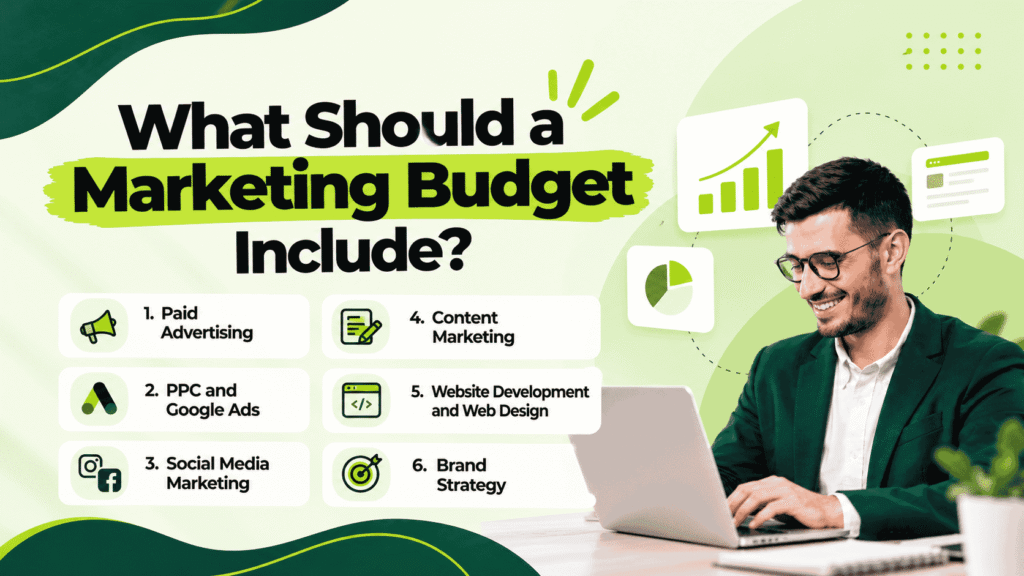
What Should a Marketing Budget Include?
Your marketing budget can be divided into different categories depending on your business.
1. Paid Advertising
Paid advertising may include:
- Google Ads
- Meta Ads
- Search campaigns
- Display campaigns
- Shopping campaigns
- Remarketing
- Lead-generation campaigns
Paid advertising can help businesses reach audiences more quickly, but the advertising budget should not be considered independently from the website, landing page, creative, offer, targeting, and conversion process.
2. PPC and Google Ads
PPC is particularly useful when potential customers are actively searching for a solution.
For example, businesses may target high-intent searches around:
- Google Ads services in Mohali
- PPC services in Mohali
- website development in Mohali
- marketing services in Mohali
- ecommerce services
- local business services
The objective should not simply be to generate clicks.
A stronger measurement path is:
Clicks → Enquiries → Qualified Leads → Customers → Revenue
This is why businesses evaluating a PPC company in Mohali or a PPC expert in Chandigarh should look beyond the advertising platform itself.
The campaign needs to connect with the rest of the customer journey.
3. Social Media Marketing
Social media marketing can include:
- Organic social media
- Paid advertising
- Short-form video
- Educational posts
- Product content
- Community engagement
- Retargeting
- Promotional campaigns
For businesses targeting local audiences, social media marketing in Mohali can support awareness, engagement, and customer relationships.
A business working with a social media marketing agency in Mohali should have a clear understanding of:
- Target audience
- Content objectives
- Platform selection
- Posting strategy
- Advertising strategy
- Conversion goals
- Measurement
Social media should be part of your marketing strategy rather than simply a schedule of posts.
4. Content Marketing
Content marketing can include:
- Blog posts
- Guides
- Videos
- Case studies
- Educational resources
- FAQs
- Product content
- Social media content
- Industry insights
Good content answers the questions customers have before they buy.
For example, a customer might search for:
- How much does a service cost?
- Which solution is right for my business?
- What should I look for when choosing a provider?
- How does a particular product work?
- What are the common mistakes?
Content can help businesses answer those questions while building visibility and trust.
This makes content marketing an important part of both SEO and broader customer acquisition.
5. Website Development and Web Design
Your website is one of the most important assets in your marketing system. You can run a strong advertising campaign, but if visitors reach a confusing website, poor landing page, or difficult checkout experience, the campaign may struggle to convert.
Your marketing budget may therefore need to include:
- Website development
- Web design
- Landing pages
- Mobile optimization
- User experience
- Ecommerce functionality
- Conversion optimization
- Website maintenance
- Analytics and tracking
This is why a web development agency in Mohali or web design agency in Mohali can play a role in marketing performance—not simply website creation. Your website should support the same message and customer journey as your advertising, content, and brand.
6. Brand Strategy
Marketing helps you reach customers. Brand strategy helps determine what customers should understand and remember about your business.
Brand-related investment can involve:
- Brand positioning
- Brand identity
- Messaging
- Brand guidelines
- Visual consistency
- Brand strategy
- Creative direction
This is particularly important for startups. Before spending heavily on advertising, a startup should understand:
- Who is our target customer?
- What problem do we solve?
- Why should customers choose us?
- What makes our offer different?
- How should customers perceive our brand?
A clear brand strategy can provide the foundation for more consistent marketing.
Marketing Budget vs. Marketing Strategy
Marketing budget and marketing strategy are connected, but they are not the same thing.
Marketing Budget | Marketing Strategy |
Available resources | Determines how resources are used |
Focuses on spending | Focuses on direction |
Allocates money | Allocates priorities |
Tracks expenses | Tracks objectives |
Answers “How much?” | Answers “Why, where, and how?” |
Your budget should follow your strategy. Simply dividing your budget between Google Ads, Instagram, SEO, and content does not automatically create a marketing strategy.
The strategy should first determine:
Who are we targeting?
What do they need?
What are we trying to achieve?
Which channels can help us achieve it?
How will we measure the outcome?
7 Steps to Build a Better Marketing Budget
Step 1: Define Your Business Objective
Start with the result you want.
Your objective could be:
- Generate qualified leads
- Increase ecommerce sales
- Increase website enquiries
- Build brand awareness
- Enter a new market
- Increase repeat purchases
- Improve customer acquisition
- Generate more local demand
Avoid starting with:
“We need to run Google Ads.”
Instead start with:
“We need to generate qualified enquiries from customers in Mohali and Chandigarh.”
The channel comes after the objective.
Step 2: Identify Your Target Audience
Your marketing budget should reflect who you are trying to reach.
Define:
- Location
- Customer profile
- Business type
- Needs
- Pain points
- Buying behavior
- Search behavior
- Purchase intent
- Decision-making process
A B2B company targeting business owners in Chandigarh may require a completely different marketing strategy from a retail brand targeting consumers in Mohali.
Step 3: Select the Right Marketing Channels
Not every business needs every marketing channel.
Possible channels include:
Search
- Google Ads
- SEO
- Local SEO
Social
- YouTube
Content
- Blogs
- Videos
- Guides
- Educational resources
Website
- Website development
- Landing pages
- Ecommerce optimization
Brand
- Brand strategy
- Brand identity
- Messaging
- Creative
The correct combination depends on your audience and business objectives.
Step 4: Estimate Your Marketing Costs
Create a simple allocation framework.
Marketing Area | What to Consider |
PPC | Ad spend + management |
Google Ads | Keywords + competition + campaign structure |
Social Media | Content + advertising |
SEO | Technical + content + optimization |
Content Marketing | Blogs + video + creative |
Website | Development + design + landing pages |
Branding | Strategy + identity + creative |
Analytics | Tracking + reporting |
Strategy | Planning + consulting |
This helps you understand that your marketing cost is more than media spend alone.
Step 5: Reserve a Testing Budget
Marketing involves experimentation.
You may want to test:
- New audiences
- New keywords
- New ad creatives
- New offers
- New landing pages
- New content formats
- New channels
Not every test will succeed.
The purpose of a testing budget is to learn which opportunities deserve more investment.
Step 6: Forecast Expected Outcomes
Before investing, decide what success should look like.
For lead generation:
Budget → Traffic → Leads → Qualified Leads → Customers
For ecommerce:
Budget → Traffic → Product Views → Add to Cart → Purchase → Revenue
This makes your marketing performance easier to understand.
Step 7: Review Marketing Performance
Your marketing budget should not remain unchanged simply because you set it at the beginning of the year or month.
Review:
- Amount spent
- Leads generated
- Qualified leads
- Sales
- Cost per lead
- Customer acquisition cost
- Conversion rate
- Revenue
- Campaign performance
- Channel performance
Shopify’s budgeting framework similarly recommends reviewing campaign data and using performance information to guide future allocation decisions.
How to Allocate Your Marketing Budget
There is no single percentage split that every business should follow.
Instead, allocate according to your current objective.
If your priority is lead generation:
Focus on:
PPC + Landing Pages + Conversion Tracking + Remarketing + Sales Follow-up
If your priority is brand awareness:
Focus on:
Brand Strategy + Content + Social Media + Creative + Targeted Advertising
If your priority is ecommerce growth:
Focus on:
Paid Acquisition + Ecommerce Website + Content + Remarketing + Customer Retention
If your priority is local growth:
Focus on:
Local SEO + Google Ads + Google Business Profile + Social Media + Location-Based Content
The right allocation depends on your business model.
Marketing Strategies to Increase Sales
Your marketing budget becomes more valuable when it supports strategies directly connected to customer acquisition and sales.
1. Focus on High-Intent Searches
Target customers who are actively searching for your product or service.
2. Improve Your Landing Pages
Make your value proposition, offer, proof, and CTA easy to understand.
3. Create Better Offers
Give customers a clear reason to enquire, purchase, or take the next step.
4. Use Remarketing
Bring relevant visitors back when they have already shown interest.
5. Use Content to Answer Buying Questions
Educational content can help customers make informed decisions.
6. Connect Brand and Performance
Your advertising, website, social media, and content should communicate a consistent message.
7. Measure Qualified Results
Do not judge your marketing only by the number of clicks or leads.
Focus on the quality of those outcomes.
Small Business Marketing Strategy in Mohali
A small business marketing strategy in Mohali should consider the local market and customer journey.
For a local business, important areas may include:
- Google Business Profile
- Local SEO
- Location-based search
- Google Ads
- Social media
- Local content
- Customer reviews
- Website optimization
- Community visibility
Businesses serving both Mohali and Chandigarh may also benefit from analyzing each market separately. Different locations can have different search behavior, competition, customer expectations, and conversion patterns.
Marketing for Startups
Startups often have limited marketing resources. That makes prioritization even more important. A startup marketing budget can be structured around four areas:
Foundation
- Brand strategy
- Positioning
- Website
- Messaging
Acquisition
- PPC
- Search
- Social media
- Content marketing
Trust
- Educational content
- Reviews
- Customer feedback
- Relevant proof
Measurement
- Analytics
- Conversion tracking
- Campaign reporting
The goal is not to spend like a large company. The goal is to create a marketing system that can grow with the business.
Performance Marketing and Your Marketing Budget
Performance marketing focuses on measurable actions and outcomes.
Depending on the business, this can include:
- PPC
- Search advertising
- Paid social
- Remarketing
- Lead generation
- Ecommerce campaigns
However, performance marketing should not mean measuring only clicks.
A better framework is:
Traffic → Engagement → Conversion → Qualified Outcome → Revenue
For example, a campaign with a low cost per click may not be successful if it generates irrelevant traffic.
This is why marketing performance should be evaluated against the actual business objective.
How to Measure Marketing Performance
Different objectives require different metrics.
Objective | Metrics to Consider |
Awareness | Reach, impressions, engagement |
Website traffic | Sessions, traffic source, engagement |
Lead generation | Leads, CPL, qualified leads |
Sales | Revenue, conversion rate, CAC |
PPC | CPC, CTR, conversions, CPA |
Ecommerce | AOV, conversion rate, revenue, ROAS |
Content | Organic traffic, engagement, enquiries |
Social Media | Reach, engagement, clicks, conversions |
Retention | Repeat purchases, customer value |
Do not optimize every channel around the same metric. A content campaign and a high-intent PPC campaign may have completely different objectives.
Should You Hire a Marketing Agency in Mohali?
As your business grows, managing branding, content, social media, paid advertising, websites, analytics, and strategy internally can become difficult.
This is where a marketing agency in Mohali may become relevant.
But choosing an agency should not be based only on the number of services listed.
Ask:
Does the agency understand your business objective?
The agency should be able to connect marketing activity to a specific business goal.
Does it understand marketing performance?
The conversation should go beyond impressions, clicks, and followers.
Can it connect strategy with execution?
Brand, website, content, advertising, and customer experience should work together.
Does it understand your target market?
If your audience is in Mohali, Chandigarh, or the wider Tricity market, local intent can matter.
Is the budget transparent?
You should understand the difference between:
Media Spend + Creative + Management + Technology + Strategy
What to Look for in a Marketing Strategist
A marketing strategist looks beyond individual campaigns.
They help answer questions such as:
- Who should we target?
- What should our positioning be?
- Which channels should receive investment?
- What should our message communicate?
- What should the customer journey look like?
- How should paid and organic marketing work together?
- What should we measure?
- Where should the budget increase or decrease?
For businesses looking for a marketing expert in Mohali, strategic thinking should be just as important as platform-level execution.
How PPC, Social Media and Content Marketing Work Together
Marketing channels should not operate in isolation.
Think of them as a connected system.
Content Marketing
Creates useful information.
↓
Social Media Marketing
Distributes content and creates engagement.
↓
PPC and Google Ads
Capture high-intent demand.
↓
Website
Explains the offer and converts visitors.
↓
Analytics
Measures results.
↓
Marketing Strategy
Uses those insights to improve the next campaign.
This creates a more connected approach to marketing & strategy.
When Should You Increase Your Marketing Budget?
Consider increasing your budget when:
- A campaign consistently generates qualified leads
- Your website converts traffic effectively
- Your sales team can handle additional demand
- Customer acquisition economics make sense
- You have identified a scalable audience
- Your tracking is reliable
- Your business has capacity to serve more customers
Do not increase spending simply because sales are slow.
First identify where the customer journey is breaking.
When Should You Reduce or Reallocate Your Budget?
Consider reducing or reallocating spend when:
- Traffic is irrelevant
- Lead quality is poor
- Campaigns consistently underperform
- Landing pages do not convert
- Tracking is incomplete
- The channel does not match your audience
- Your offer is unclear
- Sales follow-up is weak
Sometimes the answer is not a smaller budget.
It is a better strategy.
Common Marketing Budget Mistakes
1. Spending Without a Goal
Every major marketing expense should have a clear purpose.
2. Putting Everything Into Advertising
Ads cannot fix an unclear offer, weak positioning, or poor website experience.
3. Copying Competitors
Your competitor’s marketing budget does not determine yours.
4. Ignoring Your Website
Sending paid traffic to a weak website can reduce the value of your advertising investment.
5. Focusing Only on Vanity Metrics
Followers and impressions can be useful, but they do not necessarily represent revenue or qualified opportunities.
6. Changing Campaigns Too Quickly
Constant changes can make it difficult to understand what is actually working.
7. Ignoring Brand Strategy
Short-term campaigns can generate attention, but businesses also need a reason for customers to remember and choose them.
8. Measuring Only Lead Quantity
Ten highly qualified leads can be more valuable than hundreds of irrelevant enquiries.
Marketing Budget Checklist
Before finalizing your marketing budget, ask:
Business Goals
- What is our primary business objective?
- Who is our target customer?
- What market are we targeting?
- What does success look like?
Marketing Strategy
- Do we have a clear marketing strategy?
- Is our positioning clear?
- Is our offer easy to understand?
- Which channels match our audience?
Budget
- How much can we realistically invest?
- How much goes toward advertising?
- How much goes toward creative and content?
- How much is allocated to testing?
- Are strategy and technology costs included?
Execution
- Is our website ready?
- Are our landing pages effective?
- Do we have enough content?
- Is conversion tracking implemented?
Measurement
- Which metrics matter?
- Are we tracking qualified leads?
- Are we measuring sales?
- When will we review performance?
How Brandagic Can Support Your Marketing Strategy
For businesses looking to connect branding, strategy, creativity, and business-focused marketing, Brandagic’s relevant areas include:
- Brand Strategy
- Marketing Strategy
- Brand Consulting
- Marketing Consulting
- Shopify
When evaluating marketing investment, the goal should not simply be to find the best digital marketing services in Mohali or the best digital marketing company in Mohali based on the number of services offered.
Instead, look for a strategic approach that connects:
Business Goals → Brand Strategy → Marketing Strategy → Customer Journey → Execution → Measurement
That connection can make your marketing budget more purposeful and easier to evaluate.
Final Takeaway
A marketing budget is more than a number allocated to advertising. It is a framework for deciding how your business should invest in growth. For businesses in Mohali and Chandigarh, the right marketing mix may include PPC, Google Ads, social media marketing, content marketing, website development, web design, SEO, brand strategy, or a combination of these activities.
But there is no universal formula.
The right approach starts with understanding your customer, defining your business objective, choosing the appropriate channels, estimating costs, measuring marketing performance, and reallocating resources based on what you learn.
If you are considering a marketing agency in Mohali, look beyond promises of more traffic, clicks, or followers. Ask whether the approach connects strategy, branding, content, website experience, advertising, and measurement. The objective is not simply to spend more on marketing. The objective is to make your marketing budget work toward a clear business outcome.
Frequently Asked Questions
1. What is a marketing budget?
A marketing budget is the amount a business plans to invest in marketing activities during a specific period. It can include advertising, content marketing, social media, SEO, website development, branding, analytics, and other marketing expenses.
2. How much should a small business spend on marketing?
There is no single amount that works for every business. The right budget depends on factors such as revenue, industry, competition, business stage, customer acquisition costs, sales cycle, target audience, and business objectives.
3. What should be included in a small business marketing budget?
A small business marketing budget may include PPC, Google Ads, social media marketing, SEO, content marketing, website development, web design, branding, creative work, analytics, software, and strategy.
4. Is PPC important for small businesses?
PPC can be useful when customers are actively searching for a product or service. However, its effectiveness depends on factors such as keyword selection, targeting, advertising, landing pages, conversion tracking, and sales follow-up.
5. How can a marketing agency in Mohali help a business?
A marketing agency can help with strategy, campaign planning, marketing execution, content, advertising, website-related marketing activities, and performance measurement, depending on its services and the business’s requirements.
6. What is the difference between marketing strategy and marketing budget?
A marketing strategy determines what the business wants to achieve, who it wants to reach, and how it will approach the market. A marketing budget determines how much financial resource can be allocated to those activities.
7. What marketing strategies can increase sales?
Strategies can include high-intent search campaigns, stronger landing pages, better offers, remarketing, content marketing, customer retention, consistent branding, and measuring qualified business outcomes rather than only traffic or clicks.
8. Should startups invest in marketing or branding first?
Startups generally need both strategic clarity and customer acquisition. Establishing clear positioning, messaging, and brand direction can provide a stronger foundation for performance marketing and other acquisition activities.
9. How should I choose a PPC company in Mohali?
Look at its approach to keyword targeting, campaign structure, conversion tracking, landing pages, reporting, optimization, lead quality, and business outcomes rather than judging only by advertising promises.
10. How do I measure marketing performance?
Measure according to your objective. Lead-generation businesses can track qualified leads, cost per lead, conversion rate, and customer acquisition cost. Ecommerce businesses can track revenue, conversion rate, average order value, customer acquisition cost, and return on advertising spend.